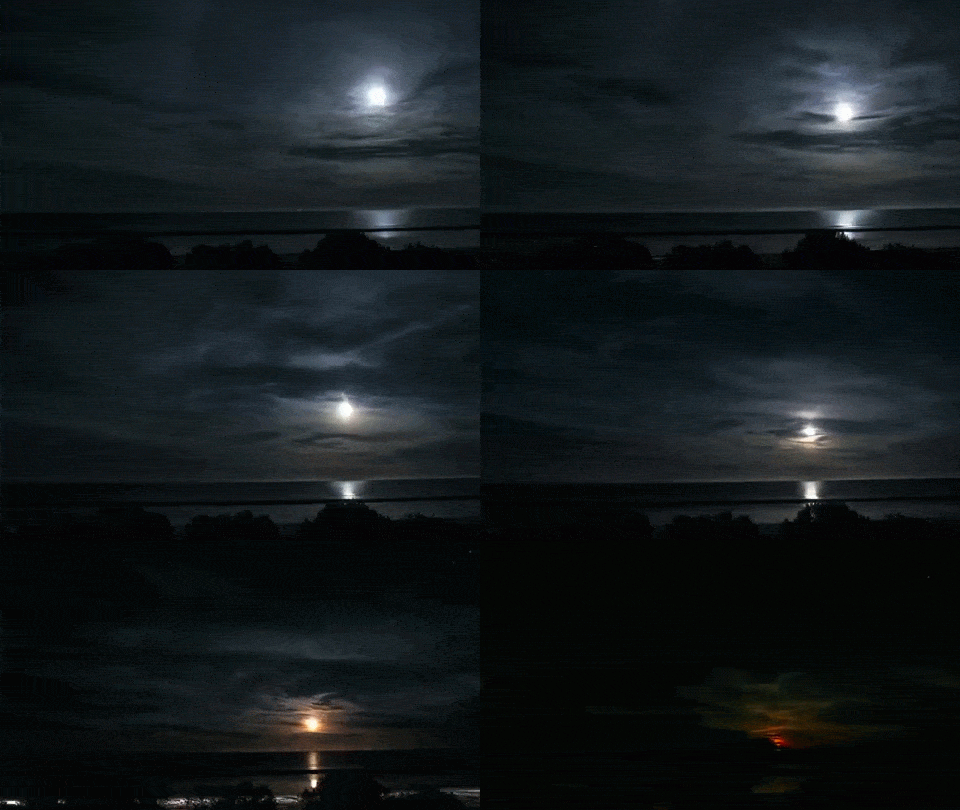
Tuesday

Living in a wooded area, you get a better chances for some encounters with wild animals, but it’s still hard to spot some shy creatures like foxes for example. Some photos of adorable baby foxes went viral on social media after being shared on internet.

At first there was only a cub who decided to pay his granny a visit on a spring morning, but then when the little baby fox noticed he’s actually welcomed the next day he came with his brother and since then they kept coming to their favorite playground. The mother Fox was watching over them from the bushes.

These playful and inquisitive creatures are just achingly cute, as you can see in these photos shared by Reddit user Vechrotex. The cubs, curious and seemingly on a mission to explore, wandered onto Vechrotex’s grandmother’s porch and peered inside the window. “Do you have anything tasty for me maybe?”

Mama fox keeps an eye on things while her cubs are exploring, Grandma’s porch is clearly an interesting place for the family. “The mom comes by a lot more than the babies,” Vechrotex explains. “She is always close when her babies are on the porch.”

“Here in Illinois we get red foxes in forested areas, we see them a lot and it’s not that big of a deal,” Vechrotex told Bored Panda. “One day my grandma saw a baby red fox and took a picture of it. She shared the picture with me and I thought it was just so cute, I decided to post it. I’m glad I was able to make so many people happy!”

Grandma now gets to enjoy watching the family visiting regularly, as the cubs frolic and put on a show, chasing each other around the porch. Kind of makes you want to move to a little house in the forest, doesn’t it?


Newborn fox cubs are blind, deaf, dark-grey in color and weigh only about 120g, but after 14 days, their eyes open. Their pupils are a striking shade of blue, and their first coat gives them a soft, fuzzy appearance. They have small, floppy ears and by now they weigh about 350g.

After four weeks, the cub’s pupils change color and are now greyish. White fur appears around the mouth and patches of red on the face and while the coat is still fuzzy, their ears are now erect. Now it’s hard to tell them apart from their parents, as they have grown up so quickly!


From late September they have grown a full winter coat and the family group breaks up. The cubs will set off to hunt, find a place to spend the winter and eventually their own mates, so the process can repeat itself again!
Source


Wednesday

A wolf has been spotted near the border between Charente and Dordogne - an area where it had been thought wolves were extinct.

The grey wolf sighting has now been confirmed by France's biodiversity office l'Office français de la biodiversité - which marks the first confirmed wolf presence in Charente since 1926.

The wolf was spotted and photographed in the commune of Gurat, on the border between Charente and Dordogne, by 28-year-old local woman Marina Varraniac-François on Monday morning, as she returned from dropping his son off with his childminder.

"He passed within two or three metres of the car," she told Le Parisien.

"At first I thought it was a big dog, but it looked a lot like a wolf. He was scared, you could tell he was scared."

She photographed and filmed the animal on her phone, and the sighting has now been confirmed by the OFB, which monitors wolf activity in France.


Wolves are relatively common in France, but they tend to stick to higher ground and are concentrated in the east of the country, particularly in the Alps.

The last time there was a confirmed wolf presence in Charente was in 1926, when local newspaper Charente Libre reported that one had killed 11 sheep.

"The species is known for its great dispersal capacity, especially during the territory search phase. Thus, since its reappearance in the Southern Alps in 1992, the wolf has crossed territories as far away as the Pyrenees, Lorraine, Burgundy and the Somme", said a spokesman for the OFB.


Once hunted to extinction, wolves were reintroduced to France in 1992 and since then have steadily expanded their territory.

Their numbers are tightly controlled, with the French state licensing hunting of a certain number per year to keep the population in check.

Nevertheless, their presence in France is the subject of fairly regular protests from farmers, who say they damage their livelihoods.
Source
VIDEO

Sunday

As the Australian bushfires continue to burn, a shocking piece of information appeared: since September, over 500 million animals have died because of the flames. Especially hard-hit was the koala population, with many of these animals dying in the calamity.

However, the situation in Australia showed us that people are willing to step up and be the everyday heroes that we need. 19-year-old Micah and 18-year-old Caleb are two such heroes and they’re being praised all over the net. These two cousins drove around Kangaroo Island, rescuing koalas and putting them in their car.

The teens plan to look after all their new koala buddies until they’re healthy and it’s safe to let them back into the wild. According to Micah and Caleb, around 60 percent of all the koalas they came across had, unfortunately, burned to death.

“This is our little koala rescue. Just trying to collect as many live ones as we can,” one of the cousins can be heard saying in a video clip they shot, showing the interior of their car.

The world has done little else but talk about the devastation in Australia (and the possibility of WWIII) in recent weeks. In a previous interview with Bored Panda, Ben Jameson who lives on the Gold Coast, near Brisbane, told us that his friends and family are “coming together, donating money where possible, helping each other out, going to communities to help clean up. Like, just regular people. Not emergency services or defense force. Just normal people.”

“A university in Sydney estimates that near 500 million animals have been killed by the fires since September. Half a billion. So many of our animals, wombats, koalas, crocs, platypus, etc. are endangered or threatened species. I don’t think people understand the scale of that number. I’m not sure if our country’s ecosystem and biosphere will recover from this, I really don’t,” Ben told us.


Meanwhile, Sam Mitchell, co-owner of the Kangaroo Island Wildlife Park, told the Guardian that people were delivering injured animals to them, including about 50 koalas.


“At least a third of what has been brought in we’ve had to euthanize, unfortunately,” Mitchell broke the sad news. “We are seeing many burns to hands and feet—fingernails melted off. For some, the burns are just too extreme.”
Source


VIDEO


A 6-year-old farm dog is being celebrated after saving a flock of sheep as a wall of fire destroyed acres of farmland in southeastern Australia.

In the early hours of New Year’s Eve 2019, kelpie-border collie cross Patsy from the rural town of Corryong, Victoria, rounded up her flock of sheep as encroaching bushfires consumed the land surrounding her owner’s farm. According to SBS News, Patsy herded her 900-strong flock of sheep into the safest paddock on the farm as her owner, Stephen Hill, battled the flames.

All but a handful of the farm’s flock were saved. Patsy’s quick thinking, Hill’s organization, and the trajectory of the flames also meant that hay bales, silage, farm houses, and the shearing shed were spared from the fire.

Cath Hill, Stephen Hill’s sister, filmed Patsy after her epic sheep rescue, sitting on the scorched farmland where the fire had passed over. “Hey Patsy, can you hear those sheep?” Hill can be heard saying in the video. “That’s all your work, well done! You little champion. Good girl.”

Hill also shared pictures of her brother’s newly nicknamed “Wonder Dog” on Instagram, captioning one moving image: “This is Patsy just after she and her human brought the sheep to safety on the morning of New Year’s Eve.

“Cool as a cucumber, Patsy waited with him until the fire got close enough to fight with a tractor and water pump,” Hill continued. “What a team!


“And here’s Patsy’s sheep,” read another post, “safe and sound today!” The caption accompanied a photo of a somewhat eerie, smoke-filled horizon behind Patsy’s flock of sheep, grazing peacefully and safely after the emergency herding.


“It’s like Armageddon,” Hill later told Metro, as her brother continued to battle with bushfires in Corryong. “Everyone is just trying to get water and feed to their animals,” she added, “shoot the ones that can’t be saved, get temporary fences up to keep stock secure, and put out all the logs and stumps still burning.


“[T]here’s people who have nothing left but the clothes on their backs,” Hill said.
Source


 VIDEO


Thursday

These heartbreaking photos show the moment a kangaroo begs for help in the aftermath of the devastating Australian bushfires. The marsupial suffered huge burns to its body before a teenager drenched it with water and gave it a drink.

The stricken animal is one of billions caught up in Australia’s worst bushfires, which continue to burn out of control across an area more than a third of the size of England. More than half a billion animals are predicted to have died while others are facing starvation and dehydration as the fires destroy their habitats. Many have had to be euthanised as they are unable to recover from their severe burns.

The images of the kangaroo were taken in the state of New South Wales, where a state of emergency has been declared. Fires have engulfed entire towns, leaving homes and vehicles reduced to rubble. State Rural Fire Service deputy commissioner Rob Rogers urged people close to bushfires to evacuate their homes, noting that four people have already died in their cars after leaving it too late to flee.

He said: ‘We know people have got a little bit of fire fatigue. They’ve been dealing with this for months now. ‘But we need people to stay focused. Tomorrow is not the day to drop your guard. Take it seriously. ‘If you are in those areas where we put those maps out, don’t be there.’

Temperatures this week have averaged 40C across the country and are set to soar tomorrow to 46C in some places. High temperatures are set to combine with dry lightning strikes and wind to add to the predicted fire nightmare this weekend. In the state of Victoria, Premier Daniel Andrews ordered the evacuation of 140,000 residents and tens of thousands of tourists.

The Royal Navy are currently plucking hundreds of people to safety after they fled to a beach in Mallacoota on the east coast as bushfires rapidly spread towards the town. Evacuees waiting to board the ship described smoke and embers everywhere.


At least 19 people have died in Australia’s bushfires, and around 5,000,000 hectares of land has been burned across the country. Authorities say around 1,400 homes have also been destroyed. Smoke from the wildfires has caused the air quality to plummet and in many parts of Australia turned daytime skies to near darkness. Communities over 1,000 miles away in New Zealand are also smelling smoke from the Australian bushfires and the glaciers have turned a deep brown because of the pollution.


Prime Minister Scott Morrison has come under heavy criticism for his handling of the blazes and the lack of equipment given to the mainly volunteer firefighters. His government has also repeatedly asserted that the fires are a natural disaster and not the result of climate change, exacerbated by Australia’s dependence on coal and other fossil fuels. He said he might cancel a planned trip to India after there was widespread condemnation when he jetted off on a family trip to Hawaii while the fires raged. Bushfires are burning across all the Australian states but showers next week may provide some respite, weather experts say.
Source


A Florida screech owl was in for a surprise when one of her hatchlings looked nothing like her, but she didn’t hold it against him. Unlike the Ugly Duckling fairy tale, the mother owl appeared to care for the baby duck as her own.

The had been incubating her eggs in a nest box in the backyard of a nature photographer for about a month. One morning, photographer Laurie Wolf noticed the figure of a little bird sitting next to the owl and ran outside excitedly to photograph it.

But when she got a closer look she realized it was a duck!

“The two of them were just sitting there side by side,” Wolf told National Geographic. “It’s not believable. It’s not believable to me to this day.”

Afraid the owl, a bird of prey, would eat the little wood duck, Wolf and her husband attempted to capture him to take him to a wildlife sanctuary. But the duckling jumped from the nest box and “made a beeline for the pond” and they never saw him again. Director of Bird Studies Canada Christian Artuso told National Geographic that what Wolf thought she saw happening was likely true.

It wasn’t the first time wood ducks have been scientifically recorded living with screech owls. Artuso witnessed a similar relationship in 2005 while he was studying eastern screech owls for his Ph.D. Only in that case, the owl incubated and hatched three wood duck chicks, says Artuso, who published his findings in the Wilson Journal of Ornithology.


“We know this occurs, but we really don’t know the frequency,” he says.

The reason, he explains, is that wood ducks practice something called brood parasitism, which means laying an egg or two in another bird’s nest to increase the chances that at least one of their offspring will survive.

“You could think of it as not keeping all your eggs in one basket,” said Artuso. “If you spread your eggs out, then your chances of passing on your genes are increased, especially if you lose your own eggs to a predator.”

Even though duck eggs are about twice the size of owls’ eggs, the owls don’t seem to suspect any foul play.

“The parents might be thinking, Oh my god! This egg is huge! We’re going to have the best baby in the world!” Artuso said.
 Source


Get ready for the wolves to start howling. The first full moon of 2020 will shine brightly in the night sky on Thursday, Jan. 9, and Friday, Jan. 10 — the day it officially becomes full.

The full January moon carries a cool nickname, the “wolf moon” — a monicker that was coined by Native American tribes that would often hear packs of hungry wolves howling on cold and snowy nights in the middle of winter.

“It was traditionally thought that they howled due to hunger, but there is no evidence for this," the publication says. “However, wolves do tend to howl more often during winter months, and generally howl to define territory, locate pack members, and gather for hunting.”

By the way, the January full moon will be one of 13 full moons appearing in 2020, because the month of October will have two full moons. And some sky watchers are calling this month’s full moon the “wolf moon eclipse,” because people in some parts of the world — not here in North America — will see a partial lunar eclipse as the moon turns full.

Stargazers will have a few good viewing opportunities, as long as the clouds don’t interfere. The wolf moon will reach its fullest phase at 2:21 p.m. Eastern time on Friday, Jan. 10, which means it will appear nearly full Thursday night, completely full Friday night and very close to full Saturday night.

In the New York City region, the moon will rise in the east-northeast sky at 3:45 p.m. Thursday, at 4:45 p.m. Friday and 5:53 p.m. Saturday, according to TimeAndDate.com.


If you are an early riser, check out the big moon as it sets in the west-northwestern sky at 7:12 a.m. Friday, 8:07 a.m. Saturday or 8:54 a.m. Sunday.

Full moon names date back to Native Americans of a few hundred years ago, of what is now the northern and eastern United States. To keep track of the changing seasons, these tribes gave distinctive names to each recurring full moon. Their names were applied to the entire month in which each occurred.

There were some variations in the moon names, but in general, the same ones were used throughout the Algonquin tribes from New England, continuing west to Lake Superior.


European settlers followed their own customs and created some of their own names.

The Full Wolf Moon. Amid the cold and deep snows of midwinter, the wolf packs howled hungrily outside Native American villages. This moon was also known as the Old Moon or the Moon after Yule. In some tribes it was called the Full Snow Moon, but most applied that name to the next moon.

January Moon Names: Man Moon (Taos). Joyful Moon (Hopi). Avunniviayuk (Inuit). Quite Moon (Celtic). Ice Moon (San Juan). Cold Moon (Cherokee). Ice Moon (Neo-Pagan). Flying Ant Moon(Apache). Big Cold Moon (Mohawk). Cooking Moon (Choctaw). Strong Cold Moon (Sioux). Little Winter Moon (Creek). Her Cold Moon (Wishram). Cold Meal Moon (Natchez). Moon After Yule (Cherokee). Wolf Moon (Medieval English). Strong Cold Moon (Cheyenne). Quiet : Dark, Wolf : Full (Janic). Great Spirit Moon (Anishnaabe). Whirling Wind Moon (Passamaquoddy). Wolf Moon, Old Moon, Winter Moon, Yule Moon (Algonquin).

VIDEO Wolves serenade the moon

Stats

Archives

Pages