Friday

On Saturday, April 12, 2025, the night sky will welcome the first full moon of spring, known as the Pink Moon. Despite its name, this lunar beauty won’t glow pink—it’s named for the vibrant pink phlox flowers that bloom early in the season, heralding spring’s arrival. As dusk settles, watch the moon rise in the eastern sky, casting a warm orange hue along the horizon, a breathtaking moment that feels like nature’s own poetry.

This year’s Pink Moon brings an extra treat. On Thursday, April 10, some northern U.S. states might witness a rare celestial duet: the nearly full moon sharing the sky with the northern lights. A predicted aurora display could paint the night with shimmering greens and purples, creating a cosmic masterpiece.

The Pink Moon carries cultural significance too. For many, it symbolizes renewal and growth, echoing spring’s promise of fresh beginnings. Native American tribes often called it the Sprouting Grass Moon or Egg Moon, tying it to the earth’s awakening. Whether you’re stargazing solo or hosting a moonlit gathering, this full moon invites reflection and connection.

To catch the best view, find a spot with a clear eastern horizon. No equipment is needed—just step outside around dusk and let the moon’s glow captivate you. If you’re in a northern state, keep an eye out on April 10 for that potential aurora pairing. Snap a photo or simply soak in the moment; either way, the Pink Moon is a reminder of the universe’s quiet magic.

Mark your calendar for April 12, and let the Pink Moon light up your spring. What will you discover under its glow?

Concerning Easter, this moon is called the Paschal Moon and its full moon appearance is the date upon which the Christian ecclesiastical calendar is based, NASA says. Note, however, that there's a difference in Easter celebration dates depending on which tradition you follow. Western Christianity celebrates on Sunday (April 17), while Eastern Christianity will have their Eastern Orthodox Easter on April 24.

Hindus will commemorate the birth of Lord Hanuman with this full moon, which corresponds with Hanuman Jayanti while Buddhists (especially those in Sri Lanka) will honor Bak Poya, the event during which Buddha visited Sri Lanka to settle a dispute. Your own culture or tradition may have other associations with the April full moon.

While these are the popularized names associated with the monthly full moons, the significance of each one may vary across Native American tribes.

April Full Moon names from different cultures: April Moon Names Leaf Moon (Kiowa). Yellow Moon (Pima). Flowers Moon (Pomo). Growing Moon (Celtic). Flower, Egg (Cherokee). Frog Moon (Assiniboine). (Full Janic), (Dark Janic). Big Spring Moon (Creek). Wildcat Moon (Choctaw). Budding Moon (Mohawk). Wind Breaks Moon (Hopi). Leaf Split Moon (San Juan). Big Leaves Moon (Apache). Strawberry Moon (Natchez). Ice Breaking Moon (Arapaho). Geese Return Moon (Dakota). Indian Corn Moon (Algonquin). Green Grass moon (Sioux). Geese Egg Moon (Cheyenne). Sugar Maker Moon (Abernaki). Awakening Moon (Neo Pagan). Seed Moon (Medieval English). Spring Moon (Passamaquoddy). Corn Planting Moon (Winnebago). Planterâs Moon (Colonial American). Ashes Moon (Taos Native American). Broken Snow Shoe Moon (Anishnaabe). Big Spring Moon, Gray Goose Moon (Cree).

Other Names : Egg Moon, Sprouting Grass Moon, Planterâs Moon, Pink Moon, Fish Moon.

VIDEO

Wednesday

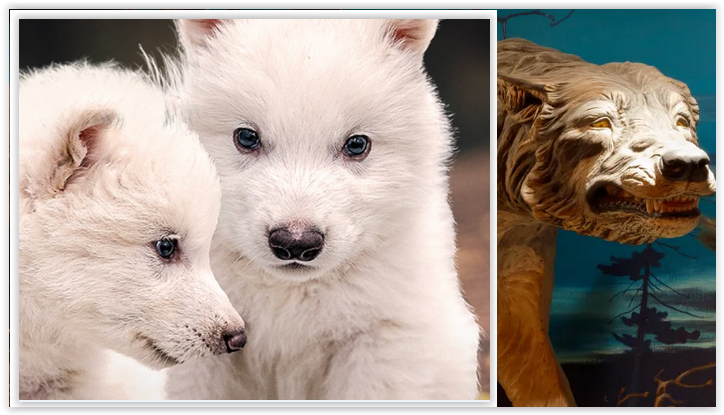
Dire Wolves Reimagined: From Reddish-Brown Legends to White Superwolf Puppies - by White Wolf
For decades, the dire wolf has captured our imagination as a fierce, reddish-brown predator stalking the prehistoric plains of North America. Iconic paleoart, like the stunning reconstructions from the La Brea Tar Pits (tarpits.org), painted these ancient canids with rich, earthy tones—think a "giant, reddish coyote" built to dominate the Ice Age. But in 2025, Colossal Biosciences flipped the script with their newly engineered dire wolf puppies, revealing a striking white coat that challenges everything we thought we knew about these extinct beasts. So, why the drastic change in color, and what does it mean for our understanding of dire wolves? Let’s dive into the science, the history, and the cultural twists behind this fascinating shift.

The Reddish-Brown Dire Wolf: A Paleoart Tradition

Dire wolves (Aenocyon dirus) roamed North America for over 100,000 years, leaving behind a treasure trove of fossils, especially at sites like the La Brea Tar Pits. Early reconstructions of dire wolves often mirrored gray wolves, with grayish coats, due to their assumed close relation. But a 2021 genomic study shook things up, revealing that dire wolves were a distinct lineage, more divergent from gray wolves than previously thought. This led scientists and artists to rethink their appearance. Influential paleoartist Mauricio Antón and others began depicting dire wolves with reddish-brown fur, hypothesizing that their coat might resemble that of canids adapted to warmer climates, like coyotes or dholes. The tarpits.org image of a dire wolf, with its warm, reddish-brown coat, became a standard—a symbol of a predator perfectly suited to its ancient environment. This reddish-brown vision wasn’t just a random guess. It was grounded in ecological reasoning: dire wolves lived in diverse habitats, from grasslands to forests, and a reddish coat might have provided camouflage in those settings. For years, this became the go-to image of the dire wolf, fueling our mental picture of these "superwolves" as rugged, earth-toned hunters.

Enter Colossal Biosciences: The White Dire Wolf Revolution

Fast forward to 2025, and Colossal Biosciences, a company known for its ambitious de-extinction projects, announced a breakthrough: they’d engineered dire wolf puppies using ancient DNA. But these weren’t the reddish-brown wolves of our paleoart dreams. Instead, they were stunningly white, with light, nearly-white coats that seemed straight out of a Game of Thrones episode (think Ghost, the albino direwolf). Colossal’s team explained their findings in a statement: “Our analysis of the dire wolf genome revealed that they were stunning, with likely light, nearly-white coats, sturdy legs, and the unique craniofacial features of a true American superwolf.”

So, how did Colossal arrive at this snowy-white version of the dire wolf? It all comes down to genetics. By sequencing ancient dire wolf DNA from fossils, Colossal identified genes associated with coat color, among other traits. They then edited gray wolf cells, tweaking 14 specific genes to express dire wolf characteristics, including pigmentation. The result? Puppies with white fur, a stark contrast to the tarpits.org depiction. Some speculate that the choice of white coats might have been a practical one—certain genes for pale coats in canids can cause health issues like deafness, so Colossal may have opted for a genetic workaround, suppressing darker pigmentation to achieve the white fur without risking the puppies’ health.

Source tarpits.org

But there’s another layer to this story: cultural influence. George R.R. Martin, the author of Game of Thrones, is reportedly involved with Colossal as a "cultural advisor." Fans on platforms like X have pointed out that the white dire wolf puppies bear an uncanny resemblance to the direwolves of Westeros, particularly Ghost. While it’s unconfirmed, some wonder if Martin’s involvement nudged Colossal toward a white coat to align with the popular image of direwolves in modern media. Whether this was a deliberate choice or a happy coincidence, it’s hard to deny the visual impact of these white puppies.

Red vs. White: A Tale of Two Dire Wolves

The contrast between the traditional reddish-brown dire wolf and Colossal’s white puppies is striking. Picture this: a majestic, reddish-brown dire wolf, as depicted by tarpits.org, standing tall with its earthy coat blending into a sunlit grassland. Now imagine a litter of fluffy, white dire wolf puppies from Colossal, their light coats glowing in the same scene, their sturdy legs and broad muzzles hinting at the "superwolf" traits Colossal described. It’s a visual clash of past and present, of artistic interpretation and genetic reality. This shift raises bigger questions about how we reconstruct extinct animals. Paleoart, like the tarpits.org depiction, relies on educated guesses based on fossils, ecology, and comparisons to living relatives. But Colossal’s work shows the power of genomics to challenge those assumptions. If dire wolves indeed had light, nearly-white coats—at least in some populations—then our reddish-brown image of them might be more fiction than fact. On the other hand, Colossal’s dire wolves are engineered, not natural. Their white coats might reflect genetic choices made for practical or aesthetic reasons, rather than a perfect recreation of the past.

What Does This Mean for the Future?

The arrival of Colossal’s white dire wolf puppies isn’t just a scientific milestone—it’s a cultural moment. These puppies, with their Game of Thrones-esque fur, are redefining how we imagine dire wolves, bridging the gap between ancient history and modern storytelling. They also highlight the potential of de-extinction technology to not only bring back lost species but to reshape our understanding of them. As Colossal continues its work, we might see more surprises, more challenges to the paleoart canon that has shaped our view of the prehistoric world. For now, the contrast between the reddish-brown dire wolf of tarpits.org and Colossal’s white puppies is a reminder of how science and imagination intertwine. Whether you prefer the earthy tones of the traditional dire wolf or the ethereal white of the new pups, one thing is clear: the dire wolf, in all its forms, remains a symbol of nature’s raw power and mystery. What do you think—would you rather see a reddish-brown dire wolf stalking the plains, or a white superwolf puppy bounding through the snow? Let me know in the comments!

THEN

NOW


Monday

April 7, 2025 – For over 12,500 years, the dire wolf—a towering, muscular predator immortalized in fossils and pop culture—has been a ghost of Earth’s past, its howls silenced since the end of the Ice Age. That silence was broken this year when Colossal Biosciences, a trailblazing biotech firm based in Dallas, announced the birth of three pups they herald as the return of this ancient canine. Named Romulus, Remus, and Khaleesi, these animals represent what the company calls the world’s first successful de-extinction, a feat blending cutting-edge science with a touch of prehistoric nostalgia.

The journey to resurrect the dire wolf began with fragments of its long-lost DNA. Scientists at Colossal extracted genetic material from a 13,000-year-old tooth and a 72,000-year-old skull, piecing together a blueprint of the species that once roamed North America alongside mammoths and saber-toothed cats. Comparing this ancient genome to that of the modern gray wolf—the dire wolf’s closest kin—they pinpointed 20 key differences across 14 genes. These genetic markers, tied to traits like the dire wolf’s imposing size, thick white coat, and robust build, became the targets of an ambitious experiment.

Using CRISPR, the revolutionary gene-editing tool, Colossal’s team tweaked the DNA of gray wolf cells, specifically endothelial progenitor cells harvested from blood samples. The edits were carefully chosen to avoid unintended consequences like deafness, a common risk in genetic tampering. The modified cells were then fused into empty egg cells through a cloning technique reminiscent of Dolly the sheep’s creation—somatic cell nuclear transfer. These engineered embryos were implanted into surrogate mothers, a pack of hound mixes, leading to the births of Romulus and Remus on October 1, 2024, followed by Khaleesi in early 2025.

Now housed in a undisclosed U.S. wildlife facility, these pups are a sight to behold. Larger than typical gray wolves, with hints of the dire wolf’s iconic features, they mark a triumph of genetic engineering. Yet, they’re not perfect replicas. Sharing roughly 99.5% of their DNA with gray wolves, they’re more like modern wolves dressed in dire wolf clothing—a hybrid creation rather than a full resurrection. This has sparked debate among scientists: is this truly de-extinction, or simply a remarkable imitation?

For Colossal Biosciences, the answer is clear. Valued at $10.2 billion, the company sees this as a stepping stone to a broader mission. Beyond reviving lost species, they aim to bolster conservation efforts, such as supporting the endangered red wolf population with genetic enhancements. The dire wolf project is a proof of concept, paving the way for even bolder endeavors—like bringing back the woolly mammoth, a goal Colossal has been chasing for years.

The implications are staggering. Imagine ecosystems enriched with creatures engineered to thrive where their ancestors once did, or endangered species given a genetic lifeline. But questions linger. Critics argue that resources might be better spent protecting living species rather than recreating the dead. Others wonder what happens when these engineered animals step into a world that’s moved on without them. For now, Romulus, Remus, and Khaleesi are thriving, their existence a testament to human ingenuity and ambition. They may not be the dire wolves of ancient lore in every genetic detail, but they carry echoes of a lost world into ours. As Colossal pushes the boundaries of what’s possible, one thing is certain: the line between past and present has never been blurrier—or more exciting.

VIDEO


Stats

Archives

Pages