Showing posts with label Jaguar. Show all posts
Thursday

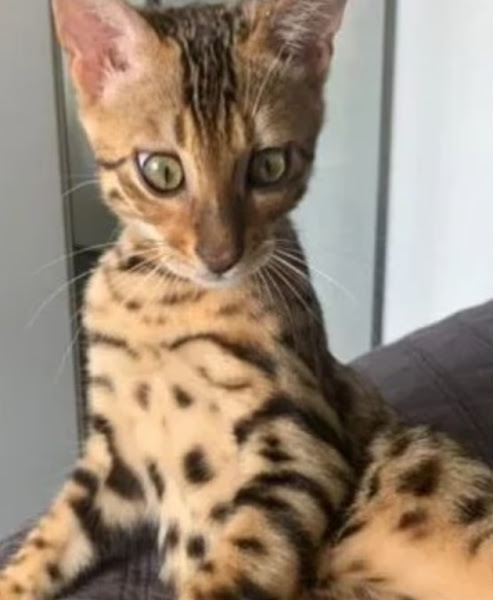
A fire department nearly lost a family's seven-month-old spotted pet kitten after mistaking it for a jaguar and releasing it into the wild.

Veterinarian Rodrigo Calil said tenants at his condominium in southeastern Brazilian state of Minas Gerais called 911 Tuesday morning after they spotted the cat, Massinha, wandering around the building.

When firefighters arrived at the building and found the seven-month-old cat in the stairs and mistook it for a wild animal, according to Brazilian newspaper Metropoles.

The firemen then used a net to trap the cat and proceeded to a forest area near the family's home where they released her.

Calil said he woke up around 7am and noticed the Bengal cat, which he purchased for $1,300 as a gift for his seven-year-old daughter, was missing.

He then discovered through a WhatsApp group chat that Massinha has been found and removed from the grounds.
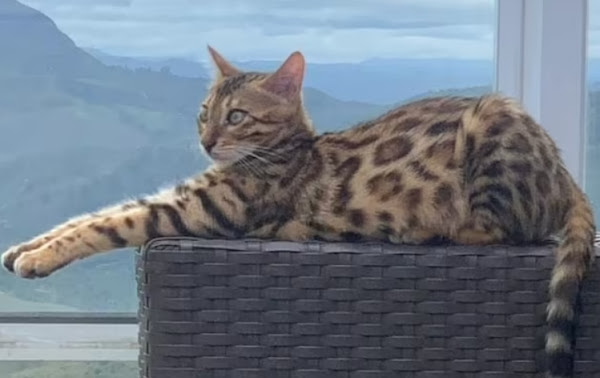
'What happened was surreal,' Calil said. 'In the period between me getting up and seeing it was gone, I joined the condominium group and saw that people were desperate thinking it was a jaguar.'

The family searched the vicinity for almost eight hours before his daughter found her in the bushes Tuesday evening.

'I chose to bring her so that she could see that I was committed to finding the cat,' Calil told O Tempo newspaper. 'She had been very sad and even cried when she heard the news of the disappearance. As soon as my daughter called for her, the cat listened and left the bush'
Calil was bemused that the fire department and building staff could make such a poor error in judgment.

'It's surreal, it's a sequence of mistakes one after another,' he said. 'A lack of preparation by a large condominium, a lack of preparation by a team from the fire department, who assumed it was a wild animal and released it in the Belvedere forest, a residential area.'

The fire department said the responding unit acted in accordance with their guidelines and removed the cat that has been roaming around the building for two days.
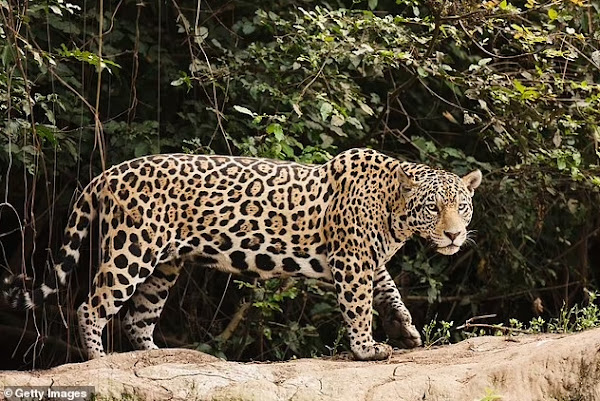
'They (building security) reported that the said animal did not belong to any local resident,' the fire department said in a statement. 'After being captured safely and unharmed, since she had no injuries and was apparently healthy, and because she had the characteristics of a domestic animal, she was released in a more remote location outside the condominium in a forested area, according to standard protocol.'

Source

VIDEO

Tuesday

To be fair, a close-up view of a jaguar's gigantic claws isn't something you see every day! In fact, we're not sure we've ever had a good view of a wild cat's paws before.

Even though Tank the jaguar is not a pet Wildlife caretaker gets up close and personal with the majestic cat. Even though she's a professional, it's still impressive AF to see her confidence with the animal!

The jaguar is the only member of the Panthera, or big cat, family native to the new world. It is also the largest cat on the North American continent. This tawny cat with dark rosettes closely resembles its cousin, the leopard, which inhabits a different continent.

To further confuse, melantistic, or all dark, individuals occur in both species and in both cases are called black panthers. Jaguars can be distinguished from leopards by coat pattern, their rosettes containing small dark dots.

They also have a more muscular, compact build, a proportionally shorter tail and larger, blunt head. In habitat and behavior, the jaguar fills a niche equivalent to the old world tiger.

These powerful hunters prefer dense forested locales near water, and prey on medium-sized mammals such as peccaries and capybaras as well as birds, fish, crocodilians and even armadillos. Jaguars, unlike other big cats, kill their prey with a powerful bite through the skull.

The jaguar is a powerful climber and swimmer. Jaguar claws are sharp and retractable, used for traction, gripping prey, climbing and scent marking.

The jaguar is threatened by loss and fragmentation of habitat, illegal killing in retaliation for livestock depredation and for illegal trade in jaguar body parts. It is listed as Near Threatened on the IUCN Red List since 2002, as the jaguar population has probably declined by 20–25% since the mid-1990s. Deforestation is a major threat to the jaguar across its range. Habitat loss was most rapid in drier regions such as the Argentine pampas, the arid grasslands of Mexico and the southwestern United States

VIDEO

Saturday

The adorable cub, which is being referred to as 'Baby' until she is officially named, has taken her father's colouration of appearing black - a characteristic only affecting 10 per cent of the wild jaguar population, while the other 90 per cent have distinctive spots.

Her birth is part of the European Endangered Species Breeding Programme, and is an important breakthrough for jaguars, which are classed as 'near threatened' in the wild.

Keira, Baby's mother, was born at the Paradise Wildlife Park in 2017, before coming to the Big Cat Sancutary in 2019, where she was paired with Neron.

Briony Smith, Curator at The Big Cat Sanctuary, comments: 'We are over the moon to welcome this little jaguar girl to our Big Cat Sanctuary family.

'We had been monitoring Keira, the mother, closely for many weeks both in person and on the CCTV we had set up in her den.

'There was no doubt that she was pregnant, all we could do was wait with excitement for the big day.

Father

'On the morning of April 6th, we could see that Keira was unsettled and agitated and we knew that she had begun to go into labour.

'This gorgeous little girl was born at 11.10 am and has gone from strength to strength since.

'I cannot believe how quickly she is developing compared to other big cat cubs and this seems to be normal for jaguars.

'She was born with her eyes open and walking strongly by 2 weeks old.

'During the 1960s and 1970s, the jaguar was heavily hunted for its fur; as many as 18,000 jaguars were killed each year until 1973, when the Convention on the International Trade in Endangered Species (CITES) brought the pelt trade to a near halt.

'Today, jaguars continue to be hunted, mostly due to conflict with humans.

'The jaguar is listed as “Near Threatened” on the International Union for the Conservation of Nature (IUCN) Red List of Threatened Species, though its status is in review and may be elevated to “Vulnerable” in the next year.'

Source


Tuesday

A historic day for DiCaprio Foundation and Tompkins Conservation’s rewilding efforts, as it marks the arrival of two new jaguar cubs in Iberá Park, situated in the wetlands of northeastern Argentina.

These two new cubs are not only the first newborns from CLT Jaguar Reintroduction Program at Iberá Park, but represent the first jaguars born in decades in this region, where the species has been absent since the industrialization of the 20th century.

The jaguar is the largest and one of the most iconic felines in the Americas, but hunting, habitat loss, and other threats left the species in danger of extinction in Argentina. Having lost 95% of their original distribution, it is currently estimated that only some 200 individuals remain in Argentina, distributed mainly in isolated patches of the jungles of Misiones province and in the mountain slope forests (“yungas”) of Salta and Jujuy provinces.

The two new cubs are offspring of two of the program’s jaguar on loan from partnering institutions: Chiqui, the father, was born in the wild but lived in a rescue center after being orphaned by a hunter; Tania, the mother, came to the center after being born and raised in a zoo. It is notable that Tania is missing a leg from an incident she endured when she was just a cub. Despite this disability, she has learned to hunt for herself since joining the Jaguar Reintroduction Program and is now the mother of the first cubs born in Iberá in approximately half a century.

In the words of Maite Ríos, the head of the Jaguar Reintroduction Program, “It’s great news that an animal with a disability and that seemed condemned to life in captivity, like Tania, is able not only to live in semi-natural conditions and hunt for herself, but to become the mother of the first cubs that could possibly live freely in Iberá soon.

Tania’s history of overcoming obstacles inspires us to keep working and collaborating with other institutions to care for and restore the heritage of all inhabitants of Corrientes province and of Argentina. For the moment, we see that the cubs are suckling well from their mother, but we must be very prudent because we’re talking about a first-time mother who must still learn to raise her brood on her own, without interference on the part of humans. With a view to being able to free them, it’s very important for these tiny jaguars to grow up in the most natural manner possible.”


“This is a historic moment for Iberá and the rest of Argentina, as we see how our most endangered mammal, an emblem of our country, takes a step towards its recovery.
Source


Sunday

With only 600 individuals left in the wild, it's extremely rare to catch sight of a black jaguar. To see one paddling through the Amazon River is an even rarer sight.

Jaguars are strong swimmers and climbers and require large areas of tropical rain forest and stretches of riverbank to survive.

A model for conservation, the Amazon Region Protected Areas ensures 150 million acres—three times the size of all US parks combined—of the Amazon are protected in perpetuity.

A group led by the World Wildlife Fund spotted just that in the 150 million-acre Amazon Region Protected Areas.

Black jaguars are cats with a dominant gene for melanism, meaning that their dark coats nearly blot out the distinctive yellow and black rosette patterns that most jaguars have.

As the video shows, these apex predators are powerful swimmers, thanks to their stocky, muscular limbs.


Listed as near threatened by the International Union for the Conservation of Nature, jaguars suffer from habitat loss and fragmentation, as well as hunting for their prized coats. See this page for ways to help save jaguars.

 VIDEO

Saturday

Under Protection: Jaguar Roaming Arizona Wilderness Is 1 of Only 3 Spotted in U.S. in Recent Years

Wildlife conservationists released new video footage on Thursday of a wild jaguar trekking through southern Arizona's Chiricahua Mountains.

The video, captured by the Center for Biological Diversity using a remote-sensor camera, offers a glimpse of the jaguar named “Sombra,” Spanish for "shadow," by students at Paulo Freire Freedom School in Tucson.

The jaguar is only the third seen in the U.S. since 2012, and the seventh in the past 20 years, the organization said. Rosette spot patterns on the cat also suggest it is the same one that was spotted seven months ago, in November, in the Dos Cabezas Mountains.

The sex of the jaguar remains unknown.

“The possibility that it may be a female gives us a lot of hope that jaguars might jump-start their recovery in a region they’ve called home for thousands of years,” conservation advocate Randy Serraglio said in a press release.


The video was captured earlier this summer, but the conservation group held off on releasing it to protect the jaguar's safety, according to spokesperson Russ McSpadden.

Other critters were also captured on the feed, including bears, deer and a mountain lion.

Conservationists believe the big cats are traveling north from Mexico due to population stressors in their habitat there and said erecting a wall along the U.S.-Mexico border will only contribute to their problems.


“Part of ensuring the survival and recovery of the northern jaguar population is stopping Trump’s horrendous border wall,” Serraglio said. “These cats must be able to move back and forth across the border as they travel long distances to find mates and establish new territories.”


Historically, jaguars lived throughout the Southwest, including on the South Rim of the Grand Canyon and in Southern California mountain regions, the center said
Source
VIDEO

Stats

Archives

Pages