Showing posts with label Orangutans. Show all posts
Thursday

In the wild, orangutan fathers play no direct role in the upbringing of their offspring. Meanwhile, the bond between an orangutan mother who raises her offspring single-handedly and her child is thought to be one of the strongest in nature. In fact, orangutan moms invest more time in each offspring than any other known mammal.

But 2-year-old orangutan Cerah was left by herself after her mom unexpectedly died last month at the Denver Zoo. And to the complete surprise of the staff members, Cerah’s dad Berani stepped up to undertake the unusual job on his own—raising his daughter as the best dad he could be.

“Cerah couldn’t have asked for a better dad. Berani is so attentive and protective of her, seeing all her needs,” the zookeepers said in a Facebook post shared two days ago.

And the heartwarming pictures of the dad and daughter snuggling speak louder than any words. They prove that love creates miracles, it heals and creates a one-of-a-kind bond that otherwise wouldn’t have been there.

After 2-year-old Cerah became motherless, her dad Berani stepped up to take care of her, which is not typical of male orangutans Orangutans are among the most intelligent primates. They use a variety of sophisticated tools and construct elaborate sleeping nests each night from branches and foliage.

The apes' learning abilities have been studied extensively. There may be distinctive cultures within populations. Orangutans have been featured in literature and art since at least the 18th century, particularly in works which comment on human society. Field studies of the apes were pioneered by primatologist BirutÄ— Galdikas and they have been kept in captive facilities around the world since at least the early 19th century.

Source
Image credits: Denver Zoo

All three orangutan species are considered critically endangered. Human activities have caused severe declines in populations and ranges. Threats to wild orangutan populations include poaching, habitat destruction because of palm oil cultivation, and the illegal pet trade. Several conservation and rehabilitation organisations are dedicated to the survival of orangutans in the wild.


Sunday

Heartbreaking footage of an orangutan trying to fight off an excavator from destroying his home highlights the terrible plight these gentle apes are facing.

“This desperate orangutan is frantically seeking refuge from the destructive power of the bulldozer; a machine that has already decimated everything else around him,” writes International Animal Rescue, who released the video for World Environment Day.

This dramatic footage shows the devastating impact deforestation is having on precious orangutan habitat.

“Despite all the obstacles thrown at them, our team were able to rescue this orangutan and bring him to safety,” the wild animal rescue group says. “Unfortunately, scenes like this are becoming more and more frequent in Indonesia. Deforestation has caused the orangutan population to plummet; habitats are destroyed and orangutans are left to starve and die.”

Orangutan habitat is being decimated at a staggering pace due to illegal logging or palm oil production. The apes are often subjected to cruel and barbaric torture or killed in order to make way for human developments. An increasing number of orangutans are being orphaned. Many are rescued by IAR, but even more are lost.

As result of human activities, studies suggest that more than 2.5 million acres are lost every year. As a result, orangutans are left to starve and die with nowhere to call home. Borneo orangutans are now considered critically endangered.


International Animal Rescue is asking for help through their Plant A Tree initiative to help reforest the orangutans’ forests.
Source

VIDEO

Friday

A visitor to US zoo, captured moment when a 15 stone ape mounted a delicate rescue of the young bird, tenderly lifting it from the water using a leaf.

The curious ape was in its enclosure, when it noticed the bird's struggle in the pond.

It yanked a leaf from a nearby bush and extended its arm out to the bird, beckoning to the chick in the hope that it will latch onto the leaf.

Onlookers cheered as orangutan managed to get the bird to grip the leaf for a split second only to have the bird drop again.

In a last-ditch attempt to rescue the chick, the orangutan gently waved the leaf in front of the bird which managed to latch on to it.

The ape plucked the bird from the water to the delight of the crowd. During the clip, one woman can be heard exclaiming: "Oh my God look, that is unbelievable, he's got him."


The massive ape carried the chick back to the main part of its enclosure, where it tenderly placed it down on the grass and proceeded to gently stroke the bird.

Cathy Smith, from the Orangutan Foundation, said: "They are very intelligent animals and can be very inquisitive.

"This shows how chilled out and good at problem solving these amazing creatures are.

"It's hard to say whether he knew he would be saving the chick but you never know. I have never heard of anything like this before."( Source)

Wednesday

The seven orangutans lived on palm oil plantation in Aceh Tamiang, Aceh province, Sumatra, Indonesia
Charity is worried other orangutans who remain on plantation will be harmed or even killed during clearance work

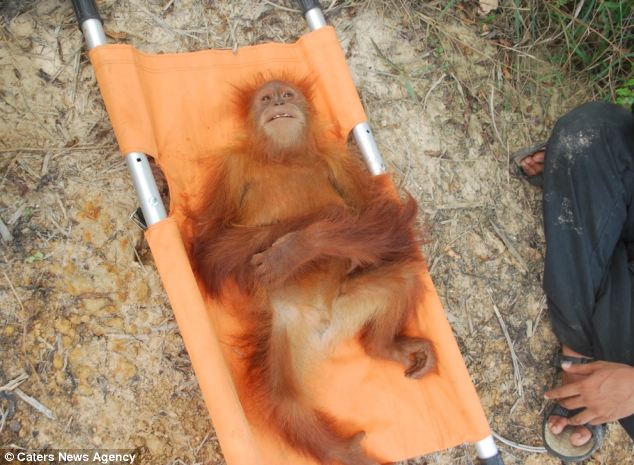
They may look miserable being led away on stretchers from their home, but these orangutans are now living a much safer life thanks to a charity’s speedy action.

Living on a palm oil plantation in Aceh Tamiang, Sumatra, Indonesia, the seven Sumatran orangutans, including three mother and baby pairs, faced losing their homes as bulldozers moved in.

But they were rescued by the Sumatran Orangutan Society and have now been safely released back to the Gunung Leuser National Park.

The plantation is managed by a company called PT. Sisirau and when one of their workers saw a great ape in the forest, the clearance work was halted and the Orangutan Protection Centre were called.

Their sister organisation, the Sumatran Orangutan Society, took cages into the plantation and captured the animals, which are considered endangered.

They sedated them to make the move less distressing, carrying them out on stretchers due to their weight.

Over the past nine months they have rescued seven of the orangutans- one of the animals they took out was found to have two pellets in her neck, although it is unclear who shot her.

But during the evacuation, the charity workers caught sight of other orangutans living on the scrub land and informed the company of their existence.


They could not rescue them as they did not have enough cages - only mother and baby can be put in a cage together.

Now with work resuming on the plantation, they are worried that these animals are in danger and could be harmed or even killed.

Helen Buckland, Director of Sumatran Orangutan Society, said: ‘The company knows that there are orangutans on their land, the estate manager has even joined the team on rescues, yet the bulldozers continue to tear down the last remaining trees.

‘We are calling on PT. Sisirau to immediately halt all clearance and operations in the area, and for the RSPO to make an example of this company by terminating their membership.’

‘The idea that this company could ever be allowed to be certified as producing ‘sustainable’ palm oil in the future is ludicrous. The RSPO’s credibility is really on the line here.’


The company is a member of the Roundtable on Sustainable Palm Oil (RSPO), an industry group which regulates certified sustainable palm oil according to a set of principles developed by palm oil companies,traders, buyers, retailers, banks and social and environmental organisations, designed to limit negative environmental and social impacts of the industry.

ButPT Sisirau argues that the company did everything in its power to ensure the welfare of the orangutans.

A spokesperson said: ‘The company at all times acted in respect to the welfare of the orangutans and when they discovered that orangutans were on the land (which they have held a licence to cultivate as a plantation on for nearly 20 years) they immediately halted all work on the site and sanctioned the Sumatran Orangutan Society to come on the land to humanely move the orangutans to a conservation area that would be more suitable for them.’


The expansion of land being cleared for oil palm plantations across Asia is recognised as a leading threat to critically endangered species including orangutans, elephants and tigers.

Palm oil is an ingredient found in up to half of processed foods, and is also increasingly being used as a biofuel in petrol tanks and power stations.

Panut Hadisiswoyo, Founder and Director of the Orangutan Information Centre said: ‘As more and more forest is replaced by oil palm plantations, more orangutans become isolated in farmlands.


‘They are at serious risk of starvation or being killed if they wander into plantations in search of food.

Yet even palm oil companies which are supposed to be committed to sustainable production continue to destroy what little habitat remains.’

More information about the Sumatran Orangutan Society can be found at www.orangutans-sos.org


THE CRITICALLY ENDANGERED SUMATRAN ORANGUTAN

The Sumatran orangutan has been classified as critically endangered by the IUCN, the International Union for the Conservation of Nature.

The latest data estimates that there are now only around 6,600 remaining in the wild, a drastic drop from the estimated 85,000 in 1900.


Orangutans were historically found in forests across Sumatra but are now restricted to just two provinces: North Sumatra and Aceh.

There are less than 864,000 hectares of orangutan habitat left on the island. Experts suggest that they could be the first Great Ape species to become extinct in the wild.

The greatest threats to their survival are habitat loss and the illegal pet trade. Sumatra lost 48% of its forests in the 20 years prior to 2007.


Large areas of orangutan habitat have been lost or degraded due to the spread of oil palm plantations into their forest homes.

Human-orangutan conflict is now frequent in agricultural areas, as orangutans are forced out of degraded forest fragments in search of enough food for survival.

For farmers, raided or damaged crops means that this critically endangered species is often considered to be an agricultural pest and killed.
SOURCE


Call them the odd couples. A pair of month-old Sumatran tiger twins have become inseparable playmates with a set of young orangutans, an unthinkable match in their natural jungle habitat in Indonesia's tropical rainforests.

The friendship between 5-month-old female baby primates Nia and Irma, and cubs Dema and Manis, has blossomed at the Taman Safari zoo where they share a room in the nursery.

After being abandoned by their mothers shortly after birth, the four play fight, nipping and teasing each other, and cuddling up for a shared nap when they are worn out.

"This is unusual and would never happen in the wild," said zoo keeper Sri Suwarni, bottle-feeding a baby chimp on Wednesday. "Like human babies, they only want to play."

The four have lived side-by-side for a month without a single act of hostility, she said.

Indonesian tigers and orangutans are both endangered species, threatened by rapidly shrinking habitats.

Conservationists estimate there are fewer than 700 Sumatran tigers still alive, while fewer than 60,000 orangutans remain in the wild. Around 90 percent of the jungle has been destroyed by illegal logging, poaching and cut-and-burn farming practices on Borneo and Sumatra islands.

The exceptional friendship will likely be short-lived, said veterinarian Retno Sudarwati, because as the animals grow up their natural survival instincts will kick in.

"When the time comes, they will have to be separated. It's sad, but we cant' change their natural behavior," she said. "Tigers start eating meat when they are three months old."
SOURCE


VIDEO Twin Baby Tigers and Orangutan Babies

All life is precious, but the demise of the orangutan hits especially close to home. One of our closest relatives — human and orangutan genomes are 97 percent identical, a study published last year in Nature found — their population has dwindled to somewhere around 50,000.

Their range, once spanning much of Southeast Asia, has shrunk to mainly just a couple of islands in Indonesia: Borneo, home to Pongo pygmaeus, and Sumatra, where its critically endangered counterpart, Pongo abelii, hangs on with a population of only around 7,000. All great apes are threatened, but the orangutan — in the Malay language, the word means “person of the forest” — is going extinct.

The main issue that orangutans face is the loss of their tropical rain forest habitat. In Indonesia, much of it has been erased by palm oil plantations. Illegal logging and gold and zircon mining are other threats. According to a study led by a researcher at South Dakota State University, Borneo and Sumatra lost 9.2 percent of their forest cover from 2000 to 2008.

Last summer Indonesia approved a two-year moratorium on granting new licenses for clearing peatlands and primary forests, the result of a $1 billion climate deal with Norway, but critics say the ban is riddled with exemptions and breaches.

Credit: Andy Isaacson

As their forest shrinks, orangutans are coming into closer contact with humans — a potentially perilous encounter. The Nature Conservancy and 19 other private organizations recently found the rate at which orangutans in Indonesian Borneo are being killed to be higher than previously thought. From 1,970 to 3,100 are killed annually, on average, enough to drive the species toward extinction in 10 to 15 years, their survey found. Orangutan populations do not recover quickly: the average interval between births is about eight years.

People are hunting orangutans for food or to protect their crops from orangutans that have already been pushed from the forest. In November, the Indonesian police arrested palm oil plantation workers in East Kalimantan in Indonesian Borneo who reported that their supervisor had paid a bounty of $110 for each orangutan they killed. Last month two Indonesian plantation companies — PT Smart, a major palm oil producer, and PT Lontar Papyrus, a wood-pulp supplier — pledged to train workers not to kill or injure orangutans.

But it is clear that enforcement remains lax, and the survey’s authors concluded that the only effective solution was likely to be cultural and social persuasion.

Credit: Andy Isaacson

The camp, a research and conservation center, was used throughout the 1980s to rehabilitate and then release orangutans that had been held captive. (Today orphaned orangutans are brought to a care center outside the park founded by Dr. Galdikas’s organization, Orangutan Foundation International, before being returned to the wild elsewhere.)

Camp Leakey draws about 2,000 international tourists a year. At a viewable feeding platform, the camp staff leaves bananas for the ex-captive orangutans and their offspring. The handouts provide these semi-wild orangutans with a supplemental diet and minimize competition with the wild orangutan population in the park. Longtime resident orangutans of the Camp Leakey area have become all too familiar with people — many have been given names by the staff — and pass through not just for the bananas but a bit of human company.
Source

In Borneo, a Safe Place for Orangutans
Credit: Andy Isaacson


More Pictures

In the Malay language, “orang” means “person” and “utan” is derived from “hutan,” which means “forest.” The name of the orangutan, Asia’s only great ape, literally means “person of the forest.” These animals once lived throughout much of Southeast Asia, but now 90 percent of the world’s orangutans live in Indonesia. The endangered Bornean orangutan (Pongo pygmaeus) numbers between 40,000 and 50,000, while the population of its critically endangered Sumatran counterpart (Pongo abelii) has dwindled to less than 7,000.

Stats

Archives

Pages