Showing posts with label moon. Show all posts
Wednesday

So you've heard of a blood moon, and maybe even a blue moon, but what about a black moon?

The phenomenon is occurring again in North America on July 31 -- the first one since 2016. The rest of the world will have to wait until August 30.

But, what does this even mean? Why is it important? Here's everything you need to know about this astronomical event.

Wait, what is black moon?

A black moon is basically the second new moon of the month, something that rarely occurs. It works similarly to a Leap Year. A lunar cycle typically takes about 29 days to complete, but our months are slightly longer. So sometimes, about every 32 months, we happen to get two full moons or two new moons. The second full moon in a month is called a blue moon, and the second new moon is called a black moon.

But a black moon also refers to a month where there are no new moons -- which is only possible in February because of its fewer days. This is less common than the other type of black moon, and occurs about once a decade.


What will I see during a black moon?

Honestly, probably nothing.

A black moon is really just a new moon, the only real significance is that it's the second one. So you won't even see the moon, because it will blend in with the sky. The moon is also going to be a supermoon, meaning the moon will appear bigger than usual because it's closer to the Earth, but because it's a new moon you still won't be able to really see it.

If you wanted this experience to sound even cooler, you could call it a "black super new moon." But a darker sky does make for better stargazing, and as luck would have it, the Milky Way is best seen in late summer. So if you can get yourself away from the city and its light pollution, you'll be in luck.
Source

VIDEO

Saturday

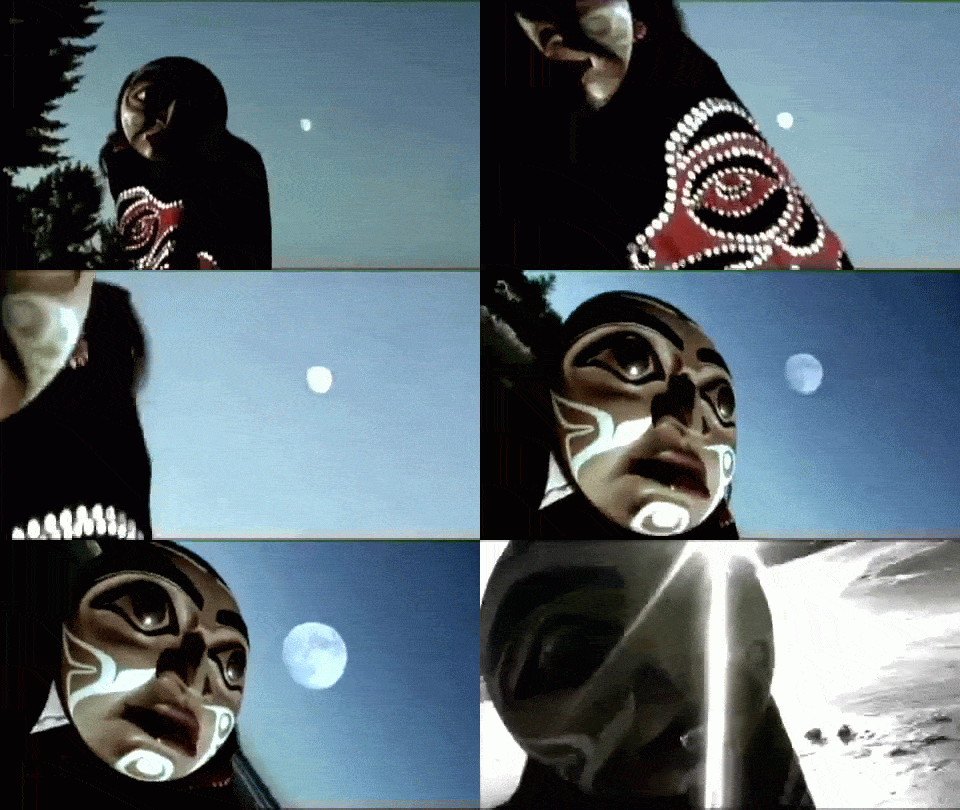
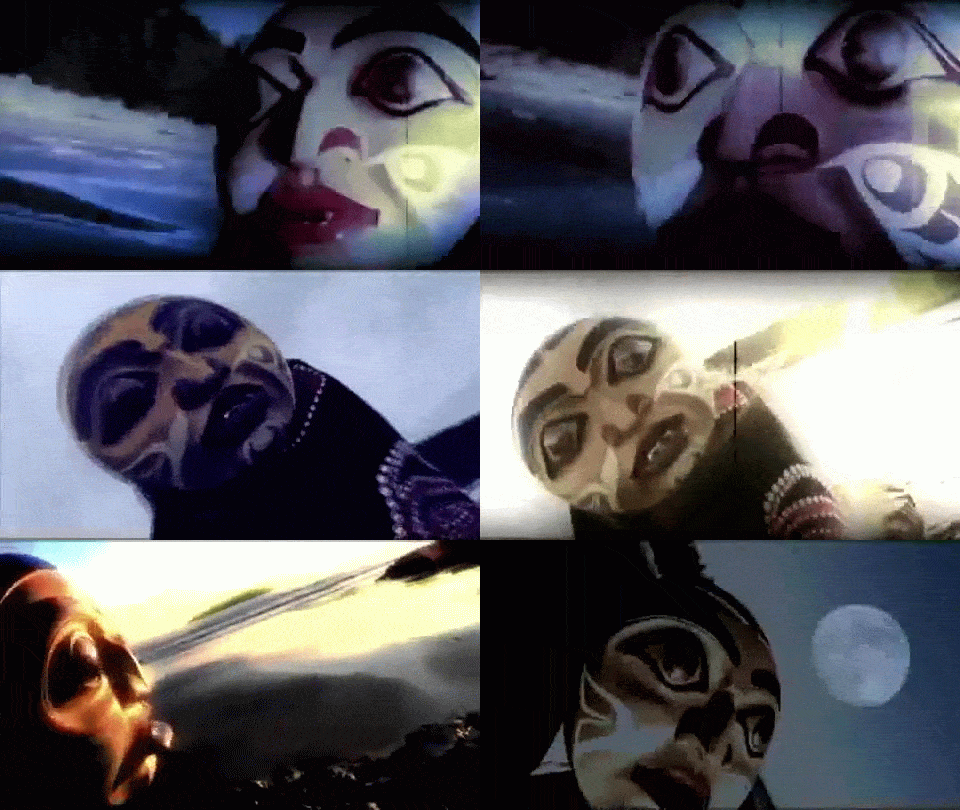
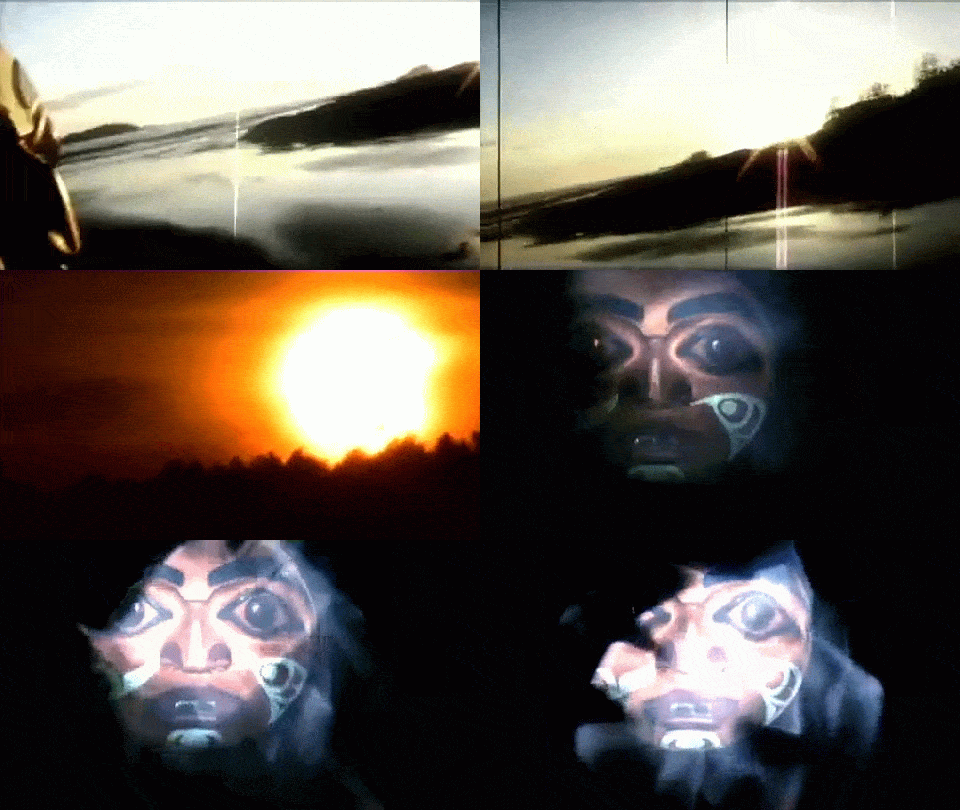
Pacific Northwest Coast Native masks are mainly used for ceremonial purposes.

The native masks often represented spirit creatures, animals and myths. When used in the Potlatch or other West Coast Native ceremonies, the native dancers would take on the personification of the creatures that the masks represented and enter the supernatural world during the dance. A West Coast Native transformation mask often represents the transformation of a human to a mythical creature or animal and vice versa.

A full moon inspires awe and wonder in all those who gaze at it. Long before recorded history, cultures around the world were charting the moons path across the night sky. Its perpetual waxing and waning, vanishing and reappearing, marked the passage of time - not clock time, but the cycles of life; the ebb and flow of the sea; the birth, maturation and migration of animals; the sprouting of new plants and the scattering of seeds.


Unlike the sun, the moon does not blaze its power upon the earth. It is subtle, more receptive and reflective. The moon brightens the darkness and is therefore a powerful guide or protector. As the force that rules the tides, it is strongly linked to water. The moon is a sacred symbol that appears in countless Native American. These ancient cultures often carved masks to express the intimate relationship between the invisible forces and spirits above, as well as the people, animals, plants, rocks and earth below.


VIDEO

Thursday

Just Relax For A Minute And Watch This Incredible Moonrise

On January 30, 2013, the slow rise of a nearly full moon over a clear horizon was a very impressive sight. The moonrise was imaged over Mount Victoria Lookout in Wellington, New Zealand by an industrious astro-photographer named Mark Gee. He had placed a camera about two kilometers away and pointed it across the lookout to where the Moon would soon be making its nightly debut.

The above single shot sequence is unedited and shown in real time -- it is not a time lapse. The people on Mount Victoria Lookout can be seen in silhouette themselves admiring the dawn of Earth's largest satellite. Although seeing a moonrise is not at all difficult because it happens every day the fact is that only half the time it is at night. Each day the Moon rises about fifty minutes later than the previous day. A full moon always rises at sunset.

Some facts about the photographer:

Mark Gee is a freelance photographer & digital visual effects artist based in Wellington, New Zealand. He has worked on many high profile & Oscar award-winning feature films, & his love of surfing & the ocean is a big part of the inspiration for his photography.

Wholly self-taught, Mark’s style of photography is influenced by his many years of experience in the feature film business, & with an eye for detail he strives to produce creative images of exceptional quality, no matter what the subject. Since he began to seriously focus on developing his photography skills over a decade ago, Mark has continuously worked on improving his craft, thriving on setting the bar ever higher and challenging himself to do better yet every time he sets out to shoot.


While his images portray a wide variety of subjects, in the past few years astro-photography in particular has captured Mark’s imagination and interest. He often ventures out to the darkest, most remote skies all around the country, enjoying the challenge of combining New Zealand’s striking landscapes with the ethereal beauty of the night sky in new, creative ways.

Mark’s passion for his craft is tangible in each and every image, & he has enjoyed an enthusiastic response from the public, particularly on his Facebook page, but also on his website, where he offers his work for sale. Source - MarkG.com.au

VIDEO
Full Moon Silhouettes from Mark Gee on Vimeo.

Sunday

Earth's dark shadow will appear to take a bite out of the full moon Monday during a partial lunar eclipse. At the same time, the moon will be at perigee—the lunar orb's closest approach during its egg-shaped orbit around our planet—creating an eclipsed "supermoon."

Lunar eclipses happen when the full moon, Earth, and the sun are lined up so that the moon crosses through Earth's shadow.

"It's a very cool kind of thing to see. It gives us an almost 3-D feeling for space that we don't normally get," said Mark Hammergren, an astronomer at the Adler Planetarium in Chicago.

Coined in 1979, the term "supermoon" is often used to describe a full or new moon that coincides with perigee—something that happens about once a year, on average.

We don't see an eclipse with every full moon because our natural satellite follows a tilted orbit around Earth. This tilt also means that an eclipse can be full or partial, depending on how much of the lunar disk falls in our planet's shadow.

The last total lunar eclipse was in December 2011, and the next one doesn't happen until April 2014.

Monday's partial eclipse will be visible to sky-watchers in most of North and South America during the early hours before sunrise.

Meanwhile, observers in Australia, the eastern parts of Asia, and across the Pacific Ocean will see the partial lunar eclipse Monday evening just after sunset.

The eclipse will last for more than two hours and will reach its peak around 4 a.m. PT, when about a third of the moon's disk will be covered in shadow.

A partial lunar eclipse stains the full moon red in an undated file picture.
Photograph by Detlev van Ravenswaay, Picture Press/Alamy

Lunar Eclipse Writ Large

In early May the moon was at perigee within minutes of the official full moon phase, creating a supermoon that appeared 16 percent bigger and 30 percent brighter than the year's other full moons.

Next week the moon will officially reach perigee the day before the full moon, swinging just 222,750 miles (358,482 kilometers) from Earth.

But the lunar orb is only 0.26 percent farther away on the days before and after its closest approach, Hammergren said.

That means the full moon will still look slightly larger than normal during Monday's partial eclipse.

"It won't be a very noticeable effect," Hammergren said. "The full moon will look only about 5 percent larger than it does on average, appearing perhaps just a little bigger than it usually does."

Still, he added in an email, a supermoon eclipse is a relatively rare sight.

"If you restrict the label of 'perigee' to within only one day of true perigee, then such eclipses will only occur every 10 to 12 years."


Eclipse "Visible Proof" of Earth's Shape

While partial lunar eclipses are entertaining events for modern sky-watchers, in ancient times they served as some of the first evidence that Earth is not flat, Hammergren added.

"The Greeks understood that lunar eclipses happen when the shadow of the Earth is falling on the moon," Hammergren said.

During a partial eclipse, Earth's shadow on the moon's face clearly traces a circle.

"No matter what your angle was when the eclipse occurred, the shadow was always circular. And the only thing that projects a circular shadow no matter its orientation is a sphere," he said.

If Earth was flat, by contrast, the shadow would sometimes appear as a thin line or a squashed oval.

An eclipse, therefore, is "visible proof that anyone can see." (SOURCE)

VIDEO June Lunar Eclipse - Bite Out Of The Strawberry Moon

Tuesday

The Earth’s shadow will darken part of the moon next Monday in a partial lunar eclipse, visible from the Pacific Ocean and surrounding areas.

The places that will get the best show, besides the middle of the ocean, include western North America, Australia, New Zealand, and Japan. In most parts of the United States, the eclipse will happen in the predawn hours, and the moon will set before the event ends.

According to NASA’s predictions, the eclipse will begin at 8:48 a.m. GMT (4:48 a.m. EDT, 1:48 PDT) on June 4 and will end several hours later at 1:18 p.m. GMT (9:18 a.m. EDT, 6:18 a.m. PDT).

At first, it won’t be that noticeable—just a vague gray shadow that gradually appears on the full moon’s surface. This is the Earth’s penumbra, or the fuzzy edge of its shadow. But at 10 a.m. GMT (6 a.m. EDT, 3 a.m. PDT), the Earth’s umbra, or full shadow, will touch the edge of the moon.

The shadow will appear to take a black bite out of the moon over the next two hours, but it won’t be that big. Even at the height of the eclipse, less than half the moon’s surface will be shaded.

This event is the counterpart of the solar eclipse that crossed the Pacific in May. Every eclipse occurs two weeks from another eclipse; that is, a lunar eclipse must occur two weeks before or after a solar eclipse. A lunar eclipse can only happen on the full moon, when the sun and moon are on opposite sides of the Earth.

Lunar eclipses can be seen easily with the naked eye, or you can use binoculars for a closer look.

This is the first of two lunar eclipses this year. The second one will be a barely noticeable penumbral eclipse in November.
SOURCE

PHOTOS The lunar eclipse of Dec. 21, 2010, as seen from Ft. Myers, Florida.

The beginning of the Lunar Eclipse around 1.30 AM EST as seen from Ft Myers,Florida (Mark Zou/The Epoch Times)

The Lunar Eclipse around 1.58 AM EST as seen from Ft Myers,Florida (Mark Zou/The Epoch Times)

The moon changes color during the lunar eclipse as seen from Ft Myers,Florida 2.33 AM EST (Mark Zou/The Epoch Times)

More brightness begins to show around the rim of the moon during the lunar eclipse as seen from Ft Myers,Florida 3.22 AM EST (Mark Zou/The Epoch Times)

The lunar eclipse around 3.30 AM EST as seen from Ft Myers,Florida Mark Zou/The Epoch Times)

The lunar eclipse around 4 AM EST (Mark Zou/The Epoch Times)

The moon returns to full Shot taking around 4.30 AM (Mark Zou/The Epoch Times)

Thursday

Although the moon has remained largely unchanged during human history, our understanding of it and how it has evolved over time has evolved dramatically. Thanks to new measurements, we have new and unprecedented views of its surface, along with new insight into how it and other rocky planets in our solar system came to look the way they do. See some of the sights and learn more about the moon here!

NASA's Lunar Reconnaissance Orbiter has traced the moon's early history as well as the latest trash left behind by moonwalkers, and now the team behind the mission has created a video smashing 4.5 billion years of the moon's existence into less than three minutes.

"Evolution of the Moon," released to mark LRO's first thousand days in orbit, starts just after the moon's congealment into a ball of molten rock, and guides you through the giant blast that formed the South Pole-Aitken Basin, through the pummeling known as the Heavy Bombardment, right through the hail of debris that resulted in the cratered satellite we all know and love.

Only one big scene is missing from the show, in my opinion: the catastrophic impact between Earth and another planet, an event that scientists believe led to the moon's creation. Consider it the prequel to "Evolution of the Moon."There's yet another scene that scientists are thinking about adding to the story: a collision involving the moon and a smaller moonlet, sometime after the moon's formation. Some researchers suspect that such a "Big Splat" could have been responsible for the marked difference in the terrain of the moon's near side and far side — although others think the Aitken Basin blast or gravitational forces could have done the job. NASA's GRAIL mission, which was launched last year, could shed more light on that chapter of the story.

There's also a "Tour of the Moon," about five minutes in length, that guides you through the highlights of the moon's topography with the help of LRO imagery. You'll get a quick overview on the mysteries of Orientale Basin and Aitken Basin, the artifacts left behind by the Apollo 17 mission, the far-side craters we can never see from Earth, and the future of lunar exploration. For space fans, it's must-see video.

Source http://cosmiclog.msnbc.msn.com/


A video from the Lunar Reconnaissance Orbiter team traces 4.5 billion years of the moon's evolution.


From year to year, the moon never seems to change. Craters and other formations appear to be permanent now, but the moon didn't always look like this. Thanks to NASA's Lunar Reconnaissance Orbiter, we now have a better look at some of the moon's history. Learn more in this video!

The Lunar Reconnaissance Orbiter team presents a "Tour of the Moon."

Stats

Archives

Pages