Monday

Recently tourists who were visiting Kimberley's Big Hole in South Africa spotted a dog in distress who had fallen down into the hole. Kimberley's Big Hole is a no longer used diamond mine and is 42 acres in dimension and a cliff drop of 700 feet (200 meters), which is roughly the height of a 50 storey building. The tourist guides apparently called rescue organizations to let them know of the dog's plight.

Kobus de Jonge posted on social media with, "I'm a tourist guide and was at the Big Hole last Wednesday. One of the guides at the hole mentioned that this dog fell in the hole last Friday and was still alive. I phoned Jaco Powell from Cape Fox Tours, a tourist guide friend and well known person from Kimberley and told him what happened. He phoned the SABC, SPCA, etc. Eventually they all pitched up - Police Rescue included. This dog HAD to be saved as she fought for her life since last Friday."

Several attempts were made to get the dog out but they were futile. The emergency rescuers that first attempted to rescue her had trouble because the ground was very unstable and the ropes were not long enough to reach the dog. Police also tried using a helicopter, but again the ropes were not long enough to safely reach the dog and conditions were not safe.


The dog was nicknamed, "Underdog" and food was thrown down the hole to keep her alive but as the days passed the hopes of saving her dimmed. Then on Saturday, ER24, a private emergency rescue company, sent a team of 7 rescuers down the hole to attempt to get the dog out. They used a special system of ropes and pulleys and lowered the team down.


At first the dog was afraid to come to them until Warrant officer John Sealy (from the police K9 Rescue Unit) managed to gently coax her over with kind words. He was able to get a leash around Underdog's neck and she calmed down as soon as he touched her.


John then swam with Underdog across the reservoir. Underdog had a life vest on, but it was so heavy and she soon became exhausted. So John held onto her while swimming her back to where they both could be pulled up to safety. She was finally rescued and once successfully pulled out of the hole, they renamed her "Topdog". The ER24 team are being called heroes and are being congratulated for their efforts.


Topdog is now in the Volksblad & Kimberley SPCA's care. She has received over a 100 applications (from as far away as Canada) to adopt her. They will screen all applications and find the best home for her.

VIDEO

Sunday

Tiny cub Karis proved she's not too dissimilar to human children as she threw herself into the pile of golden leaves carefully collected by her keepers, even ending up with a pile on her head.

The adventurous 11-week-old cub, who was born in September, is proving to be quite the character, with Mr Reid constantly coming up with new ways to entertain her.

'The keepers try to keep things interesting for Karis,' said park manager Gary Gilmour.

Karis was born on September 10 to Teekay and father Dudley, joining her older sister Libby who was born two years ago.

The cub will grow to around 150kg and brings the Blair Drummond pride to eight lions in total.

'She's doing absolutely great,' said Mr Gilmour.


'She is growing fast, and she has quite a wee temper on her.

'She's just starting to eat meat now.'

Karis has been kept away from the rest of the pride since her birth as keepers wait until she is a little bit bigger, although they expect her to be introduced to her fellow lions around Christmas time.
Source


Saturday

In 1980 the U.S. Fish and Wildlife Service declared red wolves extinct in the wild. Prior to this biologists had captured 17 wolves of which 14 became the founders of a successful zoo-based breeding program. Slowly some of them have been released back into the wild. But the red wolf is not out of danger yet.

The Red Wolf is classified as "Critically Endangered" by the IUCN's Red List of Endangered Species, with two out of three sub-species already extinct and only 90 to 100 individuals left in the third. It is virtually on the brink of extinction and needs extra protection.

But things are not going well this year for the red wolf. In 2013, 9 red wolves have been killed already. Just this week, authorities in North-Carolina hace found 2 animals that have been shot. The U.S. Fish and Wildlife Service has put out a $26,000 reward for any information that would help its investigation.

According to Brett Hartl with the Center for Biological Diversity, "The actions of a few ignorant, misguided criminals have severely crippled the recovery of one of the rarest animals in the United States. We’re adding $10,000 to the reward in the hope that someone with information about these terrible killings will step forward. But we also need the Fish and Wildlife Service to step up its law-enforcement and outreach efforts to stem this surging tide of poaching.”


But intentional poaching isn't the only problem. To complicate things, the North Carolina Wildlife Resource Commission has authorized coyote hunting in the Red Wolf Recovery Area which includes night hunting by spotlight. It’s possible that hunters might have mistaken some red wolves for coyotes since they are similar in appearance. Stopping this practice immediately, where the red wolves live, would give them a better chance of survival.

VIDEO Red Wolf Pack Howling

Please be sure to sign the petition below. 

Or Sign Here

Friday

Dorri Eijsermans never dreamed that her Dutch Shepherd, Wiebe and her koi pond fish would develop a special bond with each other.

Wiebe was intrigued by the fish ever since he was a puppy, but being so young he was too scared to approach the pond's residents. Even though the koi pond was a permanent fixture in Dorri's garden near Eindhoven, Holland, it took Wiebe months to warm up to the fish.

However, their special relationship blossomed when Wiebe began drinking from the pond after being taken out for walks and the fish associated that with feeding time. The fish were always fed when Dorri returned from the walk and the fish eventually associated Wiebe's drinking with feeding time. They began to come to the surface to acknowledge his presence.

The koi would also swim along next to the Wiebe each time he walked near the water, since they associated with Wiebe the filling of their bellies. While taking a drink, Wiebe would often give the carp a kiss. Dorri says she is delighted that Wiebe and the fish get along so well.


According to Dorri, She said: "As their owners we were delighted to see that Wiebe and the fish got along so well. When he was two months old he kept a certain distance from the fish, although they intrigued him very much. At some point Wiebe started to drink out of the pond when we came back home after a walk. We would feed the koi after we got home, so after a while the koi took Wiebe's drinking for the signal it was feeding time."


"As of then, the koi swam to the edge every time Wiebe was in sight, they even swam along next to him when he only was walking by. Now grown up, Wiebe was no longer afraid - he just kept on drinking even if the koi got so close that he licked her on the nose. The fish seemed to like it too."


Wednesday

When Congress awarded the Congressional Gold Medal to the famous Navajo code talkers a decade ago, it failed to recognize members of other tribes who also used their native tongues to transmit wartime messages the enemy could not decipher.

This week, the "forgotten" heroes from 33 tribes will receive the Congressional Gold Medal, the nation’s highest civilian honor.

At least one code talker – 96-year-old Edmond Harjo, a member of the Seminole Nation of Oklahoma – is planning to attend the Capitol Hill ceremony Wednesday.

Representatives of tribes from as far away as Alaska also plan to be there.

“It’s been a long time coming, but much deserved,’’ A.J. Foster, a spokesman for the Seminole Nation of Oklahoma, told the Los Angeles Times.

In 2000, President Clinton signed legislation awarding the medal to the Navajo code talkers, whose story was told in the 2002 movie “Windtalkers.’’


Eight years later, Congress approved and President George W. Bush signed the Code Talkers Recognition Act to recognize all Native American code talkers for their contributions during World Wars I and II.

During debate on the bill, then-Rep. Dan Boren (D-Okla.) called the code talkers a “forgotten group of American war heroes.’’

“Native American Code Talkers of the First and Second World War are true American heroes without whose efforts our troops would have certainly suffered greater casualties and would have certainly experienced slower progress in their efforts to end these conflicts,’’ Rep. Tom Cole (R-Okla.), a member of the Chickasaw Nation, said at the time. “For too long, our country has failed to recognize the efforts made by these great Native American citizens.’’


Delegations representing tribes from Arizona, Iowa, Montana, Nebraska, New Mexico, Oklahoma, South Dakota and Wisconsin also will attend the ceremony, along with family members of code talkers.

Duplicate silver medals will be presented to about 200 code talkers and the families of those deceased, according to the office of House Speaker John A. Boehner (R-Ohio).

In addition to the ceremony in the Capitol Visitor Center, a reception will be held at the Smithsonian Institution’s National Museum of the American Indian, which is featuring an exhibit on the code talkers.

The government has been stepping up efforts to recognize World War II groups before it is too late.

President Obama signed legislation last summer to award the Congressional Gold Medal to the 1st Special Service Force, the U.S.-Canadian commando unit immortalized in the 1968 movie "The Devil’s Brigade.’’

Legislation has been introduced to award gold medals to the Doolittle Tokyo Raiders, Filipino World War II veterans and World War II members of the Civil Air Patrol.

World War II veterans have been dying at a rate of 420 a day, according to the Department of Veterans Affairs. Of 16 million World War II veterans, fewer than 1.2 million survive today. Only two World War II veterans still serve in Congress.

Congress has awarded gold medals to other World War II-era groups, including the Tuskegee Airmen; the Women Airforce Service Pilots, or WASPs; the first black Marines, known as the Montford Point Marines; and Japanese American members of the 100th Infantry Battalion, the 442nd Regimental Combat Team and the Military Intelligence Service.
Source

LIVE

This past Sunday there were many devastating tornadoes that struck the Midwest states of Illinois, Indiana and Kentucky. One town in Illinois was hit particularly hard - Washington. It was virtually wiped off the map with houses and businesses being leveled.

Jon Byler Dann, survived the devastating tornado that struck Washington, Ill., that day by laying down in the basement clutching his four children – ages 8, 5, 2½ and 1½. Sadly, a very important member of the family was still in harm's way.

Before the storm, as debris started to hit his house, Jon had tried to coax the family dog, Maggie, into the safe room. But Maggie being very skittish had refused to leave her kennel. When he came up from the basement after the storm he found that his home of five years had been destroyed above him. Maggie was also missing and Jon assumed that his beloved dog was dead.

Almost 30 hours later, when they were searching through all that was left of his home, family and friends heard a faint bark coming from beneath where they were standing. They immediately started digging and discovered Maggie was buried beneath the rubble, wrapped in a piece of carpeting.


Jon burst into tears upon see Maggie who was shivering, filthy and in obvious pain. But she was alive. After giving her water, his friends arranged to drive her to a local veterinarian's office. Maggie is being treated for a dislocated hip, but is expected to be okay. Jon has had the 11-year-old sheltie since she was only 4 months old.


“I felt intense relief and elation but also just panic," Jon says of finding Maggie alive. "I'm very thankful and blessed to have my wife and my children. And finding my dog today was just unreal."


Sunday

It’s time for another full moon this weekend. November’s is known most commonly as the Beaver Moon, but it’s also been called the Frosty Moon.

The Beaver Moon peaks overnight Sunday, Nov. 17. It’s part of a trio of night-sky wonders this weekend, along with the Leonid meteor shower and prime viewing of Comet ISON.

According to folklore, the Beaver Moon gets its name for one of a few different reasons, both having to do with the dam-building, nocturnal rodents with the oar-shaped tails. The Old Farmer’s Almanac postulates that it is called the Beaver Moon because this month was just the right moment to set beaver traps before the winter freeze. But according to National Geographic, it could also be attributed to the “heavy activity of beavers building their winter dams.”

The full moon is bright — though magnitudes dimmer than the sun, according to Space.com — so it may overshadow the Leonid meteor shower, also peaking Sunday. “A full moon will shine all night long, making 2013 an unfavorable year for watching this meteor shower,” NASA’s Jet Propulsion Lab reports.


Even still, if you’re a die-hard stargazer and you try to watch for the meteors, which radiate from the constellation Leo, expect about 15 meteors per hour, according to NASA. They’ll be traveling at around 44 miles per second. “As a rule of thumb,” adds EarthSky, “the Leonids intensify after midnight, and the greatest numbers fall just before dawn.” The site recommends waking up a few hours early for best viewing.
Source

VIDEO

Native American Names for November Full Moon

Itartoryuk Moon (Inuit).
Tree Moon (Neo-Pagan).
Poverty Moon (Mohawk).
Trading Moon (Cherokee).
Geese Going Moon (Kiowa).
Falling Leaves moon (Sioux).
Fledgling Raptor Moon (Hopi).
Deer Ruting Moon (Cheyenne).
Freezing River Moon(Arapaho).
Snow Moon (Mediaeval English).
Mourning Moon : Full, Dead : Dark (Janic).
Corn Harvest Moon (Taos Native American).
Snowy Morning Mountains Moon (Wishram).
All Gathered Moon (San Juan Native American).
Beaver Moon, Frosty Moon (Algonquin Native American/Colonia).

Other moon names : Fog Moon, Deer Antler Shedding moon, Oak moon, Mad moon, Storm moon, Dark moon.

 Happy Full Moon


Saturday

Thousands of delegates are gathered in Warsaw for another round of climate talks. On the other side of the globe, indigenous leaders say they're done with the U.N. talks

As United Nations delegates gather in Warsaw in the 19th annual effort to craft a global climate treaty, indigenous leaders from across North America met half a world away and offered a prophecy: The solution will never come via the UN talks.

Tribal elders from the United States, Greenland and Mexico spoke of the need for individual action rather than government edicts, and of the difficulty – and urgency – of replacing economic questions with moral ones.

They spoke of grandfathers and grandmothers, of battles with alcoholism and disenfranchisement, of a world that's changing around them and a need to do something for their grandchildren. Most of all, though, they talked of need for a new direction in an increasingly unsustainable world.

Organized by the Bozeman, Mont.- based American Indian Institute, the gathering drew about 65 people from across North America.


Here amid the hills and mesas that painter Georgia O'Keeffe made famous, these elders presented a different palette with which to look at environmental woes. They placed little faith in the weighty United Nations process that opened Monday and will draw thousands of people to Warsaw over the next two weeks to try to find a way to stem emissions of greenhouse gases.

"I have nothing to say to them," said Angaangaq, an Inuit known here as Uncle and who since 1975 has been "runner" for his elders in Greenland, spreading their words worldwide. "Not one of those United Nations people responsible has ever changed."

"They are orators of the highest quality, but ... the time for excuses has gone long ago."

The dismissal of the UN was all the more striking given that it came from those who, in the 1970s, spearheaded the quest to have the world body recognize indigenous rights.


Forty years later, they have moved on.

Oren Lyons is faithkeeper of the Turtle Clan of the Onondaga Nation in the Haudenosaunee, formerly the Six Nations Iroquois Confederacy. In the late 1970s he saw the UN as a "beacon" that would finally begin to address and restore indigenous rights. No longer.

He spent years traveling to and talking before various global forums. At a summit in Davos, Switzerland, a few years ago he realized he had a "guaranteed prophecy" to offer. It still applies today:

"You will meet again next year, and nothing will have changed."

Of course, Native elders are not the only ones feeling disenfranchised by the UN talks. Occasionally a "people's summit" sprouts near the official one, offering space and a platform to artists, activists and others frustrated by lack of action on social and environmental justice issues at the UN proceedings.


Even at the UN talks, hope has been tempered: No breakthroughs are expected this year. Delegates and observers say the best they can hope for is progress toward a more ambitious agreement in Paris in 2015.

But for the elders gathered here in New Mexico, time is up. Change, they said repeatedly, must come from a far more personal level.

"The work that we have is for all of us to do," said Vickie Downey, a clan mother at the Tesuque Pueblo in New Mexico. "We do this for our grandchildren."

Many at the three-day forum referenced the ancient Haudenosaunee tradition of thinking seven generations into the future.

"We're a small group, the indigenous peoples of the Earth, but we're very old," Lyons said.


And Lyons, who is getting old, too, senses a return to the "old values:" Respect, concern for the future, sharing.

"How do you instruct 7 billion people as to their relationship to the Earth?" he asked. "It's very difficult – when you're struggling to protect your people and you're hanging by a thread – to instruct other people."

Uncle brought a pair of drums from Greenland. He spoke of Nanoq, the polar bear, and of the 78 new species of fish swimming in Greenland's waters – "I grew up knowing every single fish in the world of my home. Now I have 78 new ones to learn" because of dramatic changes in the environment.

He spoke, too, of his reluctance to join the circle of elders and be a runner. But as a runner – as "the world's most-traveled Eskimo," as he said – he's seen a universal message coming from tribes:

Change, he said, "is going to come from you."

"Many, many Native people have the same sayings: It is you, not your city, not your state, not your government, not the UN."

"These people are not just talking beautiful words," he added. "These people are talking wisdom if only you and I are able to listen."

This article originally appeared at The Daily Climate, the climate change news source published by Environmental Health Sciences, a nonprofit media company.


Here's another great reason to adopt a dog. Sara Pelchat from Lakeland, Florida was sleeping when her dog, Brinleigh, jumped on top of her. The pooch licked her owner's face, tugged at her shirt and was relentless about getting Sara's attention.

When Sara finally got out of bed, she saw her home filling with smoke. A plastic container was left on the stove top, and one of the burners is believed to have turned on, starting the fire. Though a smoke detector was set off, Sara didn't hear the alarm while asleep.

Brinleigh's heroic efforts are especially remarkable, as she hasn't been part of Sara's life for very long. The woman had adopted the dog from SPCA Florida less than two weeks before the fire. The second she saw Brinleigh at the kennel, there was an immediate bond.

"If it weren't for her, I wouldn't have woken up," she told ABC News. "And then Lord knows what would have happened."

"I would assume she understands to some degree, or she wouldn't have done what she did," says Sara. "It gives you a different aspect on how dogs must think."
Source


VIDEO

Friday

Sad news for the world coming out of Africa - The western black rhino, which is a sub-species of black rhino, was once widespread in the savanna of sub-Saharan Africa, but is no more.

The last such rhino was actually spotted in 2006. But after years without any new sightings, it was officially declared extinct by the International Union for Conservation of Nature (IUCN), who maintains the famous Red List of Threatened Species.

According to Simon Stuart, chair of the IUCN species survival commission, "In the case of the western black rhino and the northern white rhino the situation could have had very different results if the suggested conservation measures had been implemented. These measures must be strengthened now, specifically managing habitats in order to improve performance, preventing other rhinos from fading into extinction."

The IUCN also warns that other rhinos could succumb to extinction such as Africa's northern white rhino is which is "teetering on the brink of extinction". Asia's Javan rhino is also "making its last stand" due to continued poaching and lack of conservation.


Conservation efforts have proven to be effective in the case of the southern white rhino in Africa. They went from less than 100 individuals at the end of the 1800s to around 20,000 individuals in the wild today.

Watch the video below about the charging behavior of some white and black rhinos. The western black rhino is not shown in this clip however.

The 5K at the Arizona AIA Cross Country State Championships last weekend featured a furry bandit.

 A coyote jumped into the race at the 1.5-mile mark and ran alongside the race’s leader, Harvey Nelson, a senior at Catalina Foothills High School in Tucson. Trina Painter, cross country coach for Flagstaff High School, said the coyote ran alongside Nelson and another runner for about 50 meters before pulling off to return to the brush near the course.

“Everyone was thankful that nothing happened to anyone,” Painter said. “It was just so surreal.”

Karlene Nelson, Harvey Nelson’s mother, said she wasn’t near her son when the coyote joined in, but her sister Marylin Aune, who took the now-viral photograph , was there.

According to Karlene, Harvey didn’t realize the coyote was right next to him. Instead, he thought it was one of his competitors trying to pass him.


“It didn’t distract him,” she said. “He just kept running.”

Nelson held on to beat the coyote and the rest of the field, finishing first in 15:25.
SOURCE

VIDEO

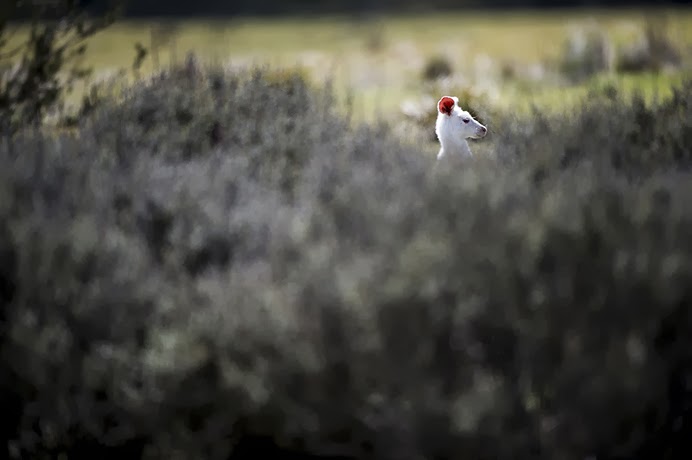
A rare albino kangaroo, its startlingly white coat standing out in sharp contrast to its grey-coloured companions, has been spotted near Canberra.

According to rangers, the animal is an eastern grey kangaroo, probably female and aged around two years old.

The age of the kangaroo has surprised wildlife staff, owing to the heightened dangers faced by the pale-skinned animal.

'It’s very rare, there’s no doubt about that,' Brett McNamara, regional manager of the Australian Capital Territory’s Parks and Conservation Service, told Guardian Australia.

McNamara said the albino was 'very comfortable' within her group, or mob, of fellow kangaroos within the park, which sprawls for 106,000 hectares and covers nearly half of the ACT’s area.


Photograph: Rohan Thomson/The Canberra Times

He added that no albino kangaroos had been seen in the ACT in recent memory, although an albino echidna was found beside a busy Canberra road last year.

Albinism, which is caused by a genetic mutation, is extremely rare in kangaroos, similar to other species. For that reason, McNamara said rangers wouldn’t be disclosing the exact location of the kangaroo.
Source

Photograph: Rohan Thomson/The Canberra Times


Photograph: Rohan Thomson/The Canberra Times


Thursday

For the first time in 15 years an endangered horned creature has been spotted in the wild in the country of Vietnam. The elusive Saola, one of the Earth’s rarest animals, also known as the ‘Asian unicorn’, was photographed in a forest in Vietnam's central Annamite mountains.

The animal which resembles the antelope animal is seen walking through dense foliage at the edge of the camera's range in the image taken in September. It was was photographed by a strategically-placed camera trap hidden in the trees foliage.

Van Ngoc Thinh, WWF's Vietnam director, said in a statement: 'When our team first looked at the photos we couldn't believe our eyes. Saola are the holy grail for South East Asian conservationists so there was a lot of excitement. This is a breathtaking discovery and renews hope for the recovery of the species.’

The Saola was discovered in the remote mountains near Laos in 1992 when a joint team of WWF and Vietnam's forest control agency found a skull with unusual horns in a hunter's home. The discovery proved to be the first large mammal new to science in more than 50 years. Despite the animal's 'unicorn' nickname, it does in fact have two horns.


The Saola, Vu Quang ox or Asian unicorn is a forest-dwelling bovine found only in the Annamite Range of Vietnam and Laos. It is the cousin to the cow, goat, and antelope. The species was defined following a discovery of remains in 1992 in the Vũ Quang Nature Reserve. There are at best, no more than few hundred and maybe only a few dozen of theses that live in the remote, dense forests along Vietnam's border with Laos.

VIDEO

Wednesday

Lexi is a Border Collie-Labrador cross who was adopted from a rescue four years ago. According to her owner, Katerina Jansen, she is part dog, part mountain goat. Her amazing climbing skills can be attributed to Katerina who trained her to balance on almost anything she comes across.

When Lexi was first rescued from the Scottish SPCA in 2009, she was severely underweight and had behavioral issues. But Katerina has since taught her to perform an impressive range of tricks including balancing on everything from basketball hoops to wall fixing.

Although Lexi had a difficult start, she soon found fame online and has many followers on YouTube. Besides mastering her amazing leap from high places, she has also been trained to run across a variety of obstacles such as bales of hay. She can even climb ladders.

Border Collies are known as sheep herding dogs and are bred for their intelligence, energy, obedience and ability to learn a range of commands quickly. Also being part Labrador, who are more laid back than the Border collies but equally as intelligent and responsive to training, it is easy to understand how Lexi picked up her tricks so easily.


Check out her video below to watch her amazing performance. She has come a long way since her days in the shelter. 'She loves to perform and does it all for the love of her owner who not only saved her life but also brought out the best in her.'

VIDEO

Tuesday

Although it has been considered extinct for nearly 80 years, the Tasmanian tiger has been declared to still be alive by a group of British naturalists. 

The team of investigators from the Centre for Fortean Zoology, is currently in Tasmania looking for clues to prove the 'thylacine', commonly known as the Tasmanian tiger, still exists. The Tasmanian tiger resembles a striped elongated dog and was zealously hunted by Europeans due to fears that it would be a threat to sheep herds.

Despite the fact that the last known animal died in the Hobart Zoo on 7 September 1936, the group claims to have gathered compelling evidence of it's presence in the remote parts of Tasmania’s north-west. They claim that it has 'highly credible' witnesses and has found animal feces that could belong to the extinct animal. The droppings have been preserved in alcohol and are being sent away for DNA analysis.

According to Richard Freeman, zoological director of the organization, “The area is so damn remote, there are so many prey species and we have so many reliable witnesses who know the bush that I’d say there is a reasonable population of them left,” he said. “I’d say there are more of them around in the world than Javan rhinos.” The WWF estimates that there are just 35 Javan rhinos left.


“If we get the DNA from them, that’ll be interesting,” said Freeman. “They are far too big for a Tasmanian devil and it can’t be a dog. Why would a dog be so far out there? It’s a very remote area.

“We’ve been baiting and also setting up camera traps. We’ve seen a lot of Tasmanian devils and a feral cat, but nothing else so far. It’s only been up for a week, though, and it can take months. In the UK, we saw deer, otters and even a woman taking a pee on a bush before we saw anything interesting.”


The Tasmanian government states that there is “no conclusive evidence” it lives on, but that doesn't deter Freeman, who plans several return trips to prove mainstream science wrong. “I’ll be coming back again and again,” he said. “The people who say they’ve seen it have nothing to gain and everything to lose. I’d say there is a population of at least 300 of them.”

VIDEO

Monday

The magnificent animal sculptures made entirely from Pipe Cleaners

When one thinks of animals made of pipe cleaners it is usually in stick figure form. But artist Lauren Ryan from California takes it to a completely different level. She makes the pipe cleaner animals in her workshop and has been practicing since she was 12. Lauren uses only pipe cleaners and strictly no glue, as she considers it cheating.

Lauren has managed to make life-like animals using nothing but pipe cleaners, felt-tip pens and a few plastic buttons. Her animals are incredibly detailed with wonderful expressions on them and are very realistic. In fact several of her works are able to move about thanks to special hinges she has woven into their bodies, and the flexible material they are made from.

Lauren has a huge passion for animals, and uses her creativity and her artistic talent to make sculptures of some of her favorite exotic and endangered species. She has woven animals from Okapi, deer-like mammals found in central Africa, to a Thylacine, the world's largest carnivorous marsupial which is thought to be extinct.

Lauren begins by building a basic skeleton from the chenille stems, the technical name for pipe cleaners, before gradually building up the layers by weaving others on top to create the full sized sculptures. She describes her technique, 'Usually the more detail required, the tighter an area becomes. I generally use the most common pipecleaner size, around 6mm wide, 12 inches long, found in most stores. I sort of just smooth them down with my fingers so the wires don't show, and they are tightly woven together.'

When she is finished her creations are very lifelike. Enjoy the photos of some of them below.


For More Photos and Info Please visit: http://chenillestems.blogspot.fr/

Professional musicians from the Orlando Chamber Soloists will mesh with 160 children’s voices — all recorded individually and all singing in Lakota — in the new “We Are South Dakota Virtual Choir 2013” video.

The video, which includes 281 video clips and Native American drumming, was a 15-month collaborative effort with more than 40 community and arts leaders. It will be unveiled at 11 a.m. Monday, Nov. 4, at the Dahl Arts Center, 713 Seventh St., then uploaded onto YouTube. The unveiling will include a demonstration of the video creation process by Dawn Marie Edwards, artistic director and producer for the Orlando Chamber Soloists, and a question-and-answer session.

“It was such a joy working with the kids and getting to know them. There is so much talent here in the Black Hills,” Edwards said in a news release.

The Orlando Chamber Soloists came up with the concept of the video to bring together the children of the four counties in the Black Hills and Pine Ridge who are served by the group during its annual summer residency. The video continues the group’s mission to break down economic and cultural barriers though music, according to the release. The text of the music is “Wahmunka oganunka inchante, He Sapa,” meaning “the heart of everything, Black Hills.”


“The kids had the choice of learning the music ahead of time by downloading the parts from our website or showing up the day of the recording and practicing,” Edwards said. “Some of the kids did show up with their parts memorized ready to record. And they sounded amazing. But most of the kids did not have access to the Internet or a computer and had little or no musical training. So, for the majority, it was a come-as-you-are situation. “
Source

VIDEO
More Information will be found at www.OrlandoChamberSoloists.org

Sunday

Here's an unlikely animal friendship story that is simply timeless. In December 2004, a frightened baby hippo became separated from his family during a devastating tsunami off the Kenyan coast.

 The baby hippo was named Owen after one of his rescuers. He was taken to Haller Park preserve in Mombasa, Kenya, where he met a tortoise named Mzee.

Owen was scared and alone when he first arrived at the preserve and bonded with Mzee and began to follow him around. The 130-year-old tortoise accepted Owen and took on the role of surrogage parent.

Owen and Mzee began to do everything together. They swam, slept and ate together. Mzee took on the role of surrogate parent and best friend.

“It is incredible! A less-than-a-year-old hippo has adopted a male tortoise, about a century old, and the tortoise seems to be very happy with being a ‘mother’," ecologist Paula Kahumbu told AFP. Paula explained that hippos are by nature social animals and like to stay with their mothers for around 4 years.


The pair remained together for several years. Eventually Mzee was moved to another enclosure when Owen grew up. Owen wasn't alone though. A female hippo named Cleo joined him as a companion.


Owen and Mzee's friendship inspired many people around the world. Children's books have been written about the pair to help children who experience loss (see the video below). They also have their very own website dedicated to keeping their story alive.
Source

VIDEO
Owen and Mzee: The True Story of a Remarkable Friendship from UNICEF C4D on Vimeo.

Stats

Archives

Pages