Thursday

Wells Fire Department Captain Jeff Nawfel was able to save this beautiful dog who managed to get out onto his roof and got stuck. Thanks Captain Nawfel.

A Husky was so happy to be saved from a tight spot that he couldn’t hold back kissing the firefighter who helped him.

Authorities in Maine received multiple calls about a dog stuck on the roof of a home. Apparently, the dog had climbed out of an upstairs window but then didn’t know how to get down.

“Wells Fire Department Captain Jeff Nawfel was able to save this beautiful dog who managed to get out onto his roof and got stuck,” the Wells Fire Department wrote.

Video captured of the rescue by shows Jasper more interested in befriending the captain than getting down from his lookout.

Erin Fenderson commented on Facebook, “This is my friend’s dog, his name is Jasper and this is not the first time he has done this… he just loves to be outside, they must have forgot to close the window….thanks for rescuing him!


Eventually, Nawfel convinced Jasper to go back inside. We don’t doubt that he got more kisses from Jasper when back inside.
Source

“I felt something at the back of my head and when I turned around, he ran away,” Vadnais said on Wednesday. “I saw my hair and the elastic on the ground.

A Calgary family is hoping to inspire cultural awareness after a troubling incident involving their 11-year-old son.

Rafe Vadnais is a Grade 6 student at a Calgary middle school. The Indigenous boy said part of his braid was cut off by another student after the dismissal bell rang on Monday afternoon.

It was the very first day Vadnais felt confident enough to go to class wearing the braid.

“I was worried about my braid, that someone wasn’t going to like it, but I went to school anyway,” Vadnais said. “My braid, I have a feeling it’s giving me strength, and I feel good about it.”

Vadnais’ mother, Shantel Tallow, said she and her son bonded over the braiding experience and felt this was a symbol of her son’s culture, reflecting wisdom and his identity.


Tallow said she was enraged when she discovered someone had cut off a part of his braid.

“For someone to do that, they must have had their eye on him,” Tallow added. “I thought about hunting the child down and scolding him and getting his parents involved, but what am I going to do with just one family?”

She doesn’t want to blame the school or the student, but said she would rather engage in a wider conversation about acceptance and celebration of diversity.


“We shouldn’t have to explain our culture, we all have culture. We’re not just skin tones. We are someone with a heart and a mind,” Tallow said.

A spokesperson with the Calgary Board of Education (CBE) said the school in question is aware of the incident and is responding appropriately.


“We are unable to offer comment on incidents involving specific students, however, the CBE believes in creating inclusive learning environments where all students feel included, safe, valued and supported in their learning,” reads a statement sent to Global News by CBE spokesperson Megan Geyer. “Honouring the diversity of students and communities is very important to us, and so we are disappointed when a situation occurs that results in a student feeling unsafe or unvalued.


“Every situation is different and requires an appropriate response. Schools work to support the students impacted, educate the school community and ensure that those responsible are held to account.”

Vadnais said he will continue to grow out his hair and continue wearing his braid.
Source

Tuesday

With spring in full bloom May's Full Moon is commonly known as the Full Flower or Big Leaf Moon. The Arapaho Indians referred to this Full Moon as "when the ponies shed their shaggy hair"

Some Algonquin-speaking nations named it the Corn Planting Moon or Milk Moon (though the milk in this case would likely have been referring to milkweed, not cows, which are not native to the Americas).

The Ontario Native Literacy Coalition notes that while the Ojibwe tribes of the Great Lakes area called the May full moon a Flower Moon ("Waawaaskone Giizis"), people of the Cree Nation in northern Montana and parts of Canada named it the Frog Moon because this was the time of year frogs became active.

According to some Native tribes, the full flower moon means increasing fertility, as temperatures become warm enough for animals to bear young.

For this reason, it’s sometimes called Mother’s moon. It also signals the near end of late frosts.

One interesting characteristic Northern Hemisphere observers may notice about the full moon is that it will be in the sky for a shorter period than the sun. This is because the full moon, being opposite from the sun as it peaks, occurs in the part of the sky that is below Earth's celestial equator, so it traverses a shorter path from horizon to horizon as it rises and sets.


May's full moon actually peaked earlier today, at 10:20 a.m. EDT (1420 GMT), but the moon can still appear full to casual observers at least one day ahead of and after the actual event.


Observers also have a chance to see the brilliant planet Venus, which shines brightly in the western sky as the moon rises in the east. Jupiter is also visible in the constellation Libra this evening.


May Moon Names: Frog Moon (Cree). Ponies shed (Sioux). Bright moon (Celtic). Waiting Moon (Hopi). Mulberry Moon (Greek). Ninth Moon (Wishram). Idle Moon (Assiniboine). Big Leaf Moon (Mohawk). Panther Moon (Choctaw). Grass Moon (Neo-Pagan). Planting Moon (Cherokee). Corn Planting Moon (Taos). Little Corn Moon (Natchez). Green Leaf Moon (Apache). Corn Weed Moon(Agonquin). Field Maker Moon (Abernaki). Blossom Moon (Anishnaabe). Shaggy Hair Moon (Arapaho). Green Leaves Moon (Dakota). Fat Horses Moon (Cheyenne). Leaf Tender Moon (San Juan). Hare Moon (Medieval English). Milk Moon (Colonial American). Strawberry Moon (Potawatomi). Hoeing Corn Moon (Winnebago). Alewive Moon (Passamaquoddy). Ninth Moon (Dark Janic), Mothers Moon (Full Janic). Flower Moon, Corn Plant Moon, Milk Moon (Algonquin). Other Moon names : Frogs Return Moon, Sproutkale Moon, Dyad Moon, Merry Moon, Joy Moon

VIDEO

Sunday

Claudia Patricia Gomez Gonzalez traveled 1,500 miles to the United States, hoping to find a job and a better future. Shortly after she set foot in Texas, a Border Patrol agent shot and killed her.

Gomez Gonzalez's shooting Wednesday drew international attention after a bystander posted video of the aftermath on Facebook Live, showing her lying on the ground, bleeding. Authorities changed their account of the incident, adding to the controversy at a time when the White House has cracked down on illegal immigration.

The deadly encounter ended the journey Gomez Gonzalez started nearly three weeks ago in an indigenous community in San Juan Ostuncalco, Guatemala.

Gomez Gonzalez earned a degree in accounting two years ago, but had not been able to find a job. "She looked, looked and nothing," her father, Gilberto Gomez, said. "I believe that's the reason why she decided to pursue the 'American dream'."

The lack of job opportunities frustrated her, and she decided to leave her home and head to the US to find work. She was following the footsteps of her boyfriend, who made the same journey about a year before.

The 20-year-old had been traveling for over two weeks with other migrants when they were met by a Border Patrol agent in a residential area in the town of Rio Bravo, Texas.


The agent -- a 15-year veteran -- fired one round from his service-issued firearm, fatally wounding Gomez Gonzalez, the United States Customs and Border Protection said. The agent, who has not been identified, remains on administrative leave.

In between sobs, her mother, Lidia Gonzalez Vasquez , said she only wants her daughter's body back. "My girl did not go there to steal, my girl left to move forward and go to school," she said. Her family held a news conference in Guatemala on Friday and asked for justice.

"It's not the first time someone dies in that country (United States)," her aunt, Dominga Vicente, told reporters. "There are many people who have been treated like animals and that isn't what we should do as people."
Source

Saturday

The animal’s front paw appeared too short, the front claws too long, the canine teeth too short, and ears too tall in proportion to the skull to be a purebred wolf, experts said.

US wildlife experts are baffled by a "wolf-like" animal that was killed by a Montana farmer. The rancher near the town of Denton shot the creature last week when it came within several hundred metres of his livestock, said officials.

State wildlife experts said they have been unable to pinpoint its species.

After inspecting the creature, they said they doubt it's a wolf as its teeth were too short, front paws abnormally small and claws too large.

Bizarre theories have circulated online that it could be a werewolf, a young grizzly bear or a relative of Bigfoot.

In a news release, the Montana Department of Fish, Wildlife, and Parks (FWP) said it was a "young, non-lactating female and a canid, a member of the dog family that includes dogs, foxes, coyotes and wolves".


"We have no idea what this was until we get a DNA report back," a spokesman for the agency, Bruce Auchly, told the Great Falls Tribune.

He added that it may be up to a week before results come in, which should help identify the cryptid. "Several things grabbed my attention when I saw the pictures," Ty Smucker, wolf management specialist for Montana FWP, told the newspaper.


"The ears are too big. The legs look a little short. The feet look a little small, and the coat looks weird.


"There's just something off about it."

Friday

President Donald Trump said at a Naval Academy commencement address Friday that “our ancestors tamed a continent,” adding that “we are not going to apologize for America.”

 "Together there is nothing Americans can't do, absolutely nothing," Trump told 2018 graduates of the U.S. Naval Academy. “In recent years, and even decades, too many people have forgotten that truth. They've forgotten that our ancestors trounced an empire, tamed a continent, and triumphed over the worst evils in history."

He added: "America is the greatest fighting force for peace, justice and freedom in the history of the world. We have become a lot stronger lately. We are not going to apologize for America. We are going to stand up for America."

Before Europeans arrived in what became the United States, Native Americans occupied the land but were forced to relinquish territory as the new Americans pushed westward as part of what was termed “manifest destiny.” In 1830, President Andrew Jackson signed the Indian Removal Act, which led to the deaths of thousands of Native Americans.

Trump previously caused controversy when he held an event honoring Native Americans in the Oval Office last November with a portrait of Jackson in the background. Trump has regularly praised Jackson, although at times with a questionable grasp of history. He has also repeatedly referred to Democratic Senator Elizabeth Warren, who has claimed Native American heritage," as "Pocahontas."

"A nation must have pride in its history to have confidence in its future," Trump said Friday. The president's comments mirrored a tweet he sent out in March celebrating National Agriculture Day.


"Our Nation was founded by farmers," he wrote. "Our independence was won by farmers. And our continent was tamed by farmers. Our farmers always lead the way -- we are PROUD of them, and we are DELIVERING for them! #NationalAgricultureDay


Trump added Friday it was a great time for the graduates to be joining the Navy. "We are witnessing the great reawakening of the American spirit and of American might," he said. "We have rediscovered our identity, regained our stride and we're proud again."
Source

Wednesday

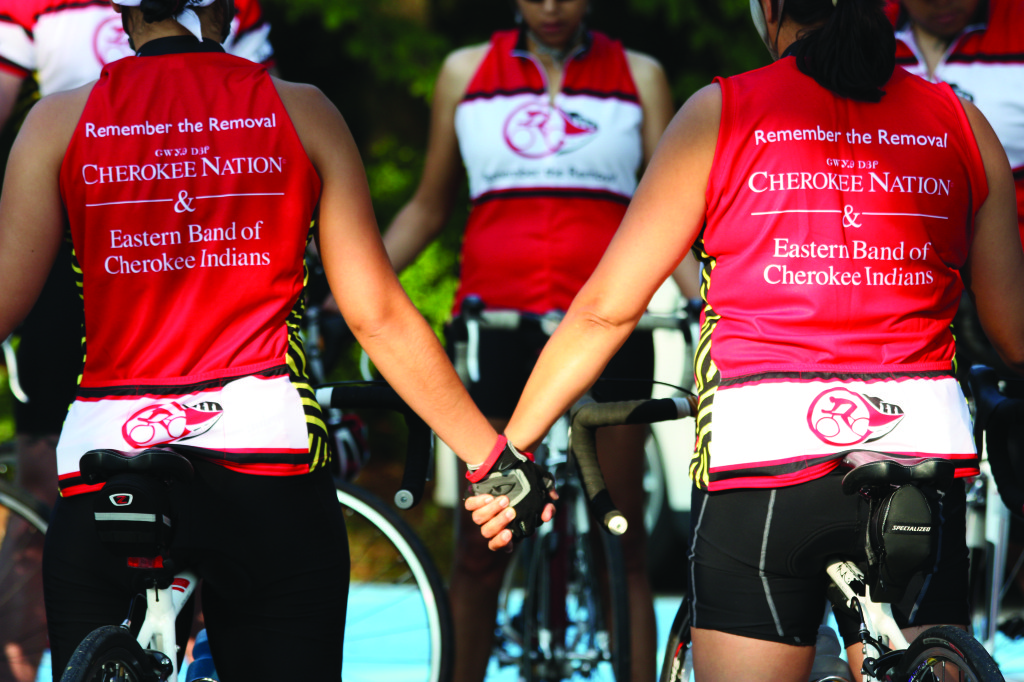
This is the ninth consecutive year Cherokee Nation members have participated in the ride. (The tribe founded the event back in 1984, and revived it in 2009.) The Eastern Band joined their western counterparts in 2011.

Since then, it has become an integral part of historical, cultural, and physical education for the Cherokee people.

“When you experience adversity as a young person, you learn what you’re capable of,” Eastern Band Chief Richard Sneed, himself an alumnus of the ride, told Bicycling. “Everyone has a transformative moment out there.”

Like Wildcat, many participants come into the ride with little to no cycling experience. After applying to make the team, each rider follows a six-month training program with both physical and educational components. “I grew up around the language and history, but the lessons have made it all the more real to me,” Wildcat said. “It’s at the core of what we do.”

The route follows the northern removal path—one of several making up the Trail of Tears, which affected at least five different tribes. It stops at important historical landmarks, such as Mantle Rock and Blythe Ferry, as well as the gravesites of those who died on the march.

“We bring in a genealogist so the riders can find a real, personal connection along the way,” said Sheena Kanott Lambert, program director of the public health initiative Cherokee Choices and a participant in the 2011 ride. “It’s one thing to read a book about our history, and another to experience it in person.”


Team members wear matching kits, provided by the tribes, that sport meaningful designs. They might show the faded signatures, for instance, of the Cherokee National Council that originally signed a petition in protest of the removal. The jerseys are red, black, yellow, and white—traditional Cherokee colors often found in mound artifacts. One copper-colored side panel features seven stars to represent the seven removed clans. Another panel shows only a single star, to represent those lost along the trail.


The ride in 1984 looked much different than it does today. Cyclists back then primarily supported themselves—toting gear, handling mechanicals, and cooking all on their own. “Today we have a marshal with flashing lights to stop traffic for us,” Sneed said. “It’s nice to have a cool hotel room at the end of the day. That original team had it much harder than we do.”

Despite the creature comforts, riders today face tough physical challenges that help bring perspective to the Trail of Tears experience. “I try to fathom what it was like for our ancestors,” Lambert said. “The beauty of it is that they persevered. It’s truly humbling.”


Daily rides vary in distance from 35-70 miles. Organizers built rest days into the schedule and have two support vans with trailers following along. On some days the team will camp, but riders will more often stay in hotels. All told, the ride generally takes about three weeks.

As the 20 or so cyclists make their way into Tahlequah on their final day, emotions run high and tears flow freely. “When we return to our community, it’s with confidence, and many alumni go on to become leaders,” Lambert said. “It’s hard to explain, but we are all more willing to strive for cultural preservation and to volunteer our time with the project in years to come. It’s life-changing.”
 Source

Canadian politician to speak Mohawk in the Canadian House of Parliament, made a surprise visit to Levi Oakes to honor him with a medal

Last week, Canadian Politician and Quebec Liberal MP Marc Miller, the first Canadian politician to speak Mohawk in the Canadian House of Parliament, stopped at the home of the last living Mohawk code talker Levi Oakes to present him with a medal to honor his service as a code talker. He also read Oakes a letter of thanks in the Mohawk language.

Miller was traveling to speak with tribal representatives about cannabis and wished to pay Oakes the visit. Miller is from the Montreal community and works in the House of Commons serving Montreal and the surrounding areas.

When at the home of Oakes, Miller presented the code talker with a symbolic medal to recognize his efforts. Miller also read a letter in the Mohawk language.

The only press on scene was Kaniehtonkie from the Indian Times, who wrote an article describing the meeting between Miller and Oakes, described the moment Miller read the letter as special. It “made Levi’s eyes light up, showing he understood every word Miller said.”

Miller told the Indian Times: “It was a personal honor to meet Levi Oakes. The role of the Code Talkers in WWII has long been an interest of mine and I wanted the Government of Canada to recognize Mr. Oakes. The spirit and success of the Code Talkers was hidden for so long.”


“Even before entering politics I have always been fascinated with languages, learning Swedish as an adult, but there is such richness to Mohawk and it is very difficult to learn,” he said.

During the meeting, Oakes surprised everyone in the room and revealed he had recently received an official letter from the U. S. Department of Defense stating he was free to share what actually happened in WWII.


“Before that, no one, including his family, had any idea the role he had during the war,” said the Indian Times.

When Miller finished reading his letter, Oakes responded in Mohawk with Tsi nika’shátste, meaning “It is so strong,” a reference to the strength of the Mohawk language.
Source

VIDEO

Tuesday

Nature was on grand display on Washington's San Juan Island this month — and photographer Kevin Ebi was there to document it.

He describes the scene as a 'dramatic act of thievery' when a bald eagle tried stealing a rabbit from a young red fox at San Juan Island National Historical Park. This battle went airborne - more than 20 feet at times - and the tussle was photographed from start to finish.

Ebi says the red fox isn't native to San Juan Island, but introduced by settlers in the 1900s. He also notes that rabbits aren't the main prey of the fox, which typically prefer berries, insects and voles. But on this day, a young fox and rabbit found themselves on the sharp talon-end of a hunting eagle.

The scene began when the fox snatched a rabbit in a meadow and that's when Ebi noticed an eagle closing in on the rabbit. He writes, "To my surprise, the scene was even more dramatic than I expected. I thought the fox would drop the rabbit, giving the eagle an easy dinner."

But the eagle had both animals in its clutches and the three animals took flight in a continuous struggle. Ebi says the kit put up a noble fight and the eagle let go with one talon, sending the fox falling back to Earth.

Ebi says, "The whole battle was over in less than 8 seconds."


The young fox scampered off and Ebi says his photos didn't show a single scratch. But the amazing encounter doesn't end there. After KING 5 shared Ebi's photos, viewer Zachary Hartje posted video footage of the exact scene.
Source


VIDEO

In many ways, this unique pageant's definition of what American beauty truly entails is the ideological antithesis to Miss America.

Here are six more reasons why Miss Indian World is a far more badass alternative to the typical American event:

1. It's NOT a "beauty pageant." "It's not a beauty pageant and it never has been," contest coordinator Melodie Matthews told Native Peoples magazine.

And she's right: The currency rewarded at Miss Indian World is not looks, but "cultural knowledge" — a quality determined by a panel of 25 judges through a personal interview, public speaking assessment, essay submission and dance competition.

While the actual judging process is relatively opaque, the message behind the standards remains abundantly clear: Leave your spray-tan at home, it won't save you here.

2. It takes place at the world's biggest powwow. Miss Indian World isn't even the biggest cultural event taking place in Albuquerque that weekend in April.


The Gathering of Nations Powwow (GON) — the largest such gathering of indigenous people in the world, according to Al Jazeera — is the celebratory backdrop against which the pageant is set.

Al Jazeera reports that GON draws an estimated 112,000 people to the area, resulting in a regional economic impact of up to $21 million and making it a fixture of New Mexico life for the past 31 years. Not to mention, the images it produces are stunning.

3. Every winner is a woman of color. It wasn't until 1941 that the first Native American contestant (Miss Oklahoma) competed, and then it was 30 years more before the second one. The first black Miss America wasn't crowned until 1984.


Miss Indian World, on the other hand, can be read as a full-on celebration of women of color.

4. There's no b*kini contest. You won't see Miss Indian World parading around in a b*kini, or evening wear for that matter — the contest's overwhelming emphasis on "cultural knowledge" leaves little room for that.

What you will see is the maintenance of what Al Jazeera calls a space for Native women to combat "stereotypical notions of the 'Indian maiden' or the disappearing Indian." Simply put, the "beach body" is not a factor here.


5. When the apocalypse comes, you want these women on your team. One of this year's runners-up, 23-year-old Megan Leary of Napaimute, Alaska, demonstrated she is ready for pretty much anything. She drives a snowmobile, fixes boat engines and carries a .243 Winchester rifle when hunting moose, Al Jazeera reports.

Other contestants demonstrate their proficiency with bows and arrows during the talent portion of the competition. No plastic cups here.

6. It helps preserve and promote a culture too often overlooked by its neighbors. Megan Young, who won the contest in 2007, told Native Peoples she saw the victory as an opportunity to raise awareness about her nation: "At the time, she felt there weren't a lot of people who knew there was a federally recognized tribe in Alabama," the report reads. (Young hails from the Porch Band of Creek Indians.)


Opportunities to celebrate individual indigenous groups on a large scale are rare — especially in a country that's historically been committed to eradicating Native cultures. Not to mention, it's a chance to combat negative stereotypes: "It's empowering for people to understand and break away from that ignorance," Young told Native Peoples.

The qualities rewarded at the Miss Indian World pageant, however, last a lifetime. These are the attributes we should really be celebrating.
Source

Thursday

Paulette Jordan won Tuesday night’s primary in the Idaho governor’s race, setting her up for a tough November election but with a shot at becoming the nation’s first Native American governor.

Jordan, a two-term state legislator, defeated multimillionaire and Boise school board member A.J. Balukoff. With 96 percent of precincts in, Jordan won more than 58 percent of the vote to Balukoff’s 40 percent.

She prevailed despite being significantly outspent and up against her party’s establishment.

Jordan will now face Lt. Gov. Brad Little in November. He won Tuesday night’s GOP primary with 37 percent of the vote. He defeated U.S. Rep. Raúl Labrador and real estate developer Tommy Ahlquist.

It is a long-shot bid for Jordan, 38. She’s running as a pro-LGBTQ rights, pro-marijuana legalization, pro-Medicaid expansion Democrat in a deeply red state. The last time Idaho elected a Democratic governor was in 1990.

Little, 64, has been lieutenant governor since 2009 and is the heir apparent to current Gov. Butch Otter (R), who decided not to run for another term. He is anti-abortion, opposes same-sex marriage and is not a fan of expanding Medicaid, though he said he would not repeal a Medicaid expansion initiative on the November ballot if it is passed by voters.


Jordan does have some advantages, namely that her candidacy is just plain exciting. She is a young woman of color running for a seat that a woman has never held in Idaho. An enrolled member of the Coeur d’Alene tribe, she would make history as the country’s first Native American governor. And her campaign comes at a time when Democrats are energized and flooding the polls nationwide in response to Donald Trump’s presidency.


Democratic turnout was off the charts in Tuesday’s elections. Precincts in and around Boise, a major hub of Democratic voters, actually ran out of ballots at one point. Statewide, Democratic turnout was more than double what it had been in the 2014 primary. That year, about 25,000 Democrats voted for a gubernatorial candidate. This time, more than 65,000 did.

Republican turnout was up in Idaho too, but not by as much as Democratic turnout. More than 155,000 Republicans voted for a gubernatorial candidate in 2014. This year, more than 191,000 did.


Jordan, who has deep roots in Idaho’s ranching culture, has some appeal among independents. A March poll by Idaho Politics Weekly found that 19 percent of independents said they liked Jordan best. That’s compared to 13 percent of independents saying they preferred Ahlquist and 12 percent saying they liked Labrador. Nine percent of independents said they preferred Little.


The same poll showed no clear front-runner in the general election. Among all voters, Jordan polled at 15 percent. Labrador and Ahlquist polled at 16 and 15 percent, respectively. Little polled at 11 percent.
Source

Tuesday

Adorable little raccoon Yasha from the Russian city of Rostov-on-Don does not spend all his time washing stuff - he prefers social work.

His main task is to calm down canine patients before their visit to the vet, and he is definitely great at it!

His owner, veterinarian Alexei Krotov, who noticed how good Yasha was in communicating with dogs, surely values his little buddy's help. However, this fluffy employee is not over popular with the feline visitors to the clinic.

Doctors sometimes need an assistant who can help them do their work in the most efficient way. Turns out, Aleksei Krotov, a veterinarian from Rostov-on-Don, Russia, has one of the best. And yes, it’s a raccoon.

Taking care of a raccoon has always been Krotov’s dream, so after he became a vet he decided to get one. This is how Yasha came into his life – Aleksei and his wife bought him from horrible conditions where he was living in Krasnodar district, and took him home.

At first he lived with them, but later the family decided to move him to Aleksei’s clinic. This is when the doctor noticed his amazing ability to calm stressed and sick dogs that come for treatment.


For this Yasha became a local celebrity and sometimes people come just to visit this adorable raccoon. Cats don’t really like Yasha, but he is amazing with dogs – and they’re really lucky to have such a fluffy doctor.


Wednesday

The Hollywood Reporter is reporting Alaska Native actor Martin Sensmeier will play legendary Jim Thorpe in a new movie that will be produced by Angelina Jolie.

The new movie is called “Bright Path: The Jim Thorpe Story.”

Sensmeier, 32, was previously in “Wind River,” “The Magnificent Seven” and “Westworld.” Sensmeier (Athabaskan-Tlingit) is an ambassador for the Boys & Girls Club of America, based in Atlanta, Georgia.

Thorpe (Sac and Fox/Potawatomi) won two Olympic gold medals in the decathlon and the pentathlon in 1912. Thorpe went on to play Major League Baseball, professional football and eventually founded the organization that became the NFL. He has been dubbed the “greatest athlete who ever lived”

The filmmakers of “Bright Path: The Jim Thorpe Story” have teamed with several tribes, including the Tuolumne Band of Mewuk Indians, the Mohegan Tribe, the Yocha Dehe Wintun Nation, the Tonto Apache Tribe and the Bear River Band of the Rohnerville Rancheria.

The involvement of the tribes from Indian Country includes financing and accuracy in the story.


“As Native Americans it is crucial that we tell our own stories. Thorpe’s is a vital one, and Bright Path will break barriers. For the first time, a major motion picture about a Native man, starring a Native man, will be made and released to a broad general audience. We couldn’t be prouder to be a part of it,” says Mohegan chairman Kevin Brown (“Red Eagle”).

Thorpe’s story was told in 1951’s “Jim Thorpe: All American,” which starred Burt Lancaster.
 Source

Tuesday

“We are humbled by and grateful for this honorable act. Pilamayaye to the donor for your respect and generosity,” said Buck in a statement released by the tribe.

 A sacred pipe sold at a Boston auction on Saturday for nearly $40,000 is being returned to Minnesota by the individual purchased it. On Monday afternoon, Prairie Island Tribal Council President Shelley Buck said that after the auction, her tribe learned that the buyer had purchased the pipe “for the sole purpose of returning it to the Dakota Oyate (people).”

Skinner’s website described the historic item as follows:

Fine Plains Catlinite Stem and Bowl, mid-19th century, catlinite pipe with lead inlay, both on the bowl and the stem, intricate pattern on stem with thunderbird at the mouthpiece, birds, small animals, and arrows with abstract designs taking up half the top space, small morning stars along the rest of the edges, an old paper label reads: “Indian pipe, Made by a Sioux Chief “White Dog”, who was hung at Mankato Minnesota in 1862 – It was presented as a peace offering to Lieut King by the chief while a prisoner in his…,” lg. of stem 17 3/4, lg. of bowl 8 in.

Provenance: A private Boston collection, has been in the same family since the 1880s.

Last week, Native News Online reported the Lower Sioux Indian Community was attempting to stop the sale of the pipe. The estimated price for the pipe was listed between $15,000 and $20,000.


However, on Saturday, Skinner, Inc. said the pipe was sold for $39,975, nearly twice its estimated value. The buyer has chosen to remain anonymous.
Source


A clever dog has figured out a way to pay for treats that has the hearts of dog lovers melting into a puddle.

Negro is a dog in Colombia who lives on the campus of Diversified Technical Education Institute of Monterrey Casanare.

For the past five years, faculty make sure that Negro is fed and a place to sleep at night. But that hasn’t stopped this dog from coming up with his own special way to get treats that’s actually quite ingenious and almost human.

Negro discovered a store on campus that sells cookies and one day noticed that students were handing over pieces of green paper (money) in exchange for the tasty treats. So the clever dog found his own green pieces – leaves – which he promptly brought over to the stand to pay for his own cookie.

“He would go to the store and watch the children give money and receive something in exchange,” teacher Angela Garcia Bernal told The Dodo. “Then one day, spontaneous, he appeared with a leaf in his mouth, wagging his tail and letting it be known that he wanted a cookie.”

How could the shop keeper refuse? That’s all the reinforcement Negro needed and now he comes by every day, leaf in mouth.


“He comes for cookies every day,”store employee Gladys Barreto said. “He always pays with a leaf. It is his daily purchase.”

Now that’s one smart pup!
Source


Stats

Archives

Pages