Wednesday

A homeless man risked his life to save several cats and dogs trapped at an Atlanta animal shelter after it caught fire, the facility's founder said.

Keith Walker, 53, rushed into the W-Underdogs shelter on December 18 after a fire engulfed its kitchen.

"I was nervous as hell, I'm not going to lie. I was really scared to go in there with all that smoke. But God put me there to save those animals," Walker told CNN. "If you love a dog, you can love anyone in the world. My dog is my best friend, and I wouldn't be here without him, so I knew I had to save all those other dogs."

While the shelter was not completely destroyed, the fire left it uninhabitable, according to W-Underdogs founder Gracie Hamlin. Luckily, W-Underdogs was only a week away from moving into its new facility in Atlanta, where the animals now reside.

"He is my guardian angel," Hamlin told CNN. "Even the firefighters didn't want to handle the dogs. They called animal control, but Keith was already in the building pulling out the cats and dogs until they were all safe."

Hamlin previously knew Walker, who has been homeless since he was 13 years old, because she lets him keep his dog, a pitbull named Bravo, at the shelter every night.

Walker was on his way to pick up Bravo and take him for a walk when he saw the fire. He was able to rescue all the animals -- six dogs and 10 cats.

"I can't thank him enough for saving my animals," Hamlin said. "I'm still in disbelief, because I've been around a fire and I know how fast they flare up. He is my hero."

Source


VIDEO


Monday

A doe was stranded in the middle of a frozen pond, unable to stand. A man decided to help the doe by giving her a little push to the shore! With the event happening just ahead of Christmas, many joked it’s one of Santa’s deer and was rescued just in time to deliver gifts.

In a video widely being shared online, the animal is seen being pushed by the man along the wide stretch of the icy pond, while it remained calm. Gliding safely towards the end of the frozen water body, the man undertook the daring rescue as his friend recorded the efforts on camera.

While the doe seemed relaxed, it sprinted away as soon as it reached the edge.

According to a Facebook post, the kindhearted man was identified as Gil Lancour of Cranmoor from Wisconsin, USA. While driving near the Cranmoor marshes, during his drive home on his lunch break on Tuesday afternoon, he spotted the animal in distress, News 9 reported.

Explaining why the animal appeared visibly calm, Lancour said that he walked out onto the ice and sat with her for a bit before pushing her off the ice, as he wanted to help the deer.

“She was struggling and I knew she needed help to get off the ice, I didn’t even think twice about it,” the man told NBC 15. “She needed to get off the ice and I was the only one around to help her,” he added.

His friend, John Moss, who filmed the rescue operation told the media outlet that he was out there too to help Lancour but seeing him in control, he decided to record the moment. “Obviously right away I was out there to help him but after he had it under control, then I was there for the show,” Moss said.

The man who is being hailed as a ‘hero’ on social media sites said that as he drives by the reservoir every day, he knew it would be strong enough to hold him and about 90 pound deer.

Source

People on Twitter lauded his efforts and thanked him for his kind gesture.

VIDEO


As the full Moon closest to the winter solstice, this is the Long Night Moon. The plane of the Moon's orbit around the Earth nearly matches the plane of the Earth's orbit around the Sun.

When the path of the Sun appears lowest in the sky for the year, the path of the full Moon opposite the Sun appears highest in the sky. For the Washington, DC, area, on Tuesday evening, December 29, 2020, moonrise will be at 4:32 PM, sunset will be 23 minutes later at 4:55 PM, the Moon will reach its high point for the night (75.8 degrees above the horizon) just after midnight at 12:15 AM on Wednesday morning, sunrise will be at 7:26 AM, and moonset will be 33 minutes later at 7:59 AM EST.

The Moon will be in the sky for a total of 15 hours 27 minutes, with 14 hours 31 minutes of this when the Sun is down, making Tuesday evening into Wednesday morning, December 29 to 30, 2020, the longest full Moon night of the year.

The Cold Moon will have a distinctively high trajectory across the sky. This results in the moon being visible over the horizon for a longer period of time.

It is also called the ‘Long Night Moon’ as the event occurs on one of the longest nights of the year. This is because the date is fairly near to the winter solstice. As it takes place just after Christmas, the full moon is called the ‘Moon After Yule’ in Europe as well.

According to the Old Farmer’s Almanac, the name Cold Moon has seeped in from some traditions observed by the native Americans. The name refers to the “frigid conditions of this time of year”.

December Full Moon Names From Native American Tribes

Kaitvitjuitk (Inuit). Cold Moon (Celtic). Night Moon (Taos). Respect Moon (Hopi). Bitter Moon (Chinese). Peach Moon (Choctaw). Twelfth Moon (Dakotah). Big Winter Moon (Creek) Real Goose Moon (Kiowa). Cold Time Moon (Mohawk). Ashes Fire Moon (San Juan). Oak Moon (Medieval English). Big BearĂ¢€™s Moon (Winnebago). Long Night Moon (Neo-Pagan). Popping Trees Moon (Arapaho). Running Wolves Moon (Cheyenne). Frost Fish Moon (Passamaquoddy). Cold Moon, Long Nights Moon (Algonquin). Snow Moon, Before Yule Moon (Cherokee). Oak Moon : Full, : Snow Moon Dark (Janic). Popping Tress Moon, Deer Horn Shedding Moon (Sioux).

Other moon names : Wolf Moon, Turning Moon, Heavy Snow Moon, Aerra Geola, Under Burn Moon, Big Winter Moon, Winter Maker Moon, Yellow Leaves Moon, Little Finger Moon, Mid-Winter Moon, Wintermonat, Small Spirits Moon.

VIDEO

Tuesday

A baby elephant struck by a motorbike while crossing a road in Thailand survived after it was revived by an off-duty rescue worker.

Mana Srivate told Reuters news agency he had performed dozens of resuscitation attempts in his career - but never before on an elephant.

In a video that went viral online he is seen giving two-handed compressions to the elephant lying on its side in the middle of a dark road.

The elephant stood up after 10 minutes.

It had been trying to cross a road with a group of wild pachyderms in the eastern Thai province of Chanthaburi.

In the video, Mr Mana's colleagues are also seen treating the motorcycle rider, who survived the crash without serious injuries. Mr Mana, who has been a rescue worker for 26 years, told Reuters he came across the accident scene late on Sunday while he was off duty on a road trip.

"It's my instinct to save lives, but I was worried the whole time because I can hear the mother and other elephants calling for the baby," Mr Mana told the agency by phone.

"I assumed where an elephant heart would be located based on human theory and a video clip I saw online.

"When the baby elephant starting to move, I almost cried," he said.

The baby elephant stood up after about 10 minutes and was taken to another site for treatment, reported Reuters, before it was returned to the accident site in the hope of finding its mother. It has escaped serious injuries too.

The other elephants returned when the mother heard her baby calling out, Mr Mana told the agency. He added that the elephant was the only victim he had ever managed to revive through cardiopulmonary resuscitation.

Source

VIDEO

Sunday

The McCormicks went for a silver, pink and blue theme on their Christmas tree. The old plastic leaves were worn but looked beautiful with baubles on each branch and twinkling lights.

But this year the family tree included one very unexpected ornament: a wild – and somewhat confused – juvenile koala. On Wednesday, 16-year-old Taylah was the last to leave the family home in Coromandel Valley, Adelaide around 3pm.

She made sure the dog was outside, closed the back doors and turned off all the lights. When the whole family arrived back around 6pm, something was odd.

“I think the dog went straight to the Christmas tree and was sniffing around and Mum thought that was a bit weird,” Taylah said. “There was baubles all over the floor … and she looked up and there was a koala in the tree. “It was pretty tangled up in the lights. It was a fake tree and very old but she still tried eating the leaves off it … I saw her munch down on some but she stopped when she realised it was plastic.”

Taylah’s mother, Amanda McCormick, said she was in shock.

“I thought ‘Is this a joke?’ I thought one of my kids may have put like a soft toy in there, but no, it was a live one,” she said.

Source 1300Koalaz

“We’ve had them in our trees before but not inside on our Christmas tree … It must have crawled in when the doors were open, it would have been in our house for at least three hours.”

The family immediately called the Adelaide and Hills Koala Rescue, but co-founder Dee Hearne-Hellon said the group didn’t believe the story at first.

“The call went through to our 24-hour hotlines and of course the operator at first thought it was a prank call,” Hearne-Hellon said.

Source 1300Koalaz

“Apparently it took a little bit of convincing that, no … Amanda really did have a koala in her Christmas tree … It was just so gorgeous, seeing it sitting there just looking.”

The rescue team quickly arrived to detangle the koala, which Taylah had dubbed Daphne. Hearne-Hellon said Daphne was a juvenile female around three or four years old and in good health.

Source

VIDEO

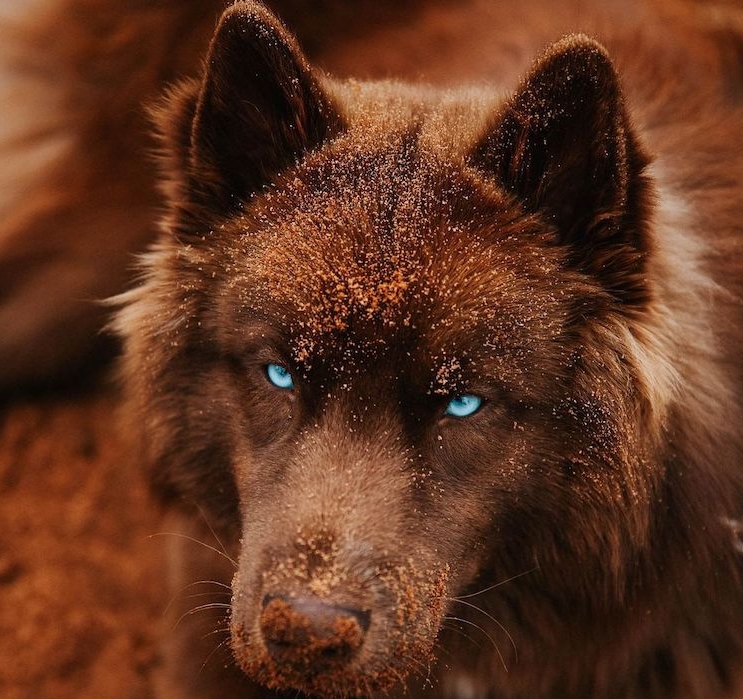
Meet SeQuoi Tenk (or Quoi for short), the incredibly beautiful, chocolate-brown Siberian Husky. He could be mistaken for a wild wolf—with his piercing blue eyes and unusual coloring—but he’s 100% Siberian Husky. His wolf-like appearance suits his nomadic lifestyle, though.

He’s currently traveling around the lower 48 of the United States with his mom, Nikki, as they search for a new home. Nikki documents their adventures on Instagram, where Quoi is captured exploring the stunning wilderness of the U.S. Unsurprisingly, he’s amassed more than 22,000 followers in just eight months.

SeQuoi Tenk might seem like an unusual name, but there is meaning behind it. “His first name SeQuoi, is after a sequoia tree,” Nikki tells My Modern Met. “They say a name can really shape a personality, and I wanted him to be big, tall, and strong like a sequoia tree is.” She continues, “Tenko is Japanese for ‘heavenly fox,’ and as much as I wanted him to be strong, I also wanted him to be sweet, which he totally is!”

Quoi is almost entirely brown, apart from an adorable white spot on his chest. All-brown huskies are extremely rare, so it’s no surprise that Quoi attracts plenty of attention.

“Everywhere we go, people stop in their tracks wanting to pet him,” reveals Nikki. “I get asked at least three–five times by strangers ‘what is he?’ and when I say ‘Siberian Husky,’ no one ever believes me, but he is AKC certified and is 100% Siberian Husky.”

Nikki originally wanted to adopt an older dog, but because she doesn’t currently have a permanent home, she struggled to get approved by the animal sanctuary she was in contact with.

PHOTOS SOURCE
“The puppy route was my only choice to get a dog,” she explains. “While he wasn’t the dog I was searching for, he was exactly the dog I needed. Full of attitude and goofiness.”

Source


Friday

In a dramatic footage, which has now gone viral on several social media platforms, 74-year-old Richard Wilbanks can be seen jumping into his backyard pond to save his three-month-old Cavalier King Charles spaniel from the alligator.

In Florida, alligators are a common sight and are often spotted wandering around in people’s backyards, swimming pools and golf courses. Recently, a man had his heart in his mouth when he found his pet dog in the grasp of an alligator. With no one around to help, the 74-year-old decided to take matters in his own hands.

In the dramatic footage, which has now gone viral on several social media platforms, Richard Wilbanks can be seen jumping into his backyard pond to save his three-month-old Cavalier King Charles spaniel from the alligator.

“We were just out walking by the pond,” Wilbanks told CNN, “and it came out of the water like a missile. I never thought an alligator could be that fast. It was so quick.”

The septuagenarian managed to rescue the puppy “Gunner” from its jaws. Narrating the dramatic incident, Wilbanks said while holding the alligator was not so tough, prying open its jaws were “extremely hard.”

Gunner had a wound in his belly but is fine after a trip to the veterinarian. Wilbanks told the website that his hands were “chewed up” and he had to get a tetanus shot from the doctor.

The couple took Gunner to the animal hospital. Amazingly, the little guy was doing just fine. They found a puncture wound but X-rays revealed no internal damage aside from having a little water in his lungs. They kept him a few days in the hospital to recover.

He has as much energy and zest for life as he ever did. One change, however, is that Richard picked him up a new leash for their walks.

“A new leash on life,” Richard quipped.

Richard’s daring rescue of Gunner was only captured on video due to cameras that had been put up in the area by the Florida Wildlife Federation and the fstop Foundation. The organizations use the video recorded by the cameras to track wildlife in the area.

Source

VIDEO


Thursday

Climate action advocates and wildlife defenders celebrated Monday after the U.S. Court of Appeals for the 9th Circuit rejected the U.S. government's approval of Liberty, a proposed offshore oil-drilling project in federal Arctic waters that opponents warned would endanger local communities, animals, and the environment.

"This is a huge victory for polar bears and our climate," declared Kristen Monsell, oceans legal director at the Center for Biological Diversity, in a statement. "This project was a disaster waiting to happen that should never have been approved. I'm thrilled the court saw through the Trump administration's attempt to push this project through without carefully studying its risks."

Marcie Keever, legal director at Friends of the Earth, similarly applauded the ruling, saying that "thankfully, the court put the health of our children and our planet over oil company profits."

Both groups joined with fellow advocacy organizations Defenders of Wildlife, Greenpeace, and Pacific Environment for a lawsuit challenging the Hilcorp Alaska project, which was approved in 2018. The energy company planned to construct an artificial island, wells, and a pipeline along the Alaska coast in the Beaufort Sea.

Jeremy Lieb, an attorney at the nonprofit law organization Earthjustice, which represented the advocacy groups, praised the court for rejecting the administration's "inaccurate and misleading analysis of this project's impact to the climate." The court determined that the administration hadn't properly considered Liberty's climate impacts as required by the National Environmental Policy Act, specifically taking issue with an economic model claiming the project would benefit the climate.

"In the face of a worsening climate crisis, the federal government should not be in the business of approving irresponsible offshore oil development in the Arctic," Lieb said. "The world cannot afford to develop new oil prospects anywhere, but especially in the Arctic where warming is already taking such a significant toll."

Research has shown that the Arctic is warming faster than the rest of the world, which has devastating effects on its human and animal inhabitants — including caribou, polar bears, reindeer, and walruses — and the planet more broadly. As one expert put it last year: "What happens in the Arctic does not stay in the Arctic."

Calling the court ruling "a victory for the planet and its people," Greenpeace senior research specialist Tim Donaghy said that it "affirms that the U.S. must take steps to transition off of oil and gas if we are to have any hope of halting the climate crisis."

"If we are going to create a just, green, and peaceful future, it must start with rejecting destructive projects like Liberty," he explained, before referencing President-elect Joe Biden's win over President Donald Trump. Ahead of the November election, climate advocates had rallied around Biden while pushing him to embrace bolder policies.

"Climate action must happen now and the Biden administration needs to keep its promise to halt any new oil and gas leasing on federal lands and waters," Donaghy said.

In addition to the climate finding, the court also determined that the U.S. Fish and Wildlife Service failed to sufficiently analyze Liberty's impact on polar bears, in violation of the Endangered Species Act — a decision that was welcomed by Nicole Whittington-Evans, Alaska program director at Defenders of Wildlife.

"Today's news is a victory for Alaska's imperiled polar bears that are threatened by oil and gas development throughout virtually all of their terrestrial denning critical habitat — in the Arctic National Wildlife Refuge, National Petroleum Reserve-Alaska, and in the nearshore marine environment as well," she said, vowing to "continue our fight against destructive oil and gas drilling and for the survival of polar bears in the Arctic."

Despite the win for the region's polar bears in terms of offshore drilling, the animals are still threatened by the Trump administration's ongoing effort to open up the Arctic National Wildlife Refuge to oil and gas extraction — despite opposition from local Indigenous people as well as environmentalists.

The administration on Monday proposed an "incidental harassment authorization" that would allow energy companies to disrupt polar bears while looking for oil and gas deposits. According to Reuters:

The Fish and Wildlife Service said that no polar bears are expected to be injured or killed during seismic operations, some of which are scheduled to take place next month, and expects disturbances to impact only a few bears.
But several veteran Arctic scientists and environmentalists in Alaska have warned against seismic operations — which can involve blasting to produce sonic images of underground formations. They argue the testing will upset wildlife and that the heavy machinery and activity involved in the work will damage tundra and speed up the thaw of permafrost.

As Monsell concluded: "The U.S. Administration seems determined to push polar bears further down the path to extinction before leaving office."

Source

Wednesday

After more than 100 bison escaped from a feedlot in southern Nebraska, local residents hopped into pickup trucks and onto horses and four-wheelers to try to catch the fleeing animals.

“We had everything,” Gene Samuelson, the Phelps County sheriff, said of the effort to wrangle the escapees that broke through a fence and fled Valley View Feeders in Overton, Neb., about 150 miles west of Lincoln, Neb., Tuesday night or early Wednesday morning.

The bison were at the feedlot to be “fattened up” before being sent to slaughter, the sheriff said. He said the herd probably got spooked by something and stampeded. But with so many people chasing the bison, the animals became scared and split off into singles and pairs, complicating efforts to catch them, Sheriff Samuelson said.

“It created a situation where we were causing more damage than we were good,” he said.

He said the farming community around Overton, population 567, is experienced with cattle ranching but does not often deal with bison. Five of the fleeing bison have been struck and killed by vehicles. The drivers and passengers were not injured, and all of the vehicles were able to be driven away.

The bison, with their dark brown coats, are hard to see at night. If one is hiding in a cornfield near a highway, it could bolt into the road and surprise a driver, the sheriff said.

When a truck driver called on Wednesday to report that he had hit a bison, Sheriff Samuelson was surprised. “What?” he asked the driver. “You said what?”

A Kansas company said to be specialists in handling bison was recruited to help capture the animals, Sheriff Samuelson said. The company, which brought portable corrals, has captured about 25 and local residents have captured about 50, he said, adding that he did not know the name of the company. While wranglers are “gaining ground” on capturing the remaining bison, Sheriff Samuelson said some of the stragglers wandering the fields — especially the tall, dense cornfields — might be on the loose for weeks or until the crops are harvested.

“We’re just letting them calm down,” he said on Saturday. The herd’s owner used an airplane to search for the escapees, which have spread across 140 square miles, he said.

Diane Scripter, who owns cattle and lives near Atlanta, Neb., about 30 miles south of Overton, said about a dozen bison were near her land on Thursday evening. At least one was still in the midst of the cows and calves she co-owns, she said.

Ms. Scripter said the bison broke through a barbed-wire fence on her property.

“It’s sure hard to make the bison do something it doesn’t want to do,” Ms. Scripter said. “It’s a scary thing to see an animal coming at you. Gates, fences — they won’t hold them. You’ve got to keep them as calm as you can, and work with them accordingly.”

Mark Williams, who owns cattle and rents grass from Ms. Scripter’s pasture ground, said “bison are a different beast” compared with domesticated cattle.

Bison, the national mammal, are different than buffalo and are the largest mammal in North America, according to the U.S. Department of the Interior. Males can grow up to six feet tall and weigh up to 2,000 pounds. Mr. Williams said some of the bison were maneuvered into corrals from one of the pastures his cattle frequent.

“They were pretty tired so they were probably a little more cooperative than what they normally would be,” he said.

Ritch A. Blythe is the president of Valley View Feeders, according to state records. He could not be reached on Saturday for comment. The county attorney is deciding whether to charge a farmer who shot and killed one of the fleeing bison in an effort to protect his livestock, cornfields and soybeans, Sheriff Samuelson said. He urged other farmers to “evaluate the situation” before reaching for a gun.

Source
Photo Source : Buffalo Field Campaign


Tuesday

A daring rescue operation is underway in Kenya to save eight rare giraffes trapped on an island by rising crocodile-ridden floodwaters.

An international team of conservationists, wildlife experts and local community members has already managed to float one of the 16-foot-tall giraffes to safety using a specially designed, handmade steel barge. However, it is now a race against time to save the other seven in what Texas-based conservation non-profit Save Giraffes Now described as a "life or death" situation.

The animals belong to an endangered subspecies of the Northern giraffe known as Rothschild's (Nubian) giraffes, which number fewer than 800 in Kenya, and 2,000 on the continent as a whole. The giraffes were introduced to an area around Lake Baringo, western Kenya, in 2011, with conservationists hoping that the isolated location would offer them protection from poaching and allow their numbers to grow.

Recently, heavy rains have caused the waters of the lake to rise steadily up to six inches a day, cutting off a piece of land where the giraffes are now trapped. In response, a collaboration between the Kenya Wildlife Service, Save Giraffes Now, Kenyan non-profit Northern Rangelands Trust and local members of the Ruko community have mounted a rescue effort to save the animals and transfer them to a 4,400-acre fenced sanctuary around four miles away.

Since the newly-formed island was cut off from the surrounding land, conservationists have been keeping the giraffes alive by providing them with food, while also conducting routine health checks. In the meantime, members of the Ruko community built a special barge to rescue the animals. The barge consists of a rectangular steel structure floating atop a series of empty drums with reinforced sides to keep the giraffes from jumping out.

On Wednesday, the rescue team used this special barge to save one of the giraffes, named Asiwa, who was stranded by herself on a separate part of the newly-formed island.

"Thankfully the rescue is off to a fantastic start, as Asiwa was the most imperiled giraffe isolated on an island that has flooded so she had less than an acre left. The Ruko community is so happy she is now safe. Here's hoping the coming days go as well," David O'Connor, president of Save Giraffes Now, told Newsweek.

Two more giraffes will be moved tomorrow and the team plans to rescue the rest in the coming weeks.

"There is great urgency to execute this rescue," O'Connor said in a statement. "We couldn't have asked for a better result, and we're eager to move the others soon. With giraffe undergoing a silent extinction, every one we can protect matters."

Source

VIDEO


An elephant dubbed the "world's loneliest" has been pictured making contact with another of his species for the first time in eight years after languishing alone in a Pakistan zoo for years.

The elephant, named Kaavan, has been relocated to a new sanctuary in Cambodia after singer Cher campaigned for him to be rescued. He has spent 35 years in Marghazar Zoo in Islamabad without proper socialisation and has been on his own since his partner died in 2012.

The 36-year-old, 9,000lb elephant received a warm welcome by chanting Buddhist monks upon his arrival, before being sent on his way to a wildlife sanctuary.

He was then pictured making contact with another elephant with his trunk, seemingly keen to check out his fellow sanctuary residents. In May, Pakistan's high court ordered the closure of the zoo where the animal spent most of his life after it fell on hard times and was in poor condition.

The campaign to have him freed caught Cher's attention and she began writing songs urging for his release. On Sunday, wildlife workers and experts, led by animal rescue organisation Four Paws, winched a sedated Kaavan into a custom-designed crate to help move him.

He was lifted out of the enclosure on to a truck, where a military convoy escorted him to Islamabad's airport. He took a 10-hour flight to Cambodia before a further five-hour truck journey to the city of Siem Reap, where the sanctuary is located.

Once his large metal crate was safely on board, he was treated to 440lbs of in-flight snacks. Vet Amir Khalil, who accompanied Kaavan on the trip, said he was not stressed during the flight and spent most of it eating and sleeping.

"He behaves like a frequent flier. The flight was uneventful, which is all you can ask for when you transfer an elephant," the vet said. Kaavan, a 1985 gift from Sri Lanka to Pakistan, has spent three months being coached by vets and experts on how to enter and exit his four-tonne travel crate safely without stress. Four Paws said very few adult elephants have ever been relocated by plane, so preparations were arduous.

Elephants are social animals that thrive on the company of other elephants, so the loss of his mate Saheli took a toll on his mental health.

"Once Kaavan feels at home in a controlled setting, he will be released in a wildlife sanctuary, in Oddar Meanchey province, in the northern section of Cambodia, where some 600 Asian elephants live in peace and tranquillity," said a statement from Neth Pheaktra, a spokesman for the Environment Ministry.

Source


VIDEO


Stats

Archives

Pages