Showing posts with label Albino. Show all posts
Friday

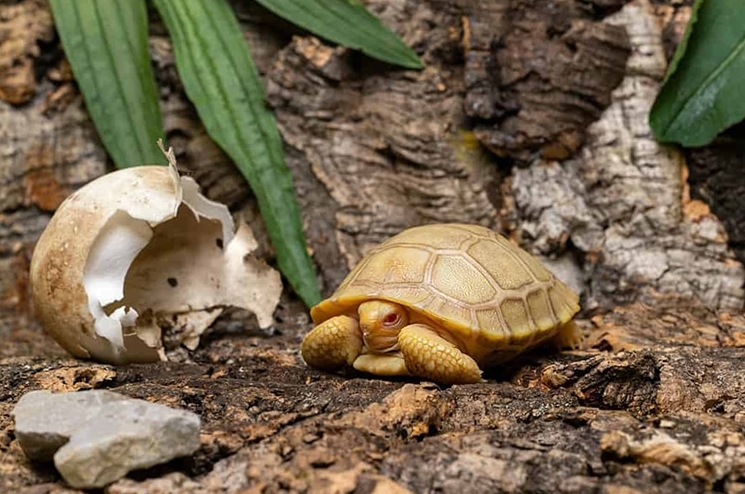
The Galápagos giant tortoise (Chelonoidis niger) is an incredible species. The massive reptiles can live well over a century and are native to the unique environment of the Galápagos Islands.

These living relics can weigh over 500 pounds and are difficult to breed. Optimistic estimates put their numbers at 10,000 to 15,000 tortoises alive today in the wild. While these creatures are already rare, a tiny baby tortoise has been born at a Swiss Zoo with albinism, making it an even greater rarity.

The Tropiquarium, a zoo in Servion, Switzerland, is to be congratulated for the arrival of the new addition. Eggs were laid by a 220-pound female on February 11, and then the two babies hatched on May 1 and May 5, respectively. Both weighed 1.8 ounces at birth. They were whisked away to be warmed in an incubator for a month. They have just now made their debut. Only one of the two has albinism, a genetic condition which prevents the production of melanin. The itty bitty reptile has a white shell, white skin, and red eyes (due to visible blood vessels).

“We were surprised to discover an albino baby,” zoo staff said in a statement. “This is the first time in the world that an albino Galápagos tortoise has been born and kept in captivity.” None have been recorded in the wild either. Zookeepers suspect albinism may appear in 1 in 100,000 tortoises, although this is speculative. The gene is recessive, so tortoises may carry it without anyone knowing. Two recessive genes must combine to appear visually.

The babies are a brilliant addition to the zoo, but they are remarkable for many reasons. The Galápagos giant tortoise is an aggressive mate, with much biting involved. When babies are born in the wild, the males and females are initially indistinguishable. However, warmer conditions during incubation produce females, while cooler temperatures produce males. These young creatures also mysteriously vanish for the first five years of their life. It is surmised they shelter under debris on their island home, hiding from predators. Around five years old, they suddenly emerge, too big for hawks to carry away.

It is unsure exactly how long the new baby tortoise might survive, as albinism can inhibit the survival mechanisms of an animal by making them more vulnerable to predators and sunlight. However, the unique creature and its sibling are part of an important mission to save a species under extreme pressure. It is unclear how global warming may affect the gender ratio among the tortoises, but it is certain that global warming will pose challenges for the species. The birth of the baby turtles is, therefore, to be celebrated.

Source


Saturday

Have you ever seen an albino turtle? A rare albino turtle swims at the Sea Turtle Reserve Centre in Kosgoda, Sri Lanka. The centre collects turtle eggs from the beaches for hatching before poachers remove them as they are considered a delicacy. Once hatched the small turtles are let free in the sea.

Albinos often struggle to survive in the wild, as their lack of pigment makes them an easy target for predators.

Sea Turtles Project

The sea turtles project is one of the turtle hatcheries located along the southern coast, this hatchery is located 3 Km south of the Bentota bridge. These turtle hatcheries were constructed to rescue and protect turtle eggs because of the rapidly declining numbers of marine turtle in Sri Lankan shores.

Marine turtle eggs are purchased from the fisherman and re-buried along the beach and left there for 48 days allowing the eggs ample time to hatch. Thereafter the baby turtles are collected from the beach and kept in tanks for 2-3 days, and released into the ocean to fend off for themselves. The few female turtles that survive will return to their natal shores after ten years to lay their own eggs.

Visitors to the hatchery could release baby turtles into the ocean at night; they could also take a glimpse at the two very rare albino turtles that are kept at the sea turtle project for research. This one of a kind sea turtle conservation project is a site that should not be missed when one visits Bentota.

Here he is! He was captured in a fisherman's net and if he had not been an albino would have been eaten. But he was brought to the folks at Kosgoda. He lives in his own holding pond. He has been there for many years. When the tsunami hit, the director ran out to the pond, grabbed him, and ran to safety. There are two of them at Kosgoda.


Sunday

While animal advocates are working to raise awareness about how harmful keeping slow lorises as pets is and working to save those they can, they’re now celebrating one of the most unique cases yet – the rescue of the first known albino slow loris in the world.

This slow loris had been taken from the wild and kept as a pet in Sumatra before being rescued this August by authorities. Since then, he has been getting the care he needs at the Natural Resources Conservation Centre in Bandar Lampung.

After completing the rehabilitation process, his rescuers believe he’s ready to begin his journey back to the wild and have started the process by bringing him back to his natural habitat in the Bukit Barisan Selatan National Park.

According to International Animal Rescue (IAR), which took part in the release, the area was chosen because it has plenty of food and its status as a conservation area will ensure protection from human activities.

While the journey home has begun, this slow loris won’t be entirely on his own for a few more weeks. First he will spend some time getting adjusted in a habituation area before being fully set free, and he’ll also be radio collared and monitored to ensure he’s thriving on his own after he is released.

Hopefully he will. The illegal wildlife trade is now threatening all species of slow loris throughout their range, which isn’t just harming individuals, it’s taking a toll on the environment.


“Although this albino slow loris is extremely rare, it is still entitled to live freely in its natural habitat like other wildlife. The reintroduction of slow lorises into the wild can also provide benefits and carry out ecological functions in their natural habitat by controlling insects and pollinating plants,” said Teguh Ismail, Head of Lampung Region III Conservation Section BKSDA Bengkulu.

As IAR has previously pointed out, these shy, nocturnal animals are easily stressed and endure a number of heartbreaking abuses as a result of the pet trade. After being torn from their homes, some lorises in captivity are fed inappropriate diets, and others have their teeth crudely clipped or broken off without anesthesia to make them defenseless, which often leads to infection and death, and also makes them ineligible for release even if they are rescued.


“This is the first known albino loris in the world and therefore extremely rare. If it wasn’t for the incredible work of the authorities to combat illegal wildlife trade, this loris could easily have died in the hands of wildlife traffickers. Thankfully, we are able to give this animal another chance to live and thrive in the wild where it belongs,” said Karmele Llano Sanchez, Program Director of IAR Indonesia.

IAR is currently working to rescue, rehabilitate and release as many slow lorises as they can, in addition to educating people about why slow lorises shouldn’t be kept as pets in an effort to stop the trade and keep them safe in the wild where they belong.
Source
VIDEO


Thursday

This is the moment a white wallaby was spotted hopping along a rural road in the dead of night - more than 10,000 miles away from its native home.

Julian Eley, 53, spotted the unusual marsupial while driving down a lane near the Essex/Suffolk border.

Despite it being pitch black, the wallaby - native to Australia and New Guinea, could be seen as clear as day hopping along the tarmac.

It is believed to have escaped from a nearby wildlife park, but experts claim it 'is not impossible' it could be living in the wild. Mr Eley said: 'I was just so shocked, it was really surprising.

'My wife wouldn't believe me, I took her down the road a couple of times but I couldn't see it anymore. 'Now I've got it on video, she believes me.'

Buggs, of Sudbury, Suffolk, managed to capture his astounding find in Foxearth on a dash cam.


Wallabys or macropods are relatives of the Kangaroo and usually only found on the other side of the world from England.

He added: 'I just took the missus to work at 8pm and then went to walk the dog. It's a nice drive down there with all the country roads. 'I knew there was something in the area and I saw something on my drive around there before.

'So I set my iPhone up on the off chance that I might see them and I just pressed record. 'There's more than one there, there's three that I know of. A couple of cyclists have said they saw two in a row.

 VIDEO

Tuesday

Not only is the dolphin vibrant leaping through the waves, but it almost seems fluorescent when it's underwater.

And swimming alongside its grey-toned friend, it really stands out. This video was shot by Kate Cummings at the Monterey Bay, California.

Ms Cummings said:  'Albinos animals in the wild are incredibly rare, as far as we know this is the only albino Risso's dolphin in the Eastern Pacific.

'Seeing the dolphin felt incredibly special because it's such a rare sighting.

'This breed can be identified by the unique pigment and scarring they collect – they get scars from each other's teeth.

'I saw this same dolphin two years ago – now it is around three years old, but is still with its mother.'


Risso's dolphins are rare but the IUCN Red List of Threatened Species considers this species 'data deficient' due to insufficient information on population status and trends.


Albinism has been observed in more than 20 species of oceangoing mammals, according to the National Oceanic and Atmospheric Administration (NOAA), but appears to be rare in dolphins. Animals with the genetic trait are not believed to be inherently weaker or less capable than regular dolphins, though their colour can make them easier targets for predators.


VIDEO

Snowy, the adorable sleepy albino skunk is basically just like a human teenager — he loves snacks and hanging with his buds, and he really hates being woken up in the mornings.

He’s just like having a real life teddy bear in the house!

Snowy was hand reared by family from birth as his mum rejected him, he’s become the most friendly, cuddly animal you could ever imagine.

He sleeps with the kids, is incredibly clean and litter trained. He does what he wants when he wants, he has the run of the house!

Albino skunk cannot be released cannot be released back to the wild.

Skunks are small, furry animals with black and white stripes. Some skunks are striped, and some are spotted or have swirl patterns on their fur. No matter the pattern, the black-and-white coloring is a warning sign to anyone who may harm this small creature. They pack a wallop of a defense mechanism — noxious odors produced from their well-developed scent glands.


Skunks are typically around the size of house cats. They grow to 8 to 19 inches (20 to 48 centimeters) long and weigh around 7 ounces to 14 lbs. (198 grams to 6 kilograms). Their tail adds another 5 to 15 inches (13 to 38 cm) to their length.


These small stinkers are found in the United States, Canada, South America and Mexico. Stink badgers, which were recently considered part of the skunk family, are found in Indonesia and the Philippines.


VIDEO

Wednesday

She was held captive by local residents for two days. Now she is in the safe hands of BOS staff while they continue to monitor her and conduct routine medical tests.

Because of her unique beauty, this sweet orangutan has touched many people worldwide.

The Borneo Orangutan Survival (BOS) Foundation, founded in 1991, is an Indonesian non-profit organization dedicated to the conserving the Bornean orangutan and its habitat.

BOS works in cooperation with local communities, as well as the Indonesian Ministry of Forestry and international partner organizations to achieve their goals. Amazingly, BOS is currently taking care of almost 750 orangutans with the help of 400 staff members.

Recently, BOS rescued a five-year-old female orangutan in the Tanggirang village, Kapuas Hulu, with the help of the Central Kalimantan BKSDA. But this sweet girl is an orangutan like no other: she’s albino.

BOS medical staff determined she is an albino orangutan because her hair, eye, and skin color are all paler than a normal orangutan. She is also sensitive to light.

Photos Source

Orangutans are native to the Indonesian islands of Borneo and Sumatra. Being that they are an arboreal species, they are dependent on the lush rainforest environment for their livelihood. Tragically, the area of rainforest across these islands has declined by over 80 percent in the past two decades alone, primarily due to palm oil production.
Source


VIDEO

An insanely adorable owl that looks like it came straight out of a fairytale has been making waves.

The said bird, which has snow-white feathers and cherry red eyes, has piqued the interest of many, some even guessing if it's a snow owl. However, the peculiar yet magical appearance of this said owl is due to a rare condition.

According to Earthables, different from what people think that it's a snow owl, this particular animal is in fact a screech owl -- albino version. Screech owls are usually gray or rusty brown, but because of albinism, this particular bird lacks melanin to produce color. As a result, the albino screech owl sports a white coat.

Its glowing red eyes, which is normally yellow among screech owls, came from blood vessels. Because of the lack of melanin even in the eyes, the owl's iris is colorless, reflecting the pink to red skin around its eyes.
Source


VIDEO

Friday

These incredible images show a rare white giraffe with no markings on its body grazing with the rest of its herd in the African bush.

The Rothschild giraffe, which has lost pigmentation in its hide because of a rare condition, was spotted roaming. Its herd seemed completely oblivious to her unusual colouring, according to photographer Jamie Manuel.

Mr Manuel said he is one of the only people to have captured images of the white giraffe since rumours of its existence emerged in February this year.

The animal has leucism, a condition where there is a partial loss of pigmentation resulting in white, pale or patchy colouration of skin or hair. Unlike albinism it is caused by a reduction in multiple types of pigment, not just melanin.

'Word was sent out that we were on the trail of the white giraffe and slowly herders sent word back of the general area it had last been seen in. He said that on the second day of searching he found a 20-strong herd in a clearing in the forest - and that the white giraffe was among them.


'The rangers were thrilled to get a closer look, and were pleased to see that the animal looked healthy and was feeding well,' he added. 'I finally managed to photograph the giraffe at close quarters and immediately wondered if it was albino or leucistic.
Source


An extremely rare albino reindeer was filmed roaming through the wilderness by a drone, which stalked the creature from a safe distance.

 The majestic animal was spotted in an isolated area of (- ... -), Norway by a drone enthusiast who wanted to capture some truly unique footage.

Using his quadcopter as a way to spy on the reindeer without startling it, the man flew his camera into the sky and captured aerial footage of it looking for food. He followed it from the air as it walked over to some trees before he later reduced the drone's altitude and travelled towards it.

In the clip, the approaching quadcopter causes the animal to jump and run away, before it then stops and turns around to look back at the camera as if deciding whether it is a threat. The reindeer concludes that it isn't going to take any chances and runs away.

Later in the video the drone operator flies his gadget high into the sky once again and films the animal from a distance. Its white fur causes it to stand out like a beacon against the green surroundings of the countryside.


The video concludes with the drone operator deciding he has captured enough footage and flying away to leave the animal in peace. Albino reindeer are incredibly rare animals with a coat of white fur and even a white tail.


The rare white reindeer is sacred to the indigenous Sami people

Thursday

The adorable baby albino was seen flapping its ears and playing around by the edge of the river, surrounded by its family in the herd.

 It sounds like a joke, but this little elephant is absolutely real, and has stunned wildlife fans with its pale pink skin colouring

For a family day out, this little baby elephant is really in the pink - thanks to its striking skin colour.

But no one seems to notice it's hue is different from the usual elephant grey tone that the others are sporting.

The calf was snapped drinking with its herd in Kruger National Park in northeastern South Africa.

With his bright pink ears flapping in the wind, the pink calf is believed to be an albino, an extremely rare phenomenon amongst African elephants.


Mr Coertze, from South Africa, said: 'We were watching the elephants drinking at the Shingwedsi River when we noticed the albino elephant calf.
Source


Stats

Archives

Pages