Showing posts with label Polar Bear. Show all posts
Saturday

Snow Bears documents the 400-mile journey a polar bear makes with her two-year-old cubs as she teaches them necessary hunting and survival skills.

Snow Bears, which airs on Boxing Day, documents the journey a polar bear makes with her two-year-old cubs from the Svalbard islands, north of Norway, to the North Pole.

Throughout the sometimes perilous expedition, their mother teaches them necessary hunting and survival skills while also encountering a number different animals.

One particularly cute moment in the trailer sees one cub shocked as a seal pops its head out of the cracked ice. The cub ends up falling back in surprise as the seal stares on.

During their 400-mile trek their mother also teaches them to stay vigilant for possible threats - one of which is a giant male bear who follows them throughout their journey.

Newborn cubs are only ~0.6 kg (1.3 lbs.) when born. By 3 months old, they may weigh ~10–12 kg (22-26 lbs.), growing approximately 20 times their original body weight in 12 weeks. If newborn humans did this, we’d need adult-size bassinets.

Cubs continue growing rapidly, more than doubling their weight between den emergence and their first birthday, and yet again between their first and second birthdays. By 2 years old, male cubs can be as big as their moms and weigh hundreds of pounds.

The mother bear’s rich milk is a significant contributor to the rapid growth of cubs but comes at a significant cost to mom.

VIDEO


Thursday

Climate action advocates and wildlife defenders celebrated Monday after the U.S. Court of Appeals for the 9th Circuit rejected the U.S. government's approval of Liberty, a proposed offshore oil-drilling project in federal Arctic waters that opponents warned would endanger local communities, animals, and the environment.

"This is a huge victory for polar bears and our climate," declared Kristen Monsell, oceans legal director at the Center for Biological Diversity, in a statement. "This project was a disaster waiting to happen that should never have been approved. I'm thrilled the court saw through the Trump administration's attempt to push this project through without carefully studying its risks."

Marcie Keever, legal director at Friends of the Earth, similarly applauded the ruling, saying that "thankfully, the court put the health of our children and our planet over oil company profits."

Both groups joined with fellow advocacy organizations Defenders of Wildlife, Greenpeace, and Pacific Environment for a lawsuit challenging the Hilcorp Alaska project, which was approved in 2018. The energy company planned to construct an artificial island, wells, and a pipeline along the Alaska coast in the Beaufort Sea.

Jeremy Lieb, an attorney at the nonprofit law organization Earthjustice, which represented the advocacy groups, praised the court for rejecting the administration's "inaccurate and misleading analysis of this project's impact to the climate." The court determined that the administration hadn't properly considered Liberty's climate impacts as required by the National Environmental Policy Act, specifically taking issue with an economic model claiming the project would benefit the climate.

"In the face of a worsening climate crisis, the federal government should not be in the business of approving irresponsible offshore oil development in the Arctic," Lieb said. "The world cannot afford to develop new oil prospects anywhere, but especially in the Arctic where warming is already taking such a significant toll."

Research has shown that the Arctic is warming faster than the rest of the world, which has devastating effects on its human and animal inhabitants — including caribou, polar bears, reindeer, and walruses — and the planet more broadly. As one expert put it last year: "What happens in the Arctic does not stay in the Arctic."

Calling the court ruling "a victory for the planet and its people," Greenpeace senior research specialist Tim Donaghy said that it "affirms that the U.S. must take steps to transition off of oil and gas if we are to have any hope of halting the climate crisis."

"If we are going to create a just, green, and peaceful future, it must start with rejecting destructive projects like Liberty," he explained, before referencing President-elect Joe Biden's win over President Donald Trump. Ahead of the November election, climate advocates had rallied around Biden while pushing him to embrace bolder policies.

"Climate action must happen now and the Biden administration needs to keep its promise to halt any new oil and gas leasing on federal lands and waters," Donaghy said.

In addition to the climate finding, the court also determined that the U.S. Fish and Wildlife Service failed to sufficiently analyze Liberty's impact on polar bears, in violation of the Endangered Species Act — a decision that was welcomed by Nicole Whittington-Evans, Alaska program director at Defenders of Wildlife.

"Today's news is a victory for Alaska's imperiled polar bears that are threatened by oil and gas development throughout virtually all of their terrestrial denning critical habitat — in the Arctic National Wildlife Refuge, National Petroleum Reserve-Alaska, and in the nearshore marine environment as well," she said, vowing to "continue our fight against destructive oil and gas drilling and for the survival of polar bears in the Arctic."

Despite the win for the region's polar bears in terms of offshore drilling, the animals are still threatened by the Trump administration's ongoing effort to open up the Arctic National Wildlife Refuge to oil and gas extraction — despite opposition from local Indigenous people as well as environmentalists.

The administration on Monday proposed an "incidental harassment authorization" that would allow energy companies to disrupt polar bears while looking for oil and gas deposits. According to Reuters:

The Fish and Wildlife Service said that no polar bears are expected to be injured or killed during seismic operations, some of which are scheduled to take place next month, and expects disturbances to impact only a few bears.
But several veteran Arctic scientists and environmentalists in Alaska have warned against seismic operations — which can involve blasting to produce sonic images of underground formations. They argue the testing will upset wildlife and that the heavy machinery and activity involved in the work will damage tundra and speed up the thaw of permafrost.

As Monsell concluded: "The U.S. Administration seems determined to push polar bears further down the path to extinction before leaving office."

Source

Tuesday

Photographer, Fabrice Guerin, took the images while visiting Arctic Archipelago of Svalbard., Norway.

The 50-year-old watched the polar bear hunting for food but after giving up, he ended up chewing on a plastic big bag that had washed up onto the rocks. Catching this moment on camera to illustrate the huge problem with biodegradable plastic in the ocean, Fabrice was left feeling speechless.
The photographer, who lives in Paris, France, said: “I spent four hours watching the polar bearon the rock from our boat. “He didn’t move for ages but suddenly he decided to walk as it was time for him to find food.

“With the guide, we followed him but we always kept our distance.

“When we decided to come back to our boat, we saw the polar bearwas looking for something into the rocks.

“We were surprised to see this magnificent animal had a plastic bag in his mouth! Fortunately, he didn’t swallow it whole.


“I never thought to see some plastic in this area but I do know there is no frontier for plastic waste.

“The global production of plastic rises every year and we discover bottles and plastic bags mostly everywhere.

“Most of this waste is not biodegradable, and a lot of animals like turtles, birds, sperm whales swallow them.”


Monday

Adorable photographs show a polar bear family snuggling up together to keep warm in the freezing snow.

The mother and two cubs can be seen cuddling each other at Wapusk National Park in Manitoba, Canada.

Climbing on their mother's back and embracing her, the cute little cubs look thrilled to be frolicking in the blistering cold climate. Wapusk National Park protects one of the largest polar bear maternity denning areas in the world.

The park, which opened in 1996, stretches over an enormous 2,836,000 acres and is within range of the Western Hudson Bay population of about 1,000 polar bears.

In late February, visitors can watch tiny three-month-old bear cubs explore their snowy new world for the first time under the watchful eyes of their mothers.

Vince Burton, 44, who took the stunning shots, said: 'It is such a privilege to be there and to witness this, not many people get the opportunity to see a polar bear and its cubs in the world.


'Even less so possibly going forward as the ice is literally melting from beneath their feet and they are struggling to find food.

'Its always rewarding when you treat the wildlife with respect, don't upset it or scare it, then it just behaves naturally in front of you as if you weren't even there.

'My favourite pictures are always those that show natural behaviour or interaction, so I love the shot of the cub looking at its mum, and the shots of the cubs playing.'


Friday

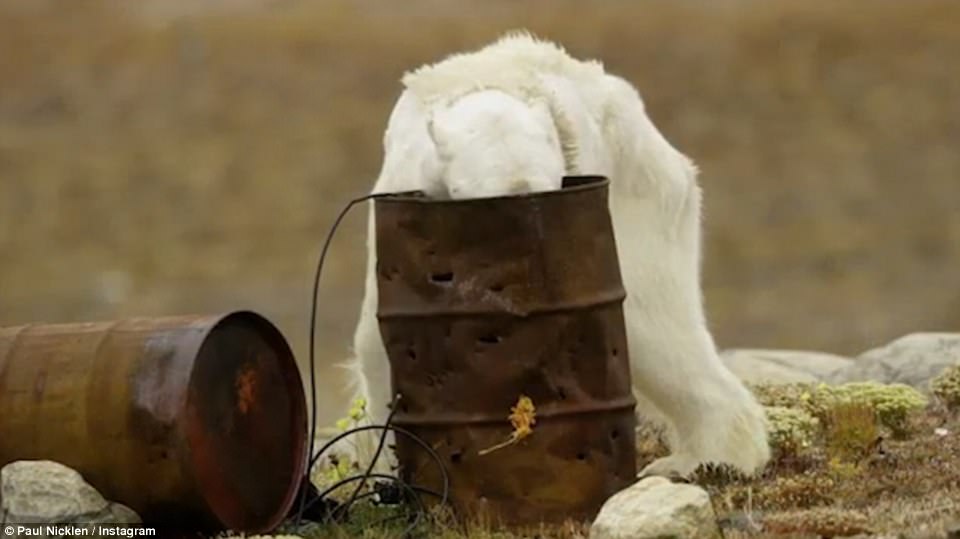
Images shows the polar bear clinging to life, its white hair limply covering its thin, bony frame. One of the bear's back legs drags behind it as it walks, likely due to muscle atrophy.

Lack of sea ice is making it more difficult for polar bears to find food.

When photographer Paul Nicklen and filmmakers from conservation group Sea Legacy arrived in the Baffin Islands, they came across a heartbreaking sight: a starving polar bear on its deathbed.

Nicklen is no stranger to bears. From the time he was a child growing up in Canada's far north the biologist turned wildlife photographer has seen over 3,000 bears in the wild. But the emaciated polar bear, featured in videos Nicklen published to social media on December 5, was one of the most gut-wrenching sights he's ever seen.

"We stood there crying—filming with tears rolling down our cheeks," he said.

Images shows the polar bear clinging to life, its white hair limply covering its thin, bony frame. One of the bear's back legs drags behind it as it walks, likely due to muscle atrophy. Looking for food, the polar bear slowly rummages through a nearby trashcan used seasonally by Inuit fishers. It finds nothing and resignedly collapses back down onto the ground.


In the days since Nicklen posted the footage, he's been asked why he didn’t intervene.

"Of course, that crossed my mind," said Nicklen. "But it's not like I walk around with a tranquilizer gun or 400 pounds of seal meat."


And even if he did, said Nicklen, he only would have been prolonging the bear's misery. Plus, feeding wild polar bears is illegal in Canada.

The wildlife photographer says he filmed the bear's slow, beleaguered death because he didn't want it to die in vain.


"When scientists say bears are going extinct, I want people to realize what it looks like. Bears are going to starve to death," said Nicklen. "This is what a starving bear looks like."

By telling the story of one polar bear, Nicklen hopes to convey a larger message about how a warming climate has deadly consequences.

Polar bears have long been unwitting mascots for the effects of climate change. As animals that live only in Arctic regions, they're often the first to feel the impacts of warming temperatures and rising seas.


The large, half-ton bears find concentrations of seals on sea ice. During summer months, it's not uncommon for polar bears to go months without eating while they wait for Arctic ice to solidify.

In 2002, a World Wildlife Fund report predicted that climate change could eventually lead to polar bear endangerment or extinction. Even then, the report found that polar bears were moving from ice to land earlier and staying on land longer, unhealthily extending the bears' fasting season. By the end of summer, most bears studied by the World Wildlife Fund showed signs of starvation.


Fifteen years later, polar bears' icy hunting grounds are in even worse shape. The National Snow and Ice Data Center, which tracks sea ice cover annually, has regularly noted record lows in sea ice coverage—a decline that is expected to only get worse. (Read more about drastic predictions for dwindling sea ice.)


A study recently published in the journal Biosciences looked at how climate science is often falsely discredited. The study found climate deniers are able to downplay the threat of climate change by discrediting the threat facing polar bears.

However, a study published last year by the European Geosciences Union and this year by the U.S. Geological Survey confirms melting sea ice continues to be an existential threat to polar bears.
 Source
VIDEO

Sunday

A bowhead whale beached on the remote outpost in the Arctic Ocean, and the news spread fast among the island's bears.

From a distance to tourists on passing ship Akademik Shokalskiy, it looked like a flock of sheep, but it soon became evident these were ravenous polar bears feasting on an unexpected meal.

Nature reserve rangers on the remote island calculated there were no less than 230 polar bears arriving to devour the food.

They included single males, single females, mothers with cubs and and even two mothers with four cubs each.

The sight was un unexpected bonanza for tourists on the Finnish-built vessel on part of an epic Arctic voyage from Murmansk to Adadyr in Chukotka.

The group had made a layover on the island, famous as the last place on the planet inhabited by the extinct woolly mammoth.


Information on this unique gathering has been passed to the international scientific group that monitors Chukotka and Alaska's population of polar bears.


Members of the group and staff of the Wrangel island nature reserve continue observations of this unusual polar bear conclave.


The island lies in the Arctic Ocean between the Chukchi Sea and East Siberian Sea.

Members of the group and staff of the Wrangel island nature reserve continue observations of this unusual polar bear conclave.
Source


Stats

Archives

Pages