Showing posts with label fox. Show all posts
Wednesday

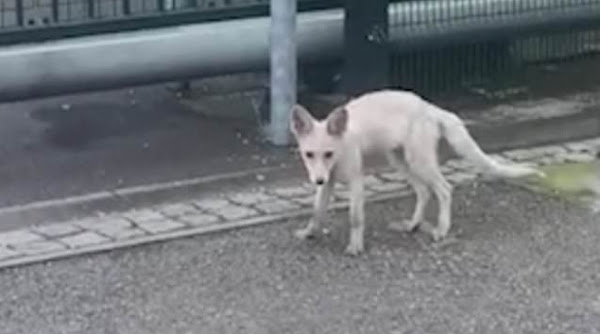
Two adorable albino foxes have been spotted playing in a park in north London.Eagle-eyed Chinamski Pereira, 42, was standing on his balcony one early morning in August.

He saw the two rare animals darting between railings before heading into a park in Angel, north London. The music manager grabbed his phone to capture the moment as the two foxes ran and played together. He said: 'At first I thought they were two dogs playing.

'Then I looked more closely and saw that they were actually two albino foxes. 'I see foxes around here all the time, but to see two albino ones together is very unusual.'

Chinamaski's video shows the white-furred pair weaving in and out of metal gates before heading into the park and chasing a red-furred fox.

Albino foxes have striking white fur and this pair appear to be underfed. This isn't the first time the rare furry creatures have been spotted in the capital.

There was another sighting of a single albino fox in north London in early July of this year.

In 2015, two albino foxes were photographed taking a nap in a back garden in Brixton, south London.

Albinism is the congenital absence of melanin in an animal or plant resulting in white hair, feathers, scales and skin and reddish pink or blue eyes. Individuals with the condition are referred to as albinos.
Source VIDEO

Monday

A rare black fox has been spotted roaming streets in south Wales. Residents in Barry and Sully in the Vale of Glamorgan saw the unusual sight on Tuesday morning after the animal reportedly escaped from its owner.

Barry resident Leigh Partiland took a photo of the fox and said: “He was terrified of all the trucks and lorries coming off the docks.”

The foxes are not native to the UK and originate from North America, where around 10 per cent of the fox population is black.

“Black foxes could be the descendants of foxes bred for the fur trade and released into the wild many years ago,” an RSCPA statement said. “Others could have escaped from captivity and continued to survive in the wild.”

It is believed the foxes seen in Wales are tame and could possibly approach people. On Facebook, one commenter said he had even seen the fox lurking outside Home Bargains in Barry.

There are no restrictions on breeding or owning black foxes in the UK, but it is not a step the Royal Society for the Prevention of Cruelty to Animals (RSPCA) encourages.

A spokesman for the Welsh branch of the charity told the BBC: “Silver foxes are the same species as the red foxes we have living wild in the UK but with different colouration.

“Traditionally, they were bred for their fur but are now sometimes kept as exotic pets.

“Foxes are wild animals with very specific needs that are no different to those of foxes living in the wild and they require specialist care.

VIDEO

Friday

For a long time, fox got its reputation as clever or cunning. This reputation partially refers to their excellent hunting skills, but it’s also because of their sharp appearances which make them look smart.

The Tibetan fox, also known as the Tibetan sand fox, is a species of true fox endemic to the high Tibetan Plateau, Ladakh plateau, Nepal, China, Sikkim, and Bhutan, up to elevations of about 5,300 m (17,400 ft). It is listed as Least Concern in the IUCN Red List, on account of its widespread range in the Tibetan Plateau's steppes and semi-deserts.

The Tibetan fox is small and compact, with a soft, dense coat, conspicuously narrow muzzle, and bushy tail. Its muzzle, crown, neck, back and lower legs are tan to rufous coloured, while its cheeks, flanks, upper legs and rumps are grey. Its tail has white tips. The short ears are tan to greyish tan on the back, while the insides and undersides are white. Adult Tibetan foxes are 60 to 70 centimetres (24 to 28 in), not including tail, and have tail lengths of 29 to 40 cm (11 to 16 in). Weights of adults are usually 4 to 5.5 kg (8.8 to 12.1 lb).

The Tibetan fox is restricted to the Tibetan Plateau in western China and the Ladakh plateau in northern India. It occurs north of the Himalayas in the northernmost border regions of Nepal and India, across Tibet, and in parts of the Chinese provinces.

Mated pairs remain together and may also hunt together.[10] After a gestation period of about 50 to 60 days, two to four young are born in a den, and stay with the parents until they are eight to ten months old. Their burrows are made at the base of boulders, at old beach lines and low slopes. Dens may have four entrances, with entrances being 25–35 cm in diameter.

At present, the Tibetan fox is not in danger of extinction, but it is still listed as a second-class national protected animal in China because of its ecological importance. As the main predator of plateau pika, if there are no Tibetan foxes, the local plateau pika would flood and destroy the grassland.

However, the concern of Tibetan foxes’ survival is rising with the dropping plateau pika population in recent years. Due to the government-sponsored pika poisoned programme and overgrazing, there is a possibility that the pika population would not just be controlled but even eliminated. Due to human disturbance, the balance of nature is on the edge now.

If Tibetan foxes lose their major food source, their survival status needs to be reassessed in the future.

VIDEO

Wednesday

A man became best friends with a fox after the sick animal was rescued from the side of a road.

The red fox was named Cropper and was rescued by The Fox Project in Turnbridge Wells in England. Seriously injured and ill with toxoplasmosis, he could not be returned to the wild. There were only two choices: euthanize him or find him a home.

The rescue opted to save him and Mike Trowler ended up giving Cropper a home. A retired engineer, Mike is fascinated by fox behavior and spends a great deal of time with them.

In addition to nursing injured foxes back to health, he also takes in orphaned fox cubs and raises them until they can be released back into the wild.

After he took in Cropper, Mike patiently nursed the fox back to health. Cropper would eat food from the dog’s dish and curl up with the cats and loved to spend time with Mike. The two would go for walks together and Mike would roll him over and give him belly rubs. This video tells the story of the pair’s loving friendship.

After six happy years with Mike, Cropper passed away in 2007. However, another fox, Jack, who had been suffering similar illnesses, has moved in with Mike. Jack enjoys watching TV with Mike and even reluctantly tolerates a bath in the sink.

Foxes should not be kept as pets and the only reason Cropper and Jack could not be returned to the wild is that they would not have survived because of their health problems. Mike cautions that rescuing foxes takes a great deal of patience and understanding, and a strong awareness of fox behavior.

The Fox Project is a Wildlife Information Bureau and Fox Deterrence Consultancy that was established in 1991 in the UK. They added a Wildlife Hospital in 1993. They admit and treat around 700 foxes and 250 cubs annually.

Source
VIDEO

Tuesday

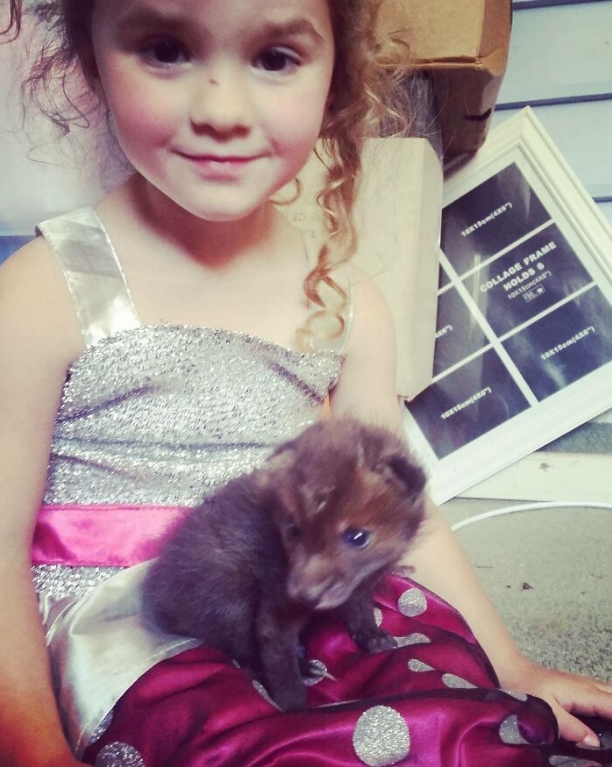
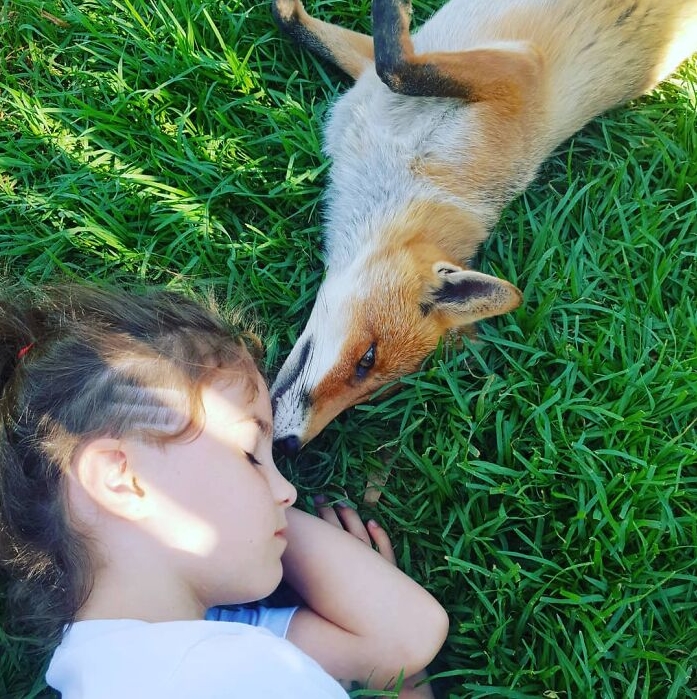
When the fox named Fergie was found as a baby with mom nowhere to be seen, she was mistaken for a puppy and was brought to a wildlife carer. This mistake saved Fergie’s life. As soon as she arrived at the sanctuary, Fergie bonded with an 11-year-old girl, Phoenix, forming an inseparable friendship.

In Australia, under the Rural Lands Protection Act 1998, it is an offense to keep, supply, or release foxes because they threaten biodiversity by hunting and killing native wildlife. Due to this act, foxes have only 2 options; either be left where they were found, unable to get veterinary attention, or get euthanized.

Even though foxes are classified as wild animals, in an enclosed country like Australia, it is different. “Foxes in Australia are a declared pest animal and it’s actually illegal to move them, keep them without a permit or provide them with veterinary attention.”

“According to the law, Fergie should have been either left where she was or euthanized. Thankfully the person who found her didn’t even know she was a fox and took her to a wildlife carer who then contacted us,” shared Rachael. “We’re a farm animal sanctuary and never dreamed we’d find ourselves faced with foxes in need. We hate keeping animals in captivity but sadly it was the best of 2 options.”

“We try really hard to keep their living space interesting (she has a friend called Toby who was also found orphaned). We spend time with them and provide them with enrichment. We’d love to improve and expand their enclosure one day soon… We were unfortunately hit incredibly hard with huge vet bills last year so will need to get on top of those first,” Rachael wrote.

Luckily, by mistake, a person who found Fergie thought that she was a puppy and brought her to a wildlife carer, who then contacted Rachael. To save Fergie, Racheal took in the fox to live in a family-run farm animal sanctuary that she founded

Image credits: greenerpasturessanctuary

Meanwhile, Fergie and Phoenix have formed an inseparable bond and spend a lot of their time together

Source

Thursday

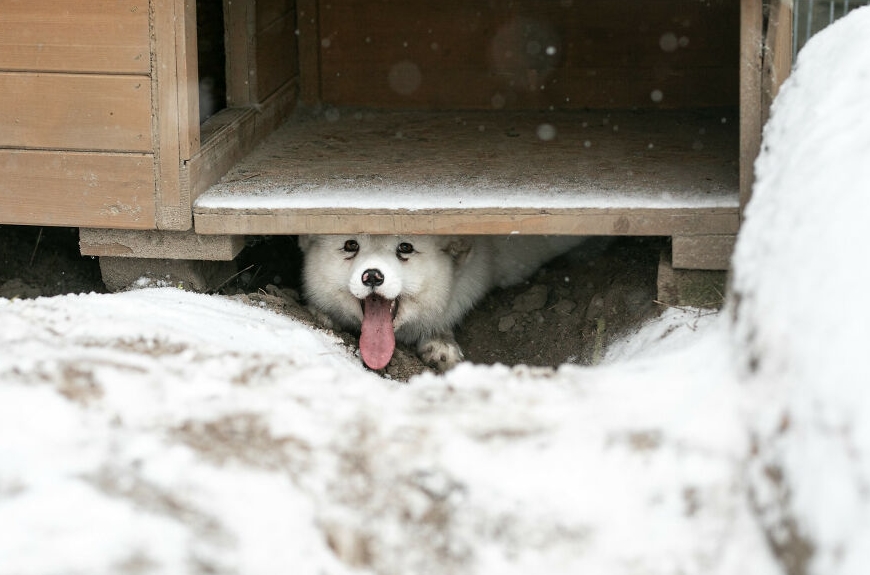
Maciek is a polar fox who, in September, was rescued from a fur farm by activists from Otwarte Klatki (Open Cages Poland).

Since he was rescued, Maciek has been living in a home sanctuary where he’s loved and taken care of. Even though he lost his paw due to his previous owners’ negligence, he’s been enjoying his life outside of the fur farm and just being his sassy little self.

This year, Maciek experienced snow for the first time. And his reaction was simply heartwarming!

Photos are by Andrew Skowron from Otwarte Klatki.

The Arctic fox (Vulpes lagopus), also known as the white fox, polar fox, or snow fox, is a small fox native to the Arctic regions of the Northern Hemisphere and common throughout the Arctic tundra biome. It is well adapted to living in cold environments, and is best known for its thick, warm fur that is also used as camouflage.

It has a large and very fluffy tail. In the wild, most individuals do not live past their first year but some exceptional ones survive up to 11 years. Its body length ranges from 46 to 68 cm (18 to 27 in), with a generally rounded body shape to minimize the escape of body heat.

Arctic foxes must endure a temperature difference of up to 90–100 °C (160–180 °F) between the external environment and their internal core temperature.To prevent heat loss, the Arctic fox curls up tightly tucking its legs and head under its body and behind its furry tail. This position gives the fox the smallest surface area to volume ratio and protects the least insulated areas.

Arctic foxes also stay warm by getting out of the wind and residing in their dens. Although the Arctic foxes are active year-round and do not hibernate, they attempt to preserve fat by reducing their locomotor activity. They build up their fat reserves in the autumn, sometimes increasing their body weight by more than 50%. This provides greater insulation during the winter and a source of energy when food is scarce.

Arctic foxes generally eat any small animal they can find, including lemmings, voles, other rodents, hares, birds, eggs, fish, and carrion. They scavenge on carcasses left by larger predators such as wolves and polar bears. In areas where they are present, lemmings are their most common prey, and a family of foxes can eat dozens of lemmings each day. In some locations in northern Canada, a high seasonal abundance of migrating birds that breed in the area may provide an important food source.


Wednesday

A woman was shocked after finding a furry companion in one of her household appliances. Natasha Prayag had just arrived back at her Streatham home after visiting her partner’s parents – but, unknown to her and her boyfriend, Adam, a cheeky visitor had managed to sneak through the open front door.

After getting bags from the car, the couple turned around and were surprised to see a fox chilling in their hallway. However, upon seeing Natasha and Adam, the animal bolted off inside. Natasha explains that she thinks the small, dark space offered the creature a sense of security.

After taking a few snaps, the 32-year-old tried to tempt him out with some food. She added: ‘You can see it looks quite relaxed from the pictures we took – almost quite happy.

‘We tried to coax him out first by whistling, then banging around a bit but he held steady.

‘I eventually got some food from the fridge – my little one’s pea pasta – put in a Tupperware box and placed it outside to lure him out.

‘After a few minutes he slowly creeped out and towards the pasta that was placed in the garden. However, he smelled the pasta then ran off out the back gate into the street.

(Picture: Jam Press/Natasha Prayag)

‘He stopped, came back, sniffed pasta again then ran off. At this point, we closed the kitchen/garden doors in case he wanted to return.’

A spokesperson from the RSPCA told MailOnline: 'This would definitely be a surprise for anyone to find!


'If anyone finds a wild animal in their home, we recommend keeping a safe distance and to call us or a local wildlife centre for advice.

'Please don't try to remove a wild animal yourself as they can get easily frightened, we recommend leaving it to experts like our team of frontline animal rescuers who are able to safely remove wild animals from situations like this.'

Source

(Picture: Jam Press/Natasha Prayag)


A video of two rescued foxes giggling and laughing when getting belly rubs is spreading happiness to millions of viewers. The foxes, Finnegan and Dixiedo, were rescued from fur farms as are all the foxes at the Save A Fox Rescue sanctuary.

As their rescuer comes to visit with them, Finnegan and Dixiedo get excited and roll onto their bellies to get petted. Finnegan lets out a “ha-ha-ha-ha,” which is how foxes communicate happiness and greetings.

Save A Fox is the largest fox rescue in the USA. “We are a domestic fox rescue. What does this mean? We rescue foxes from fur farms and take in pet surrenders. All these foxes were born in captivity and could never be released so it is our job to give them a happy life,” Save A Fox explains on YouTube.

They do adopt their foxes, but have conditions to ensure the foxes are well looked after and that their new guardians are legally allowed to own them. It’s important to know what to expect in caring for a fox as they are a lot of work.

Juniper the fox became an Internet sensation after appearing on social media; but her mom cautions that foxes are not all cute and cuddly. They smell, are stubborn, and require a lot of special care to keep them healthy and happy.

Red foxes (Vulpes vulpes), the most common foxes throughout the world, have a wide variety of vocalizations, with as many as 20 different calls depending on how one defines them, said Stephen Harris, a biologist at the University of Bristol, England, who has studied their vocalizations. They use these calls to find mates, interact with rivals and communicate within their family groups. This variety befits their role as highly social mammals, Harris told LiveScience.


Foxes communicate with each other in a variety of ways. As in the domestic dog and many other carnivores, many different facial expressions and body postures are used. Friendly greetings such as tail wagging are used when meeting family members
Source
VIDEO


Tuesday

The fox had been up to his mischief for weeks before his stash was finally discovered by a resident. The collection had numerous flip-flops, sandals, crocs, and trainers.

In the German neighbourhood of Zahlendorf in Berlin, a curious case of stolen shoes has been traced to a fox.

A fox with an affinity for fashion has shown an impressive collection of over 100 pairs of shoes and flip flops after havings stole them from residents of Zahlendorf said reports.

Residents of the neighbourhood realised their shoes kept going missing. For some time, they had no clue who the culprit was. But recently, the thief was caught red-handed in the act.

The fox had been up to his mischief for weeks before his stash was finally discovered by a resident. The collection had numerous flip-flops, sandals, crocs, and trainers.

The case of missing shoes came to the fore after Zehlenforf resident Christian Mayer posted about his shoe going missing on a local Facebook group. He was angry and disappointed as his pair was a new one.


However, Mayer soon found out he wasn’t the only victim of the footwear theft in the neighborhood.

After a tip-off from a person, Meyer managed to track it down and saw the animal with two flip-flops in its mouth. A few days from the sighting, Mayer followed the animal and reached a large green to discover the entire stash of stolen shoes.
Source

Tagesspiegel editor Felix Hackenbruch posted photos of the evidence on Twitter.


Monday

A fox and a hedgehog make unlikely dinner companions, but footage from webcams set up in a wildlife enthusiast’s garden captured an unexpected midnight feast being shared by an unusual pair.

The animals were filmed sharing a dinner of dried mealworms and dog food in Stu McKenzie’s garden, in Malvern, Worcestershire.

Mr McKenzie, 48, said it was a “surprising” discovery as hedgehogs are usually seen as prey.

“I have seen them in the garden at the same time and the hedgehog normally rolls into a ball and the fox avoids it,” he said.

“But I have never seen them so close together feeding out of the same bowl. It’s a metal bowl and I put in dried mealworms and canned dog food.

“I strapped a trail camera to a tree in the garden like I’ve been doing for two months now to see what appears.”


Mr Mckenzie, a former BBC cameraman, said he was also surprised to see a hedgehog as he lives close to the town centre of Malvern. Hedgehogs prefer living on the edge of woodlands, but also thrive in gardens of both urban and suburban areas, according to conservation group Hedgehog Street.

“I couldn’t believe the fox came up to the hedgehog and ate right next to it. In footage I’ve got from a few weeks ago, the fox stays well clear. I think foxes are opportunistic,” he said.

“I would imagine if a hedgehog was injured the fox would eat it if it could, but it probably knows it’s not wise to try that with a healthy hedgehog.”

Wildlife experts say that while foxes have been known to eat hedgehogs, the small critters are more likely to be preyed on by badgers.
Source 

 VIDEO


The Caballero family went through this recently when a gray fox cub mistook their terrier for her mom and followed them to their home

Ever had an animal walk you home from school or from a friend’s house? You know, like a random kitten or a puppy you didn’t know would follow you, probably wanting a treat, a pet, or just friendship, and end up inviting itself into your home, if not your entire life?

Well, the Caballero family from Tempe, Arizona were outside on their regularly scheduled walk with their dog named Olive when they were joined by a tiny baby gray fox. Now, apparently, the critter mistook the family’s terrier for her mother and started following them around the neighborhood.

The fox was about 20 centimeters in length (for reference, she could fit in the palms of your hands) and had a coat of varying shades of gray. They later found out that she was just 6 weeks old at that point.

The tiny fox followed them home, where the sprinklers were on at that moment, so she ran to have a drink, which is when Rosalyn noticed how thirsty she was as she couldn’t stop drinking—she just kept gulping and gulping.

Pairing that with the fact that the fox was far away from home and her mother, alone—something that is not typical of foxes as they are pack animals—the family decided it would be best to get in touch with Southwest Wildlife Conservation Center for help.


The three found a box and captured the baby fox so that she wouldn’t wander off into danger. They got the fox inside the box without touching her, simply luring her in. And though calling her a Fox in the Box is a cute and endearing name, the kids were quick to name her Foxy.

The fox was soon brought to the Southwest Wildlife Conservation Center. She was first fed using syringes, but now has learned how to eat on her own from a bowl.


Turns out that this isn’t the first time gray foxes have been spotted in the area as the family saw a pack of them walking past their garden last year. However, what was out of the ordinary was that Foxy was alone, dehydrated, and obviously lost. The fox was dehydrated and in stress, when the family decided to scoop it into a box and to bring it to a wildlife center The baby fox is now safe with the Southwest Wildlife Conservation Center, who will care for it until it’s release into the wild
Source


Sunday

A young fox’s private life was revealed to a woman when she kept tabs on what he got up to in her garden. The fox took up residence in Jen’s backyard last March, much to her delight. And this week, he appeared to have a new friend…a girlfriend.

Jen lives in England and said the foxes like their garden probably because all the neighboring properties have dogs and cats.

“Fortunately (or unfortunately as I want a cat!) we have neither,” said Jen. “Next door has three cats, and there are numerous huge dogs in neighboring gardens too! There’s a giant Rottweiler next door, two German shepherds on the other side, Staffordshire terriers to the right. We’re the only house without dogs so they probably feel safe!”

Jen has seen the young male fox mature. “He’s a young fox as we’ve seen him grow. He comes out most days and sunbathes. Our garden is about 200 ft long and enclosed. We leave the bottom of the garden wild. As there’s a pond down there too, we get quite a lot of wildlife around and he lives at the end of it. Hopefully they’ll have a den there!”

The female companion can be distinguished from the male as she has a slightly narrower face and smaller ears from her new beau.

Jen said that the foxes like to play together and as she works from home she was able to take photos of the pair playing together.


“I work from home and keep a camera on the windowsill in my office as he comes out most days, sometimes he comes quite close to the house.

“These pictures were taken about 200ft away. He sometimes come within about 20 or 30ft of the house but runs off if you open the door. I once got close when he was asleep when I needed to go to the shed but he ran away when he woke up.”

Jen does not feed them and does not want them to become reliant or familiar with humans, as it may endanger them.


“We’ve left the end of the garden wild with country flowers etc so get a lot of birds/butterflies as well as the foxes and hedgehogs, there were toads/frogs in the pond as well,” wrote Jen.

“The pond pic is from when we first moved in, the entire garden was pretty overgrown so it’s not exactly an ornamental pond and has seen better days!”

“I’m glad they run away if I open the door or go into the garden, as not everyone is welcoming of them as I am,” she wrote. “I don’t feed him either for that reason.”

Jen is thrilled the young male fox has found a mate. “I’ll be beyond excited if there are kits!”
Source


Thursday

Surprises are something we don’t expect to see⁠—that’s why they’re surprises. Well, this person got a surprise and a half. Twitter user @marcy_com recently stumbled on a rare find he didn’t see coming.

One fateful day, while he was on National Route 275, he found a cute puppy beside the road, all by herself. She appeared too young to take care of herself, so he called her Luna and made a decision to take her under his wing. For a while, at least. He responsibly decided to look for her owners on social media.

That’s where the unexpected half of the surprise really begins. Though no one claimed to be the owner of the puppy, the account buzzed with replies and reactions. Inarguably, Luna looks like a cute cub, so people commented mostly on that.

But among some of the replies, some doubt rose about her real identity. It started after he posted an extremely cute video where she barks very weirdly. “Uh, that’s a cute… puppy?” one person replied.

To another few, her face reminded them of a tanuki, a raccoon dog, in Japanese. Finally, as suspicion mounted, some began suspecting that Luna was in fact a fox cub. That’s when the “duh” moment came and @marcy_com realized why no owner had answered his call: it was a wild fox cub! Fun fact: a fox in Japanese is kitsune.

In Japan, it’s illegal to have foxes as pets, so @marcy_com searched for places that could take Luna in. She didn’t need to have owners, but that didn’t mean she didn’t need to be taken care of. He found a place called North Fox Farm in a Hokkaido town called Kitami. There, the experts have determined that she’s about one to two months old. She’s too young to forage for food or fend for herself, so she’ll spend her time there until she grows stronger.


Foxes are members of the dog family. A female fox is called a “vixen”, a male fox is called a “dog fox” or a “tod” and baby foxes are called “pups”, “kits” or “cubs”. A group of foxes is called a “skulk” or a “leash”. Foxes are the only type of dog capable of retracting their claws.
Source


Stats

Archives

Pages