Showing posts with label fox. Show all posts
Wednesday

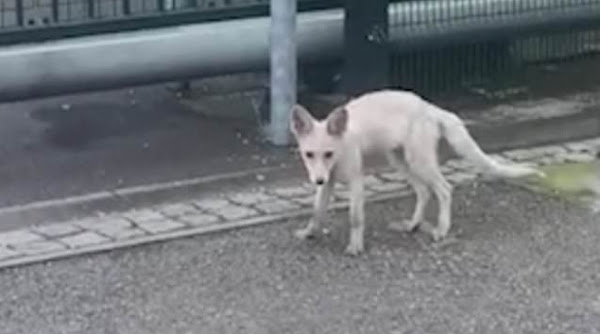
Two adorable albino foxes have been spotted playing in a park in north London.Eagle-eyed Chinamski Pereira, 42, was standing on his balcony one early morning in August.

He saw the two rare animals darting between railings before heading into a park in Angel, north London. The music manager grabbed his phone to capture the moment as the two foxes ran and played together. He said: 'At first I thought they were two dogs playing.

'Then I looked more closely and saw that they were actually two albino foxes. 'I see foxes around here all the time, but to see two albino ones together is very unusual.'

Chinamaski's video shows the white-furred pair weaving in and out of metal gates before heading into the park and chasing a red-furred fox.

Albino foxes have striking white fur and this pair appear to be underfed. This isn't the first time the rare furry creatures have been spotted in the capital.

There was another sighting of a single albino fox in north London in early July of this year.

In 2015, two albino foxes were photographed taking a nap in a back garden in Brixton, south London.

Albinism is the congenital absence of melanin in an animal or plant resulting in white hair, feathers, scales and skin and reddish pink or blue eyes. Individuals with the condition are referred to as albinos.
Source VIDEO

Monday

A rare black fox has been spotted roaming streets in south Wales. Residents in Barry and Sully in the Vale of Glamorgan saw the unusual sight on Tuesday morning after the animal reportedly escaped from its owner.

Barry resident Leigh Partiland took a photo of the fox and said: “He was terrified of all the trucks and lorries coming off the docks.”

The foxes are not native to the UK and originate from North America, where around 10 per cent of the fox population is black.

“Black foxes could be the descendants of foxes bred for the fur trade and released into the wild many years ago,” an RSCPA statement said. “Others could have escaped from captivity and continued to survive in the wild.”

It is believed the foxes seen in Wales are tame and could possibly approach people. On Facebook, one commenter said he had even seen the fox lurking outside Home Bargains in Barry.

There are no restrictions on breeding or owning black foxes in the UK, but it is not a step the Royal Society for the Prevention of Cruelty to Animals (RSPCA) encourages.

A spokesman for the Welsh branch of the charity told the BBC: “Silver foxes are the same species as the red foxes we have living wild in the UK but with different colouration.

“Traditionally, they were bred for their fur but are now sometimes kept as exotic pets.

“Foxes are wild animals with very specific needs that are no different to those of foxes living in the wild and they require specialist care.

VIDEO

Friday

For a long time, fox got its reputation as clever or cunning. This reputation partially refers to their excellent hunting skills, but it’s also because of their sharp appearances which make them look smart.

The Tibetan fox, also known as the Tibetan sand fox, is a species of true fox endemic to the high Tibetan Plateau, Ladakh plateau, Nepal, China, Sikkim, and Bhutan, up to elevations of about 5,300 m (17,400 ft). It is listed as Least Concern in the IUCN Red List, on account of its widespread range in the Tibetan Plateau's steppes and semi-deserts.

The Tibetan fox is small and compact, with a soft, dense coat, conspicuously narrow muzzle, and bushy tail. Its muzzle, crown, neck, back and lower legs are tan to rufous coloured, while its cheeks, flanks, upper legs and rumps are grey. Its tail has white tips. The short ears are tan to greyish tan on the back, while the insides and undersides are white. Adult Tibetan foxes are 60 to 70 centimetres (24 to 28 in), not including tail, and have tail lengths of 29 to 40 cm (11 to 16 in). Weights of adults are usually 4 to 5.5 kg (8.8 to 12.1 lb).

The Tibetan fox is restricted to the Tibetan Plateau in western China and the Ladakh plateau in northern India. It occurs north of the Himalayas in the northernmost border regions of Nepal and India, across Tibet, and in parts of the Chinese provinces.

Mated pairs remain together and may also hunt together.[10] After a gestation period of about 50 to 60 days, two to four young are born in a den, and stay with the parents until they are eight to ten months old. Their burrows are made at the base of boulders, at old beach lines and low slopes. Dens may have four entrances, with entrances being 25–35 cm in diameter.

At present, the Tibetan fox is not in danger of extinction, but it is still listed as a second-class national protected animal in China because of its ecological importance. As the main predator of plateau pika, if there are no Tibetan foxes, the local plateau pika would flood and destroy the grassland.

However, the concern of Tibetan foxes’ survival is rising with the dropping plateau pika population in recent years. Due to the government-sponsored pika poisoned programme and overgrazing, there is a possibility that the pika population would not just be controlled but even eliminated. Due to human disturbance, the balance of nature is on the edge now.

If Tibetan foxes lose their major food source, their survival status needs to be reassessed in the future.

VIDEO

Wednesday

A man became best friends with a fox after the sick animal was rescued from the side of a road.

The red fox was named Cropper and was rescued by The Fox Project in Turnbridge Wells in England. Seriously injured and ill with toxoplasmosis, he could not be returned to the wild. There were only two choices: euthanize him or find him a home.

The rescue opted to save him and Mike Trowler ended up giving Cropper a home. A retired engineer, Mike is fascinated by fox behavior and spends a great deal of time with them.

In addition to nursing injured foxes back to health, he also takes in orphaned fox cubs and raises them until they can be released back into the wild.

After he took in Cropper, Mike patiently nursed the fox back to health. Cropper would eat food from the dog’s dish and curl up with the cats and loved to spend time with Mike. The two would go for walks together and Mike would roll him over and give him belly rubs. This video tells the story of the pair’s loving friendship.

After six happy years with Mike, Cropper passed away in 2007. However, another fox, Jack, who had been suffering similar illnesses, has moved in with Mike. Jack enjoys watching TV with Mike and even reluctantly tolerates a bath in the sink.

Foxes should not be kept as pets and the only reason Cropper and Jack could not be returned to the wild is that they would not have survived because of their health problems. Mike cautions that rescuing foxes takes a great deal of patience and understanding, and a strong awareness of fox behavior.

The Fox Project is a Wildlife Information Bureau and Fox Deterrence Consultancy that was established in 1991 in the UK. They added a Wildlife Hospital in 1993. They admit and treat around 700 foxes and 250 cubs annually.

Source
VIDEO

Tuesday

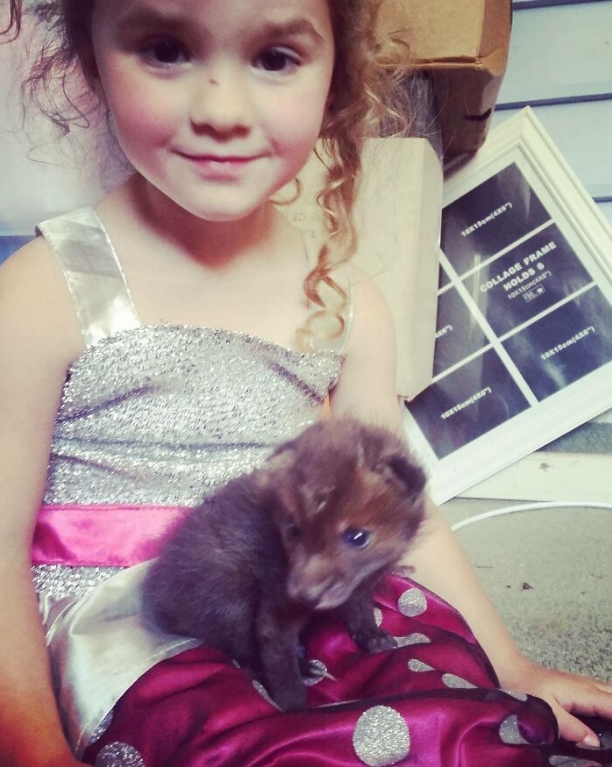
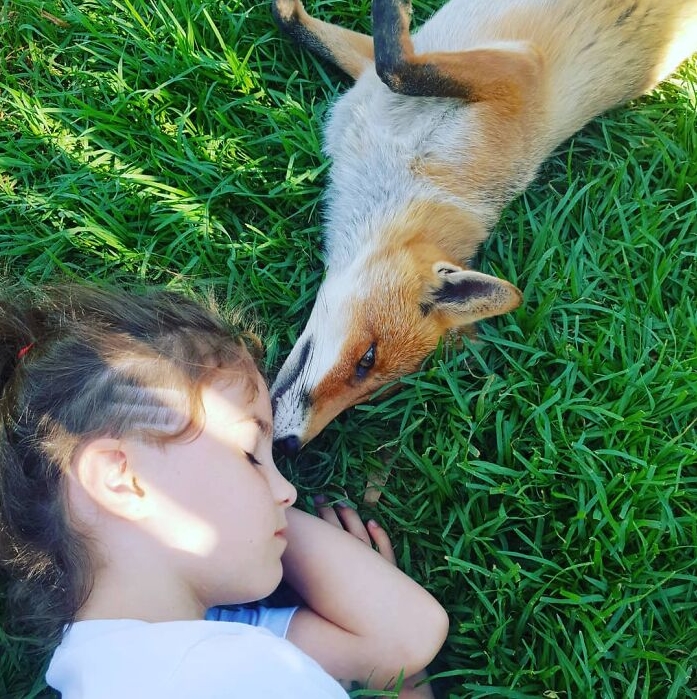
When the fox named Fergie was found as a baby with mom nowhere to be seen, she was mistaken for a puppy and was brought to a wildlife carer. This mistake saved Fergie’s life. As soon as she arrived at the sanctuary, Fergie bonded with an 11-year-old girl, Phoenix, forming an inseparable friendship.

In Australia, under the Rural Lands Protection Act 1998, it is an offense to keep, supply, or release foxes because they threaten biodiversity by hunting and killing native wildlife. Due to this act, foxes have only 2 options; either be left where they were found, unable to get veterinary attention, or get euthanized.

Even though foxes are classified as wild animals, in an enclosed country like Australia, it is different. “Foxes in Australia are a declared pest animal and it’s actually illegal to move them, keep them without a permit or provide them with veterinary attention.”

“According to the law, Fergie should have been either left where she was or euthanized. Thankfully the person who found her didn’t even know she was a fox and took her to a wildlife carer who then contacted us,” shared Rachael. “We’re a farm animal sanctuary and never dreamed we’d find ourselves faced with foxes in need. We hate keeping animals in captivity but sadly it was the best of 2 options.”

“We try really hard to keep their living space interesting (she has a friend called Toby who was also found orphaned). We spend time with them and provide them with enrichment. We’d love to improve and expand their enclosure one day soon… We were unfortunately hit incredibly hard with huge vet bills last year so will need to get on top of those first,” Rachael wrote.

Luckily, by mistake, a person who found Fergie thought that she was a puppy and brought her to a wildlife carer, who then contacted Rachael. To save Fergie, Racheal took in the fox to live in a family-run farm animal sanctuary that she founded

Image credits: greenerpasturessanctuary

Meanwhile, Fergie and Phoenix have formed an inseparable bond and spend a lot of their time together

Source

Thursday

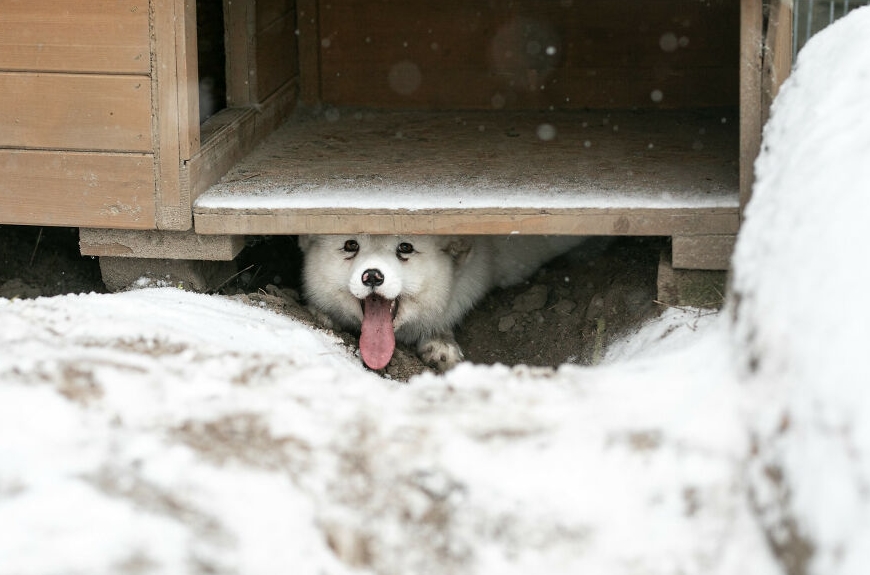
Maciek is a polar fox who, in September, was rescued from a fur farm by activists from Otwarte Klatki (Open Cages Poland).

Since he was rescued, Maciek has been living in a home sanctuary where he’s loved and taken care of. Even though he lost his paw due to his previous owners’ negligence, he’s been enjoying his life outside of the fur farm and just being his sassy little self.

This year, Maciek experienced snow for the first time. And his reaction was simply heartwarming!

Photos are by Andrew Skowron from Otwarte Klatki.

The Arctic fox (Vulpes lagopus), also known as the white fox, polar fox, or snow fox, is a small fox native to the Arctic regions of the Northern Hemisphere and common throughout the Arctic tundra biome. It is well adapted to living in cold environments, and is best known for its thick, warm fur that is also used as camouflage.

It has a large and very fluffy tail. In the wild, most individuals do not live past their first year but some exceptional ones survive up to 11 years. Its body length ranges from 46 to 68 cm (18 to 27 in), with a generally rounded body shape to minimize the escape of body heat.

Arctic foxes must endure a temperature difference of up to 90–100 °C (160–180 °F) between the external environment and their internal core temperature.To prevent heat loss, the Arctic fox curls up tightly tucking its legs and head under its body and behind its furry tail. This position gives the fox the smallest surface area to volume ratio and protects the least insulated areas.

Arctic foxes also stay warm by getting out of the wind and residing in their dens. Although the Arctic foxes are active year-round and do not hibernate, they attempt to preserve fat by reducing their locomotor activity. They build up their fat reserves in the autumn, sometimes increasing their body weight by more than 50%. This provides greater insulation during the winter and a source of energy when food is scarce.

Arctic foxes generally eat any small animal they can find, including lemmings, voles, other rodents, hares, birds, eggs, fish, and carrion. They scavenge on carcasses left by larger predators such as wolves and polar bears. In areas where they are present, lemmings are their most common prey, and a family of foxes can eat dozens of lemmings each day. In some locations in northern Canada, a high seasonal abundance of migrating birds that breed in the area may provide an important food source.


Stats

Archives

Pages