A Saskatoon Cree teacher has been shortlisted for a global award worth $1 million.
Belinda Daniels is the only Canadian teacher up for the Global Teacher Prize awarded by the Varkey Foundation. "I was pretty ecstatic, overwhelmed, and it was exciting," Daniels said on CBC's Saskatoon Morning.
Daniels is from Sturgeon Lake First Nation and was first inspired to teach when she was an administrative assistant at a local high school.She has been teaching for 15 years and said she learned that a good educator is someone who brings their passion and a sense of belonging into the classroom.
"(I) was inspired to teach the Cree language," Belinda explained. "Since then I have been self-taught and I have been taking extra classes. I created a Cree language summer camp around 11 years ago to reclaim my language, which really awakened my own identity and my own purpose. I wanted to share that feeling of connectedness with my students."
The Global Teacher Prize is a $1 million award that is given to an "exceptional teacher who has made an outstanding contribution to the profession," according to the Varkey Foundation website. Daniels is one of 50 teachers who made the shortlist from 8,000 nominees all over the world.
Daniels said, she would invest the money in indigenous languages and education, creating a bottom up initiative that is a collective process and taps into local indigenous scholars.
Source
Jana Mashonee is very dedicated to helping Native youth in any way she can. Jana gives back to her Native community by helping others believe in themselves and their ability to achieve their goals.
In her travels around the country, Jana has met with and listened to thousands of Native youth. Their strong support is what is making Jana's special work so successful.
Jana's Native Youth Motivational Presentation has become the most successful presentation of its kind in the country.
Her unique blend of music, dance and motivational speaking is reaching young people everywhere.
Jana addresses the issues of cultural pride and identity, motivation and ambition, education, alcohol, tobacco and drug awareness.
She proactively involves her audiences in this extraordinary interactive presentation. Music, lecture, questions, answers, and demonstrations are the main components of this educational, entertaining, and motivational program.
Jana's Kids raises funds to offer scholarships to American Indian and Aboriginal youth for academic, artistic, and athletic achievement (Triple "A") as part of the program's educational initiative.
It is Jana's mission to help provide our youth the resources to achieve their dreams. SOURCE
"We were all children once. And we all share the desire for the well-being of our children, which has always been and will continue to be the most universally cherished aspiration of humankind." - We the Children
By resolution 836(IX) of 14 December 1954, the General Assembly recommended that all countries institute a Universal Children's Day, to be observed as a day of worldwide fraternity and understanding between children. It recommended that the Day was to be observed also as a day of activity devoted to promoting the ideals and objectives of the Charter and the welfare of the children of the world. The Assembly suggested to governments that the Day be observed on the date and in the way which each considers appropriate. The date 20 November, marks the day on which the Assembly adopted the Declaration of the Rights of the Child, in 1959, and the Convention on the Rights of the Child, in 1989.
In 2000 world leaders outlined the Millennium Development Goals (MDGs) – which range from halving extreme poverty to halting the spread of HIV/AIDS and providing universal primary education, all by the target date of 2015. Though the Goals are for all humankind, they are primarily about children. UNICEF notes that six of the eight goals relate directly to children and meeting the last two will also make critical improvements in their lives.
In 2012, the Secretary-General launched a new initiative Education First. The Initiative aims to raise the political profile of education, strengthen the global movement to achieve quality education and generate additional and sufficient funding through sustained advocacy efforts. Achieving gains in education will have an impact on all the Millennium Development Goals, from lower child and maternal mortality, to better health, higher income and more environmentally-friendly societies.(Source)
Indigenous Children As every child, indigenous children have the right to:
*Not be discriminated against
*Enjoy their culture
*Use their own language (read and write in their own language),
*Profess and practice their own religion
*Have access to education, vocational training, health and other services that are culturally sensitive
*Be protected from all forms of violence, exploitation, abuse and abandonment, including commercial sexual exploitation, trafficking and child labour that is likely to be hazardous or to interfere with the child’s education.
Children of the Brazilian indigenous Tikuna people
Native Pride
Children Faces of Tibet
Native Future
"If
a child hasn't been given spiritual values within the family setting,
they have no familiarity with the values that are necessary for the just
and peaceful functioning in community."
Being
spiritual is remembering. It is remembering that the first thing that
was gifted to you when you came into being was the spirit.
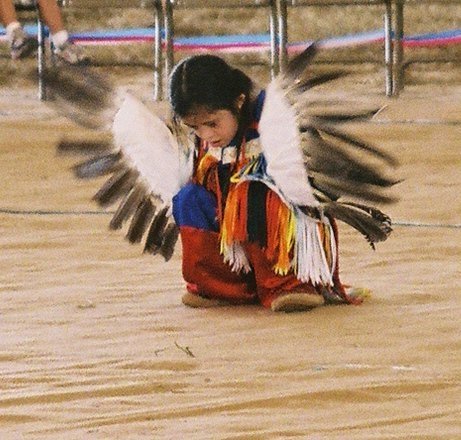
Aztec dancer Mayahuel represents the next generation of dancers
"We do not inherit the Earth from our ancestors: we borrow it from our children."
The Promise of Tomorrow
Let
me look into my own eyes and see the beauty You have created. Let me
have good thoughts. Being Human is not the color of my skin. Being Human is to listen to my heart, to think only the things You have
taught, to watch nature, and live in harmony. Being Human is to act and
to walk in a sacred way. -A Child
As an eagle prepares its young to leave the nest will all the skills and
knowledge it needs to participate in life, in the same manner so will I
guide my children. I will use the culture to prepare them for life.
LEGAL and child protection systems are failing to protect Aboriginal children from rape and sexual abuse and are adding to their psychological suffering, according to a controversial book to be launched today.
In Our Greatest Challenge, human rights lawyer Hannah McGlade calls for a radical new approach that stops exonerating Aboriginal men and empowers communities to discipline perpetrators.
Dr McGlade argues that when the law is used as the primary response to child sexual assault, victims are left traumatised and further harmed by the legal process and discrimination in the court system.
She claims that as a Noongar woman speaking against child sexual assault, she has experienced intimidation and abuse,
as well as "alienation and marginalisation".
Children's rights should be made a formal Close the Gap target and there should be a national deputy commissioner for Aboriginal children, she says.
Dr McGlade says child sexual assault is not readily characterised as a human rights violation because Aboriginal human rights discussion has been set by Aboriginal men and works "to men's advantage".
"Child sexual assault is largely perpetrated by men upon predominantly girl children, thereby raising the uncomfortable issue of Aboriginal men's participation in human rights abuses against Aboriginal children. The biased nature of Aboriginal human rights discourse has unfortunately negated recognition of child sexual assault as a serious human rights matter," she writes.
She argues that in the Australian context, a bias towards Aboriginal male offenders has been evident and often this has "rendered invisible the harms suffered by victims, predominantly women and children".
"It has now been recognised that major justice inquiries such as the Royal Commission into Aboriginal Deaths in Custody failed to acknowledge the high rate of homicide of Aboriginal women, which far outnumbered the deaths (predominantly of men) that occurred in custody."
In many prosecutions for child sex offences, "the response of the state Aboriginal legal service was to publicly attack the prosecutions and aggressively defend perpetrators by using technical legal arguments to secure a number of acquittals".
She says criminal justice responses should be developed that are more inclusive of women and children, and cites the Community Holistic Circle Healing program of Hollow Water, Canada.
The CHCH model entails the development of a "healing contract" that offenders must agree to be bound by, involving healing circles held with the victims and perpetrators and their families; the sentencing circle in which victims, offenders, families and the wider community are brought together, and in which a non-custodial sentence is imposed on the offender; and a final "cleansing" ceremony held to acknowledge the offender's participation within the program and reintegration back into the community.
"Hollow Water's CHCH has great possibilities that should be explored in the Australian context," she writes, adding that while a non-incarceration model may be controversial, "it should be recognised that Australian courts have released offenders on suspended sentence without any supervision, treatment or rehabilitation measures".
She argues children must be involved in the process rather than ignored in consultations.
Dr McGlade says attacks on the NT Emergency Response have also been led by male-dominated land councils.
"Their position has been supported by the office of the Aboriginal and Torres Strait Islander Social Justice Commissioner, an office occupied exclusively by Aboriginal male appointees since its inception in 1992.
"Opposition to the NTER has at times entailed denial of . . . violence against women and children and child sexual assault." SOURCE
The cycle of life for the woman is the baby, girl, woman, and grandmother. These are the four directions of life. She has been given by natural laws, the ability to reproduce life. The most sacred of all things is life. Therefore, all men should treat her with dignity and respect. Never was it our way to harm ★her mentally or physically. Indian men were never abusers. We always treated our women with respect and understanding. So from now on:
I will treat women in a sacred manner. The Creator gave women the responsibility for bringing new life into the world. Life is sacred, so I will look upon the women in a sacred manner.
In our traditional ways, the woman is the foundation of the family. I will work with her to create a home atmosphere of respect, security and harmony.
I will refrain from any form of emotional or physical abuse. If I have these feelings, I will talk to the Creator for guidance.
I will treat all women as if they were my own female relatives. This is my vow.
Native Philosophy TO THE EARTH
Our Mother Earth is the source of all life, whether it be the plants, the two-legged, four-legged, winged ones or human beings. The Mother Earth is the greatest teacher, if we listen, observe and respect her. When we live in harmony with the Mother Earth, she will recycle the things we consume and make them available to our children and to their children. As an Indian man, I must teach my children how to care for the Earth so it is there for the future generations. So from now on:
I realize the Earth is our mother. I will treat her with honor and respect.
I will honor the interconnectedness of all things and all forms of life. I will realize the Earth does not belong to us, but we belong to the Earth.
The natural law is the ultimate authority upon the lands and water. I will learn the knowledge and wisdom of the natural laws. I will pass this knowledge in to my children.
The mother Earth is a living entity that maintains life. I will speak out in a good way whenever I see someone abusing the Earth. Just as I would protect my own mother, so will I protect the Earth. I will ensure that the land, water, and air will be intact for my children and my children's children - unborn.
Native Philosophy TO THE CHILDREN
As an eagle prepares its young to leave the nest will all the skills and knowledge it needs to participate in life, in the same manner so will I guide my children. I will use the culture to prepare them for life.
The most important thing I can give to my children is my time. I will spend time with them in order to learn from them and to listen to them.
I will teach my children to pray, as well as the importance of respect.
We are the caretakers of the children for the Creator. They are His children, not ours.
I am proud of our own Native language. I will learn it if I can and help my children to learn it.
In today's world it is easy for the children to go astray, so I will work to provide positive alternatives for them. I will teach them the culture. I will encourage education. I will encourage sports. I will encourage them to talk to the Elders for guidance; but mostly, I will seek to be a role model myself.
I make this commitment to my children so they will have courage and find guidance through traditional ways.
Native Philosophy TO THE CREATOR
As an Indian man, I realize we make no gains without the Great Spirit being in our lives. Neither I nor anything I attempt to do, will work without the Creator. Being Indian and being spiritual has the same meaning. Spirituality is out gift from the Great One. This day, I vow to walk the Red Road.
As an Indian man, I will return to the traditional and spiritual values which have guided my ancestors for the past generations.
I will look with new eyes on the powers of our ceremonies and religious ways, for they are important to the very survival of our people.
We have survived and are going to grow and flourish spiritually. We will fulfill our teachings and the purpose that the Creator has given us with dignity.
Each day, I will pray and ask for guidance. I will commit to walk the Red Road, or whatever the spiritual way is called in my own culture.
If I am Christian, I will be a good one. If I am traditional, I will walk this road with dedication.
If each if us can do these things then others will follow. From this day forward, I will reserve time and energy for spirituality, seeking to know the Creators will.
Native Philosophy TO THE FAMILY
The creator gave to us the family, which is the place where all teachings are handed down from the grandparent, to the parent, and to the child. The children's behavior is a mirror of the parents behavior. Knowing this, I realize the importance for each Indian man to build a strong and balanced family. By doing this, I will break the cycle of hurt and ensure the positive and mental health of the children, even the children yet to be born. So from now on:
I will dedicate my priorities to rebuilding my family.
I must never give up and leave my family only to the mother.
I am accountable to restore the strength of my family. To do this, I will nurture our family's spiritual, cultural, and social health. I will demonstrate trust, respect, honor and discipline; but mostly I will be consistent in whatever I do with them.
I will see that the grandparents and community Elders play a significant role in the education of my children.
I realize that the male and female together are fundamental to our family life. I will listen to my mates council for our family's benefit, as well as for the benefit of my Indian Nation.
Native Philosophy TO THE COMMUNITY
The Indian community provides many things for the family. The most important is the sense of belonging; that is, to belong to "the people", and to have a place to go. Our Indian communities need to be restored to health so the future generation will be guaranteed a place to go for culture, language and Indian socializing. In the community, the honor of one is the honor of all and the pain of one is the pain of all. I will work to strengthen recovery in all parts of my community. As an Indian man:
I will give back to my community by donating my time and talents when I am able.
I will cultivate friendships with other Indian men for mutual support and strength.
I will consider the effects of our decisions on behalf of the next seven generations; in this way, our children and grandchildren will inherit healthy communities.
I will care about those in my community so that the mind changers, alcohol and drugs, will vanish, and our communities will forever be free of violence.
If each of us can do all these things, then others will follow; ours will be a proud community.