The Wolf as Myth and Symbol
In the European mind, wolves long stood as a symbol of baneful, uncontrollable nature. As far back as the time of Aesop in 500 BCE (Before the Christian Era), wolves in literature are portrayed as wicked villains and long-fanged, terrible beasts. Before the Middle Ages, wolves were nearly always the greedy thief, criminal trickster, or cruel remorseless murderer. The wolf does not fare well in the European imagination.
In Historia animalium, Aristotle began the scientific inquiry about the wolf. He notes gestation lengths, how and when pups are born, and the fact that certain species of wolves are smaller than others. However, he also added his share of speculation: "The fleeces of the wool of flocks ...devoured by wolves, and the garments made from them... become...infested with lice..." (Aristotle 1965:129).
Nearing the beginning of the 12th century ACE (After the Christian Era), Aristotle’s fledgling scientific examinations were replaced by the full-blown mythology presented in early works precursing the bestiary such as the Physiologus. The Physiologus, although presented in a definitive volume, is likely the work of many authors, representing a coalescence of ancient oral literature. The Physiologus is not a collection of scientific facts about animals, but rather is a collection of fables, myths, and folklore. Over time, the Physiologus expanded into the more popular bestiary. Bestiaries often tried to incorporate moral imperatives of the growing Christian religion. This attempt to weave Christian beliefs into daily life transformed the bestiary from merely a collection of enjoyable stories into moral allegories (Lopez 1978). Although bestiaries were in existence even before the 4th century ACE, the first mention of Canis lupus appears after the 7th century ACE (Lopez 1978). Once the wolf appeared in the bestiary, a literary record of feelings toward and thoughts about the wolf begins. In his book Of Wolves and Men, Barry Lopez discusses ways the wolf was portrayed in bestiaries. He says:
The wolf of the Physiologi and the bestiaries could strike a [human dumb with his gaze....The wolf of the bestiary was reputed to have only one cervical vertebrae; thus he was unable to turn his head and look behind him...The wolf was thought to eat earth in times of great famine....The Devil seeks the saintliest to bring down. For the same reason, a sheep picked out of the flock and killed by wolves took on a special significance....T.H. White, in modern translation of a 12th century bestiary gives us a moralization regarding the wolf: "For what can we mean by the Wolf but the Devil?" (Lopez 1978:221)

The bestiaries were full of what we know today to be incorrect information about wolves. False biological assumptions, fantastical tales of the wolves' evil nature and religious imperatives regarding the Wolf and the Devil filled the pages. Perhaps the way we, today, are most familiar with the wolf is through those few of these tales that have managed a continued existence into the present day. In particular, we can look toward fables and fairy tales passed to us from earlier generations of Europeans. Among the most famous are Grimm’s Fairy Tales (1800s) and Aesop's Fables (500 BCE). The Brothers Grimm brought us tales such as "Little Red Riding Hood." Aesop's Fables brought us entertaining moral allegories such as "The Fox and the Grapes and Never Cry Wolf."
Aesop's Fables are very short tales that always end with a "moral." After giving a creative literary representation of a situation, the resolution precedes a sentence offering a moral lesson or some sort of ethical instruction. For example, examine the fable titled "The Nurse and the Wolf:"
"Be quiet now," said an old Nurse to a child sitting on her lap. "If you make that noise again I will throw you to the Wolf." Now it was chanced that a Wolf was passing close under the window as this was said. So he crouched down by the side of the house and waited. "I am in good luck to-day," thought he. "It is sure to cry soon, and a daintier morsel I haven't had for many a long day." So he waited, and he waited, and he waited, till at last the child began to cry, and the Wolf came forward before the window, looked up at the Nurse, wagging his tail. But all the Nurse did was to shut down the window and call for help, and the dogs of the house came rushing out. "Ah," said the Wolf as he galloped away, "Enemies’ promises were made to be broken." (Aesop 1947)
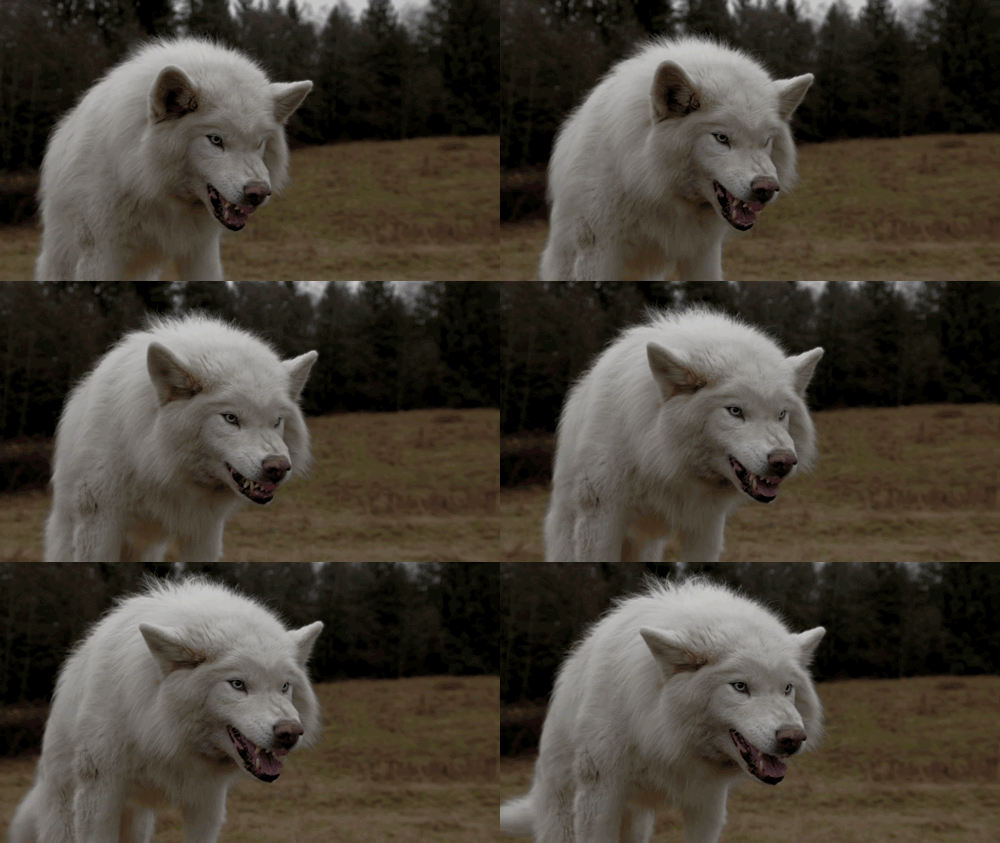
Aesop’s Fables do more than just offer a moral suggestion. Often the characters in the stories act as symbols. Since the fables are so short, the desired message must be delivered quickly and effectively. Using symbolic representations in the form of stereotypical characters facilitates that goal. The situations involved in both fairy tales and fables use character and creature symbols to convey situations more easily. The wolf is one of these chosen symbols. By looking closely at the way the wolf is portrayed in fables and fairy tales, we can see what the wolf symbolizes. The stereotypes and symbols evolved out of cultural feelings and beliefs, ultimately reinforcing themselves through the perpetuation of the fables and fairy tales. For example, the relevant points in The Nurse and the Wolf lie in the way the wolf is perceived. In this case, the wolf is conniving his way toward what he hopes is an easy dinner. The wolf is also a child-eater. The wolf patiently waits outside the window, hoping for such a "dainty morsel." Finally, as the Nurse hastens to close the window, the wolf is shown as a creature to be feared.
Many of Aesop's other fables portray the wolf in a similar way. The Wolf in Sheep's Clothing is the tale of a Wolf who is living just outside a pasture where sheep are kept and guarded. As the shepherd and his dogs are always present, the Wolf has great difficulty catching a meal of mutton. One day he discovers the skin of a sheep that was flayed and thrown aside. He puts the pelt on over his own, and starts out to walk among the sheep. The lamb of the sheep whose fleece he is wearing soon begins to follow him close by. Upon noticing this, the Wolf works his way to the end of the field where he quickly makes a meal of the little lamb. He continues this for some time and is always able to find an easy dinner as appearances are deceptive. Once again, it is interesting to inspect the assumptions about the wolf that are inherent in this tale. Like the first fable, the wolf is portrayed in a decidedly negative light. The wolf is shown as a tricky, conniving, greedy thief who will go to great lengths to tear into the flesh of a poor little lamb.

Aesop's Fables also portray the wolf in connection with wild nature and wilderness. As we will see later, the conceptual connection between wolves and unbridled, untamed, unkempt, and uncontrollable wilderness in the European mind links directly with religious attempts to exterminate wolves.
In contrast to the previous fables we examined, the fable titled The Wolf and the Dog, portrays the wolf as part of nature and as a truly free spirit. In the following paragraph, I retell the fable in my own creative dialogue:
A starving Wolf comes upon a plump and obviously well-fed dog. Gaunt and near-death in her hunger, the Wolf approaches the Dog. The Dog says to her, "Aah, Cousin, I knew how it would be; your irregular life will soon be the ruin of you. Why do you not work steadily as I do, and get your food regularly given to you?" The Wolf replies that this seems like the ideal situation. She asserts that she regrets not having a place, as the Dog does, among humans. The Dog replies, "Ah, just come along with me to my Master. You may share my work and you will always be fed. This I can easily arrange." Surprised by her good luck, the Wolf follows the Dog toward town. Soon, the Wolf notices a spot on the Dog's neck where the fur has been worn away. The Wolf inquires of the Dog why this is so. The Dog replies, "Oh, that? That is where my collar is fastened so that I may be chained up in the yard. It sometimes chafes a bit, but I am used to it." The Wolf stops and stares a moment in disbelief. She then asks, "So you cannot run free? You cannot roam? You must always stay in one place?" The Dog confirms the Wolf's suspicions, but points out that a collar is a small price to pay for plentiful food. The Wolf replies, "I cannot accept this! I see it is better to starve free than to be a fat slave! Good bye to you, friend Dog!" The Wolf turns and sprints back into the depths of the forest.
This fable is especially intriguing in that makes a clear connection between the wild wolf, freedom, and wilderness. It admits that the wolf sometimes has a hard life. It shows the wolf's desire to be free and to wander. Although this fable does not show the wolf in a wholly positive light, neither is the wolf portrayed as evil. This fable is important because it substantiates, through symbolism, the conceptual connection between the wolf and the wild.
In Aesop's Fables, we saw the wolf portrayed as a wild, boundless animal who is a conniving, tricky, sneaky thief and killer. This falls directly into line with the wolf as a symbol of evil in European society.
Whereas fables are typically short and moralistic, a fairy tale is a sometimes lengthy story whose main purpose is to entertain. Fairy tales occasionally contain a moral lesson, but unlike fables, the moral is not the focal point of the tale. Although the literary structure of fairy tales differs from that of fables, tales and fables differ little in their content regarding wolves. One needs only to recall some of the more famous fairy tales to elucidate the similarities. Recall the tale of the Three Little Pigs. Each Pig tries to build a house that will provide protection from the Wolf. But neither straw nor sticks can protect the little pigs as the Wolf "huffs and puffs and blows their houses down!" and promptly eats them. The smartest Pig builds his house of brick, which, fortunately, the evil Wolf is unable to destroy.

Consider also Little Red Riding Hood. As the tale goes, the young red-hooded Girl starts out through the dark and dangerous woods to her Grandmother's house. She is warned to go there directly, to make no stops. Along the way, she meets a Wolf, who asks of her where she going and who she is. Not knowing the "true" nature of the Wolf, she is not frightened. The Wolf then conceives of his plan to snap up both the Grandmother and the plump and tasty morsel of Little Red Riding Hood herself. The Wolf tempts the child to dally in the forest by pointing out the beautiful flowers and melodious birds. Although instructed otherwise, Little Red Riding Hood cannot resist the Wolf's temptation. With Little Red Riding Hood occupied by picking flowers and listening to birds, the Wolf rushes off to Grandmother's house. He tricks the Grandmother into allowing him to enter the house, and immediately eats her. He then dons her nightgown and sleeping cap, and crawls into the bed, drawing the covers up high. When Little Red Riding Hood arrives at the house, the Wolf makes short business of eating her. Having satisfied himself, he falls asleep in Grandmother's bed. This tale is replete with symbolism regarding the wolf. The wolf is portrayed as a tempting, greedy, deceptive killer and eater of small children and old women.
Alongside fears expressed in the fables and fairy tales, Europeans also had a deep seated fear of the werewolf. Lycanthropy refers to the quality of being a werewolf or human-wolf. A lycanthrope is a person who assumes the human-wolf form. These half-human/half-wolf creatures were seen as manifestations of the Devil. Legend tells us that these dark, evil creatures of the night would come into villages under cover of darkness to feed upon mortals.
Through the powers of Satan, and occasionally out of free will, normal humans sometimes can acquire the ability to shape-shift into the "lurid, sensational, criminal, and irrational" wolf-like creatures (Otten 1986). Acting from violence and evil, these human-wolves manifested all that was projected onto and hated about wolves, nature, and human nature in general. In the time of the Inquisition, hysteria revolving around werewolves and their criminal acts was nothing short of epidemic. Just as the massive witch trials in Salem led to the burning murder of so-called witches, the craze of werewolves led to a similar massacre. Suspected werewolves were burned alive at the stake. One writer, Montague Summers, who deeply studied the wolf lore of the Middle Ages, writes:
The werewolf loved to tear raw human flesh. He lapped the blood of his mangled victims, and with gorged reeking belly he bore the warm offal of their palpitating entrails to the sabbat to present in homage and foul sacrifice to the Monstrous Goat who sat upon the throne of worship and adoration. His appetites were depraved beyond humanity (Summers 1966:123).

The pre-existing real and imagined fears of wolves exacerbated and gave credence to the tales of these werewolves. The werewolf is thought of by some researchers to represent how difficult the switch from an organicist world view to the mechanistic world view really was . Since the werewolf represents unbridled nature to the fullest extent, werewolfism can be seen as a psychological response to a new world imperative that ordered humans to separate nature from culture within themselves, and to discard as useless and even vile that which corresponded with the "nature" half of the culture/nature dualism. The werewolf also helped to contribute to the development of the wolf as a symbol of unkempt and unruly nature.
Most importantly, emerging out of these fables and myths is a symbol: not the wolf itself, but instead a caricature that barely corresponds to reality. Humans created the wolf in their minds. Telling tales that perhaps began as innocent stories of a creature that awed and frightened people, European society escalated these tales into near-truths. Over time, the mythology and beliefs people held toward wolves created the symbolic wolf.
In the far distant past, many different human civilizations existed in a state of relative peace with the land and each other . Guided by a holistic goddess religion, ancient peoples respected and revered nature, life, and the creatures that were part of the Earth (Eisler 1987). Evidence of the ability to live in relative peace with nature and even predators is exemplified through the wolf rituals practiced by Native Americans. Although the wolf, the grizzly bear and other large mammals posed, perhaps, a threat to Native Americans, instead of destroying the populations of these animals, Native Americans learned to live in harmony with them. Wolf rituals practiced on the northwest coast of the United States are a case in point. These exceedingly complex and sacred rituals were a way of revering the wolf. Native Americans respected and admired the strength and survival skills of the wolf. These ceremonies ensured respect for the wolf, as those participating sought to receive the strength, hunting skills and bravery exhibited by wolves.
Native Americans, like the ancient peoples living under the guidance of the earth goddesses, saw and respected the interconnections between all aspects of the natural environment. These ancient egalitarian goddess societies left sometimes vast traces of their civilizations. Archeologists believe that the goddess-centered societies had a deep, religious respect for women, nature, life, and life-givers. These civilizations lived in a state of sexual equality and harmony with nature or literally thousands of years. Slowly, however, due to many varied factors including increases in the number of warring peoples, the development of male-based social hierarchies, the introduction of Christianity, and the rise of science-religion, the state of equilibrium began to crumble . The holistic, life-centered world view began to shift. Instead of viewing the world as a living creature made up of living interdependent parts, nature came to be viewed mechanically, like a clock. Slowly, over a long period of time, the cogs and wheels in the system became no more than lifeless, inanimate parts, functioning individualistically to form a whole that is no greater than the simple sum of its parts .
Carolyn Merchant (1980) describes the cognitive and physical events that preceded and endorsed the shift to a mechanistic world view in great detail. Although the paradigm shift from an organic to a mechanistic world view began centuries before, Merchant attributes much of the impetus for a final and full paradigm shift to the advent of the scientific revolution in the early 17th century. The organic-mechanistic shift occurred very slowly. The ancient goddess societies revered women, nature, and all life. The beginning stages of the mechanistic shift began to devalue women. Then, through time, nature came to be devalued as well. Even as early as 500 BCE (the time of Aesop) hints of the organic-mechanistic shift exist in the mythology and fables of the time. Merchant picks up on this, asserting not that the organic-mechanistic shift occurred at the time of the scientific revolution (approximately 1480), but that the famous male minds of the scientific revolution such as Descartes, Hobbes, Locke, and Newton exacerbated the shift, causing it to become more evident in mainstream culture .The shift to a mechanistic paradigm is very important with respect to the wolf.

The dualistic thinking that comprises part of the mechanistic world view created separations between parts of a whole. Men were conceptually separated from women, culture from nature, and rationality from emotion. These dualistic pairs were regarded as having a dominant or superior half: men, culture and rationality. After the belief that men, culture and rationality are superior to their counterparts followed the notion that the subordinate parts (nature, women, and emotion) should be destroyed, dismantled, ignored, and devalued. Because nature and women were conceptually devalued, any feminine or naturalistic human attributes were shoved aside as irrelevant parts of the cultured human.
Murder, destruction, disorder, and emotion were all traits cast out of human culture and squarely upon the realm of nature. Instead of recognizing these traits as integrated parts of humanity, negatively perceived characteristics were scapegoated onto nature and animals. It was animals who were wild, bloodthirsty, remorseless murderers. Despite the fact that humans are perhaps the most ferocious of all predators, they saw themselves as civilized, culturally advanced, and undeniably separate from and better than the disorganized, disheveled natural world. In this way, the human characteristics associated with nature or the natural world were denied and projected negatively outward onto other animals.
Unfortunately for the wolf, it became one of the "others" upon whom these negative traits were projected. The wolf became a literal reservoir for emotions and characteristics that humans sought to separate from themselves. Characteristics relating to wildness and to nature, such as savagery, brutishness, lawlessness, and remorselessness, among others, were transposed away from civil and governed humanity to the outlaws of nature. People failed to recognize that they were exhibiting the very behaviors they falsely attributed to and condemned in the wolf. They sought after killing and exterminating the wolf with a bloodthirsty fervor that cannot match even the most extreme notions of the evil wolf. By rejecting the predator within ourselves and projecting these qualities onto wolves and nature, we as humans refuse responsibility for our own predacious actions (Burbank 1990:171).
The displacement of "undesirable" human characteristics onto the wolf provided an impetus for their destruction. It also began the creation of the symbolic wolf. Seen as manifesting all of the negative, brute qualities of unbridled wildness, the wolf began its journey as an outlaw. Wolves were seen as a direct embodiment of uncontrollable nature.
Upon a foundation of the wolf as a manifestation of negative natural qualities, layers of mythology and religion were glued. The fables and fairy tales further advanced the notion of the wolf as evil and uncontrollable. "Denial of human animality, violence, and wildness, and the ascription of these traits to the wolf and to the world of nature has resulted not only in the eradication of wolves, but in the decimation of the natural world..." (Burbank 1990:179). In trying to reconcile the loss of holism created by mechanistic, dualistic thinking, Europeans developed within themselves the symbolic wolf. The Europeans fought against this wild wolf conceptually and physically in hopes of conquering that which they banished from--but still existed--within themselves.
SOURCE


