Showing posts with label wolf. Show all posts
Saturday

That was a close one: This morning in northern Italy, a wolf swam for its life in a canal. Turns out, he was very lucky in the accident - firefighters fished him out of the water, which wasn't even easy, but they did a good job.

The intervention began shortly after 7 a.m. in Gaggiano, an agricultural municipality in the southeast of the Milan area, between Via Milano and Via Italia. Firefighters from the Milan detachment on Via Darwin and the SAF (Speleo-Alpine-Fluvial) river unit arrived at the scene. Veterinarians from the ATS in Magenta (Milan) arrived at 12:30 p.m. to take charge of the wolf rescued this morning from the waters of the Naviglio Grande canal.

As explained by the Milan firefighters, the animal is expected to be handed over to a CRAS (wildlife recovery center) in either Milan or Piacenza. While awaiting this support, the firefighters had no choice but to keep the wolf secured in a net on the raft used to retrieve it, for safety reasons. Nevertheless, the animal appeared docile and allowed itself to be petted by the firefighters, who tried to keep it calm.

"Naviglio" refers to a system of navigable canals in the Lombardy region of Italy, particularly associated with Milan. The term comes from the Italian word "naviglio," meaning "canal" or "waterway." These canals were originally constructed for irrigation, transportation, and to support trade and agriculture, dating back to the Middle Ages. The most famous ones in Milan are the Naviglio Grande and Naviglio Pavese, which are still visible today and are part of the city's historical and cultural landscape. In modern times, the Naviglio Grande, for example, is a popular area for tourism, dining, and nightlife.

Italian wolves, specifically the Italian wolf (Canis lupus italicus), are a subspecies of the grey wolf native to the Italian Peninsula. They’ve adapted to a variety of habitats, from the forests and mountains of the Apennines to more open rural areas. Here’s a rundown of what makes them interesting:

Size: They’re generally smaller than other European grey wolves. Males typically weigh 24–40 kg (53–88 lbs), and females are a bit lighter, around 20–35 kg (44–77 lbs). Length-wise, they’re about 100–140 cm (39–55 inches) long, not counting the tail.

Appearance: Their fur is usually greyish with a mix of black and brown tones, though it can vary. In winter, it thickens up to handle the colder Apennine weather. Some have lighter, almost whitish coats, especially in certain regions.

Since the 1970s, thanks to legal protection and reforestation, their population has rebounded. They’re now found from the central-southern Apennines up to the western Alps, occasionally popping up near human settlements. Estimates suggest there are about 1,500–2,000 wolves in Italy today.

Source
VIDEO


Sunday

Her subsequent medical examination showed no other problems, so the animal will be able to return to her original territory after recovering for approximately one month.

Volunteers from Greece’s animal welfare organization ”ARCTUROS” launched an operation recently to save a trapped female wolf from a house’s iron fence in a village near Thessaloniki.

The unfortunate, petrified animal had most likely been chased by dogs and became trapped in its attempt to jump over the fence.

The incident took place in the village of Kastania in the county of Thessaloniki.

The Arcturos Emergency Response Team rushed to the scene and, along with the assistance of the Veterinary School of the Aristotle University of Thessaloniki, began the operation to sedate and then rescue the animal.

The rescuers named the wolf Elizabeth, which proved to be particularly fortunate in all of her misfortune.

Her wound did not affect any of the vital organs of her body, something that would in all likelihood have caused her death.

After being sedated, the volunteers of ARCTUROS carefully removed the wolf from the fence and the veterinarian was then able to treat her wounds.

Photo Credit ARCTUROS

Elizabeth was later transferred to the ARCTUROS Veterinary Clinic in Aetos, Florina where her wounds were stitched up.

Source

VIDEO

Saturday

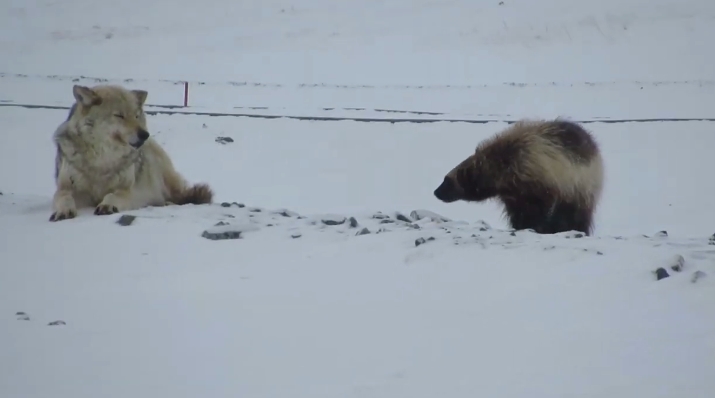
A wolf is seen just laying down relaxing, enjoying the day as if he were any other dog. A wolverine comes trotting not view and you think there’s going to be a wild battle. But, the wolf doesn’t flinch and seems as content as ever.

The wolverine walks around and the wolf just lays there happy as a clam.

Due to its close resemblance to the bear and the wolf, a wolverine is often incorrectly thought to belong to the same family as the wolf. A wolverine belongs to the weasel family, and it is known to be the largest among the land dwelling species of that family. It is sometimes called a glutton, or skunk bear, and has close resemblance to a small bear.

It is a very fierce animal, with a reputation for ferocity, and strength that is not proportional to its size. It is even able to prey on animals bigger than its size.

The wolverine predominantly lives in the remote areas of the subarctic and alpine tundra, in the northern hemisphere, mostly in the European Nordic countries of western Russia, Siberia, Alaska and Canada. They are very rare in the southern range of Europe and North America, due to a number of factors, including trapping and habitat fragmentation.

The wolf, on the other hand, is a member of the canine family, and it is the largest of that family. It can weigh up to 175 pounds, and can either be gray, white, brown, reddish, tan or black in color. A wolf is a very social animal, and they will often dwell in family groups, called packs. There is a strict hierarchical order in wolf packs, with the mother or father as the family head. On average, a pack will have 7 to 8 members, but it can consist of any number between 2 and 20 wolves.

They have one of the most complex communication systems in the animal world. Wolves have a build that closely resembles that of dogs, but with thicker fur and pricked ears. They are much more intelligent than wolverines, dogs and coyotes. They can communicate by howling, snarling, whining or barking. They will rarely go near humans or livestock, although they are mistakenly thought to be killers. Wolves are very common animals, found almost anywhere, especially in deeply forested areas.

VIDEO


Thursday

Intense drone footage from Northern Ontario captured a rare view of a wolf attempting to hunt a moose.

YouTuber Dan Nystedt was filming a moose that was near the shore of a lake using a Phantom 4 Pro. He says he was excited to see the moose, but just as he was leaving, he captured something very exciting.

Despite the size difference, a wolf suddenly appears from the woods, and the two animals begin a battle for their lives. After a back and forth for dominance, the moose retreats, and the wolf grabs hold of the moose's underside.

After a what seems like forever, the moose manages to break free of the wolf, and it slowly walks away with the wolf in tow.

The moose then heads for deeper water, tiring the wolf, and making it more difficult for it to attack.

Eventually, the wolf retreats, and is later seen with another wolf. At the end of the clip, the moose can be seen swimming across the deep lake, and it's presumably safe, for now at least.


"Captured this footage by happenstance while shooting some scenics in Northern Ontario. Was excited by the moose sighting, as I was leaving something unexpected took place. Shot in 4K with Phantom 4 Pro. " Dan Nystedt

VIDEO

Friday

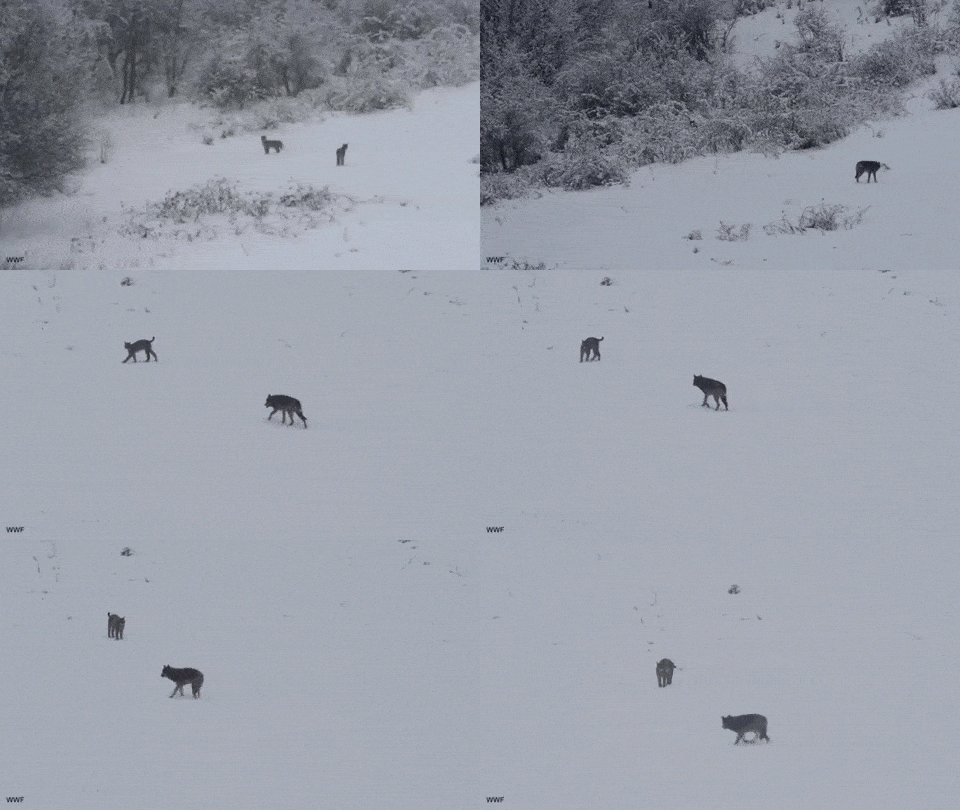
A little skirmish between a dog and a cat is nothing to write home about. But a snowy standoff between a wolf and a lynx? We're listening.

This rarely seen interaction between two of Europe's top predators was caught on camera in the Carpathian Mountains of Poland by forest ranger and biologist Zenon Wojtas, who's been tracking wolves in this region for many years, after becoming fascinated with the elusive animals when he was just a teenager.

Wojtas works at the Magura National Park in Beskid Niski, a region of the Carpathians known as the "Wolf Mountains". Here, one of the continent's largest populations of bison roams side by side with other wildlife rarely seen in Europe, including brown bears, boar, beavers, lynx and the area's star canid predators, wolves. His focus is on the monitoring and protection of these often vilified carnivores.

Having spent countless days (and nights) in the dense Carpathian forests, even during the cold winter months, Wojtas has notched up many amazing wildlife encounters, but this is one he describes as the "experience of a lifetime".

"I don't think many people can say they've seen how a wild lynx behaves in the presence of a wolf – not to mention three lynxes, as this was a female with two kittens," he says.


The young cats, seen in the video at a safe distance from the unfolding action, watched their mother's behaviour intently. On the wolf's part, Wojtas explains, the interaction looked quite playful, with lots of yelping and barking. But the lynx, likely in protective mode with her young close by, didn't appear to be in a light-hearted mood. "As the wolf slowly walked towards the female lynx, she arched her back to protect her kittens, as all mothers would do. It was not a fight, the wolf only wanted to play," he says. In the end, he recalls, the lynx chased off the wolf, who retreated with its tail between its legs.


A clip of his unforgettable encounter was featured by the WWF this week to spotlight the steady return of large predators like wolves and lynx to some parts of Europe. "Both these incredible animals have bounced back from the brink of extinction thanks to strong protection, but they are still at risk," the group writes. "We cannot run the risk of losing them again; they are fundamental species to keep our natural ecosystem in balance.”
Source


VIDEO

Sunday

This is the cheeky moment a brave wolf sneaked up behind a dosing lion and bit the end of its tail in a wildlife reserve in Botswana.

 Feeling the sensitive pain in its tail, the lion quickly woke up and turned round to pounce on his enemy only to see the wolf making a very swift exit into the bush.

This startling scene was captured by photographer Mark Drysdale from Johannesburg, South Africa, who watched in amazement as the wolf approached the lion. Mr Drysdale, 54, was photographing animals in Piper Pan Central Kalahari Game Reserve when he spotted the lion and the wolf.

'I watched the wolf approach the Lion from a few different angles, as wolves always hang around the Lions to try and steal a few scraps from their dinner table,' he said.

'This wolf sneaked up on the Lion from behind him and managed to close enough to have a munch on his tail because the lion was flicking his tail from side to side.

Photos Facebook

'I wondered what the wolf was going to do, but I certainly didn't expect him to bite the Lions tail. I thought the inter-action was very funny and typical of a bold naughty wolf,' he said.

'There was certainly no danger involved to me, for the wolf it was a different situation,' Mr Drysdale joke


Stats

Archives

Pages