Thursday

Seventy-four percent of all dog owners believe that their dogs experience guilt when doing something the owner doesn't want them to do. But then almost sixty percent of dog owners claim that their dogs’ guilty behavior leads them to scold their dog less.

One dog owner described her reasoning for believing her dog felt guilt as this: “I behave in a particular way when I feel guilty; my dog behaves in a similar way in equivalent circumstances; I know intuitively that my behavior is motivated by guilt; therefore the behavior I see in my dog is also accompanied by feelings of guilt.”

Although there is plenty of evidence for what scientists refer to as primary emotions – happiness and fear, for example – in animals, there is little evidence for secondary emotions like jealousy, pride, and guilt in animals. This lack of evidence is usually explained that these secondary emotions seem to require a level of cognitive sophistication, such as pertains to self-awareness or self-consciousness. The thought has been that these secondary emotions may not exist in non-human animals.

Charles Darwin observed that the types of behaviors associated with guilt such as keeping one’s head down, and averting one’s eyes, were also seen in other social non-human primate species. Not too surprising, guilt serves to reinforce social relationships and to minimize the effects of transgressions against social partners. The same behavioral patterns have been observed in wolves as well as domesticated dogs. In wolves, it is thought that guilt-related behaviors serve to reinforce social bonds by reducing conflict and increasing tolerance from other members of their social pack. Although this could also be true of dogs, their social groups would basically just be humans.

Given the fact that owners report that they are likely to scold their dogs less following the display of guilty behaviors, it stands to reason that dogs “guilty look” may just be a learned response. Research has found that dogs don’t always act guilty – only under certain circumstances. Dogs displayed significantly fewer guilt-related behaviors when being greeting by their owners, compared with when they were scolded. Another finding was that dogs who had misbehaved were not statistically likely to behave differently than dogs who had not misbehaved.

There was however a subtle finding that may have actually provided evidence that the dogs who had misbehaved were more likely to show guilt-associated behaviors. But not in the way one would anticipate. In an experiment each dog had three opportunities to greet their owners. Once before a rule had been established, the second time after the rule had been established and dogs had an opportunity to violate the rule, and the third time, after the rule had been established, but without an opportunity to violate the rule. Although all the dogs were more likely to act guilty during the second greeting while being scolded, only the dogs who had actually transgressed were more likely to continue acting guilty during the third greeting. These experiments were all done within a laboratory environment.

It has been suggested that future research should investigate these questions in a familiar environment rather than in a laboratory. The research should also examine a social rule that has already been established between an owner and their dog. It appears then that there may still be some time before we will know for certain whether dogs can experience guilt, or whether people can determine if a dog has violated a rule prior to finding concrete evidence of it.

Call to action on Indigenous peoples at risk of extinction in Colombia

The Wayuu people are in danger of becoming extinct. According to Amnesty International, this indigenous group is one of 34 Colombian nations that are in immediate danger of disappearing forever if something is not done immediately.

The Wayuu or Guajiros, who are Arawak, are among the few Latin American ethnic groups that have been able to avoid European acculturation over the centuries.

Angelica Ortiz, a Wayuu, testified at the Inter-American Commission on Human Rights (IACHR) earlier on in the year and spoke about how large scale coal mining in Colombias Guajira peninsula has gravely impacted her community. The Cerrejon mine (a BHP Billiton, Anglo American and Xstrata joint venture) is one of the largest open pit mines in the world.

Mining development has gone on despite the Colombian constitution recognizing the right of the indigenous people to manage the resources found on their territories.

Ortiz says that her people have higher rates of diseases, including cancer, and their environment has changed as sources of food have disappeared. There has been an increase of violence as women are being raped and people are being killed. Many have fled the area and if this continues, the whole Wayuu people will be dispersed and their culture will be lost forever.

The mining companies are now trying to deviate a river, which is currently the Guajira's only source of water, a region prone to drought. Ortiz said, Territory, for indigenous peoples, is life, and mining is equal to misery.

Linda Cabrera, from the Asociacion Colectivo Mujeres al Derecho, told the IACHR that mining industries create war-like conditions in rural and indigenous areas with a disproportionate impact on women.

In 2009, the Constitutional Court of Colombia determined 34 Indigenous Nations“ including the Wayuu“ to be in imminent danger of physical or cultural extermination due to the impact of armed conflict and forced displacement. The Court called the situation an emergency which is as serious as it is invisible.

In a 2010 report, Amnesty International documented an intensification of threats and attacks on indigenous communities and their leaders in Colombia. Those who raise their voices in opposition to such projects continue to be targeted with threats and killings.

Last year, it emerged that thousands of Wayuu, who mostly neither speak nor read Spanish, had been given derisive names on identity cards issued by authorities.(Source)


Watch UN film “Wayuu Gold, Fighting for Access to Fresh Water”:

VIDEO Colombia: Wayuu Gold, Fighting for Access to Fresh Water


A petition to the President of Colombia and the Secretary-General of the United Nations to intervene and save the Wayu has already attracted nearly 20,000 signatures, you can add yours here.


Blink and you might miss it. A team of researchers studying leopards and other cats on the Indonesian island of Sumatra has instead captured a few seconds worth of video of the Sumatran striped rabbit (Nesolagus netscheri), a species so rare and elusive that it has only been photographed three times previously, in 1998, 2000 and 2007. Prior to that, the rabbit had only been sighted in 1972 and several times earlier than 1929.

After seeing these images, the researchers took the opportunity to compile further data on the rabbit by asking other researchers in Sumatra if they had ever seen the animal. The only positive responses came from scientists working in Kerinci Seblat N.P. In a paper published online last week in the journal Oryx, the researchers conclude that these two Sumatran parks are probably the last strongholds of the rare species.

“We can’t say they don’t occur elsewhere,” lead author Jennifer McCarthy, a doctoral candidate with the University of Massachusetts Amherst, said in a prepared release, “but we are saying it’s important to preserve those areas in order to save the species.”

The isolated section of Bukit Barisan Seletan where the researchers got their photos does not currently get much human traffic, but wildlife in other parts of the park face threats from poaching and encroachment. Sumatra lost more than 3.1 million hectares of forest habitat to logging, coffee and palm oil plantations between 2000 and 2009, so the researchers say it is important to preserve this land before it, too, disappears.

McCarthy’s husband and co-author Kyle McCarthy, an assistant professor with the University of Delaware, said in another release that this is an important opportunity to remind people that the Sumatran striped rabbit even exists. “We’ve had a chance to not rediscover a species but, in essence, to bring focus back to a very rare rabbit. Often things like rabbits go overlooked because most people don’t even know there is a Sumatran rabbit. Part of doing field work in remote locations is that we are able to see things like this, and it can be really important for conservation.”


Jennifer McCarthy tells me that they their next step is to try to determine what is required for the rare rabbit’s critical habitat. “We can then make sure that we direct effective conservation initiatives that will hopefully prevent this extremely rare species from disappearing,” she says.

Previous research suggests that the Sumatran striped rabbit was never a common species. It is similar in size to the common European rabbit (Oryctolagus cuniculus) but with much smaller ears and several stripes of color in its fur. The Sumatran rabbit is similar in appearance to the related Annamite striped rabbit (Nesolagus timminsi), found in the mountains between Laos and Vietnam. Genetic samples reveal that the two Nesolagus species diverged from each other around eight million years ago.

Source


Here’s the fleeting glimpse of the nocturnal rabbit captured by the team’s camera traps in Bukit Barisan Seletan National Park:

VIDEO Rare Rabbit Captured on Camera

Wednesday

Disasterous pipeline halted in Colorado

A huge victory for endangered fish and other river species was recently given by the Federal Energy Regulatory Commission. For the second time they rejected a permit for a massive, controversial pipeline that would be a disaster for the Colorado and Green rivers. The Flaming Gorge pipeline would suck an astonishing 81 billion gallons of water from the Green river each year. This would have caused a potentially fatal blow to one of the West’s last great rivers. In addition it would have spelled disaster to razorback suckers and Colorado pike minnows.

The Center for Biological Diversity and it's allies had intervened with legal action against the pipeline's permit process. The commission said the project was poorly defined and that its proponent, Wyco Power and Water, Inc., was dismally unprepared to get all the authorizations needed to build it. In other words the outrageous attempt to deplete two rivers should be over with.

The Center for Biological Diversity has continuously led efforts to protect the sucker fish habitat. They have also worked to restore important desert rivers. All of this may offer a glimmer of hope for the razorback sucker and other native fish as it led to the decommissioning of a diversion dam and environmentally destructive power plants that depleted Fossil Creek water. The Center for Bological Diversity has also slowed excessive livestock grazing that degraded water quality there. Their most recent efforts have been to begin to reintroduce native fish back into the creek.

Razorback suckers are a large warm water fish species that are native to the Colorado River basin. Unfortunately the construction of more than a dozen dams throughout the lower basin of the river has left little natural habitat for the fish. Once common throughout the river basin, the sucker is now reduced to less than a quarter of its former range and its presence is rare in most areas. Because the remaining fragmented wild populations are in such serious jeopardy, the halting of the pipeline provides a wonderful opportunity to allow for it's comback.

Photo: Richard Zimmerman

VIDEO Green and Colorado River Fly Through

A new $40 million study has found the energy dynamics of the Arctic Ocean changing drastically, and in ways not foreseen by previous climate change predictions.

The study, which involved 10 teams from 27 countries, looked at the open water along the breaks in multi-year ice, which are known as flaw leads. The results paint a depressing picture of ways in which climate change is altering the Arctic’s marine ecosystem, from weather, ocean currents and the life of flora and fauna, all due to record lows of ice coverage and thickness.

The results, which show that climate change is reducing biodiversity, were released at last week’s International Polar Year Conference, which saw criticism of an apparent attempt by the Canadian government to muzzle its own scientists attending the conference.

In its latest assault on environmental protections, Canada’s government has just stopped funding a key research site in the Arctic looking into what is now a record hole in the ozone layer, which protects the earth from the harmful effects of the sun’s radiation and which has been eaten away by now-banned chlorofluorocarbons (CFCs), used as refrigerants and in aerosols.

“The Arctic Ocean is definitely changing on a whole lot of different fronts,” said Prof. David Barber, of the University of Manitoba at the conference. But this is not news to the Inuit, the indigenous people of the Arctic, who had a small conference presence but are having to work hard to make their voices heard and get their longstanding knowledge taken into account.

The president of the Inuit Circumpolar Council, Aqqaluk Lynge of Greenland, told the conference that traditional knowledge could complement scientific evidence and analysis and emphasized that Inuit highly prize working with scientists.

“We as Inuit fully welcome the opportunity, indeed, the necessity, of working with scientists from around the world,” he said. “We welcome and we need the … research and data generated so that our decisions may be made with sound and cutting-edge knowledge. We Inuit want to cooperatively move from knowledge to action.”

Photo-Credit: SUE FLOOD

Lynge said that Inuit knowledge, ranging from traditional ceremonies, to technologies, to cultural expression and language, provides resources upon which scientific investigators can draw to enhance their understanding of the Arctic.

“You have to understand that to us the Arctic is our home. It is not a mining company or a scientific laboratory. It is our home,” he said.

Lynge said that climate change is a major threat to Inuit.

“I have seen the sadness of my people as they do not know how to cope with these changes that often robs them of their traditional livelihood and their culture,” he said. “Inuit keep asking [for] help to address their concerns regarding climate change. They ask me increasingly to take their local concerns to the international community.”

But Lynge noted a “most chilling impact.”

And that is “the fear that our knowledge system will be so severely jolted by such a radical shift in the climate that the very foundation of who we are as a people may be at risk.” (Source)

Watch 2007 interview with Aqqaluk Lynge about how a proposed airport expansion in Britain would effect his people thousands of miles away in North Greenland:

VIDEO Interview with Aqqaluk Lynge, Inuit Leader

Curious Baby Penguin Encounters Its First Human (VIDEO)

Penguins have been a hot, or rather cold topic in the news lately. In March, a Humboldt penguin sprang from a Japanese aquarium and spent 82 days on the loose in Tokyo Bay. Then, in April, an aerial survey determined that the Emperor Penguin population has doubled in Antarctica

The latest dapper waterbird to waddle into the spotlight is this baby Gentoo penguin caught on video by adventure blogger Joel Oleson. In this short but irresistible viral video, the curious penguin explores Oleson and nibbles at his clothes and face. “Could have lost an eye!” Oleson writes in the video’s YouTube description.

According to Oleson’s blog, the penguins weren’t afraid to approach him because they had never encountered humans before:

"The penguins were amazing. We went around in Zodiak’s and would see penguins swimming along with us and jumping out of the water like dolphins. For me it was seeing the animals in their habitat and walking around on Antarctica which felt like being on Mars. Not that I’ve been on mars, but definitely felt like another planet. There aren’t any trees or bushes, just liken, moss, and strange grasses. While some would describe it as a barren wasteland, the reality is it’s some of the richest fauna on the planet. Tons of different kinds of whales, various seals and sea lions, elephant seals, various sea birds including various cormorants, sea eagles, and we saw a huge albatross.

The conditions were great while we were there. While we were glad we brought our snow clothes, the wind wasn’t too bad. Our Chilean guide brought us to a couple of different glaciers. For the zodiac rides we wore these orange Life suits that apparently can float. They did give us the suits and we wore our normal clothes under them"


VIDEO Curious little baby penguin

There's no doubt about it: dogs sure know how to sleep. The amount of time spent napping varies from dog to dog and depends on the dog's age and personality. Counting little naps and longer snoozes, most dogs sleep about fourteen hours a day.

Nobody is sure why dogs sleep so much. The amount of sleep that an animal needs depends upon its species. Horses and cows may sleep only three or four hours daily, because they require long hours of grazing to supply their bodies with sufficient food. Bats and opossums may sleep closer to 20 hours.

The various breeds of dogs also seem to have different sleep requirements. Some very large breeds of dogs, like Newfoundlands, Saint Bernards, and mastiffs, often spend a great deal of their lives sleeping – perhaps up to sixteen or even eighteen hours a day. For this reason they were often referred to as "mat dogs," because they could always be found lying in front of the fireplace, much like a giant, furry hearth mat.

Dogs sleep more than us, but they wake more frequently than we do. How much and when they sleep depends on the level of activity in their environment. A dog living as a pet in the home is likely to sleep more than a dog that works for a living, like a search and rescue dog or a dog working on a farm. Dogs are lucky – they are able to adjust their sleep pattern so that they can be awake when there is something to do, and asleep the rest of the time.

Of course, today's modern indoor dog sometimes sleeps out of boredom. You can help your pet by providing plenty of stimulation during the day – this can be in the form of toys, a companion, or plenty of walks and playtime with you. If he has enough to do during the day, he may stay awake when the sun is up and sleep at night when you do.

Sleep Patterns

Dogs have the same sleep patterns as humans. When your dog first goes to sleep, he enters the slow wave or quiet phase of sleep. He lies still and is oblivious to his surroundings. His breathing slows, his blood pressure and body temperature drop, and his heart rate decreases. (Source)


After about ten minutes, your dog enters the rapid eye movement (REM) or active stage of sleep. He rolls his eyes under his closed lids, he may bark or whine, or may jerk his legs. During this stage, the brain activity is similar to that seen during the dreaming sleep of humans, and is evidence that dogs have dreams.

Incidentally, adult dogs spend about 10 to 12 percent of their sleeping time in REM sleep. Puppies spend a much greater proportion of their sleep time in this type of sleep, no doubt compacting huge quantities of newly acquired data.

Below, some selected videos of sleep-fearing pooches for your enjoyment:


I'm a dog, so good at sleeping!


Tuesday

A celebration of light, colour and nature!

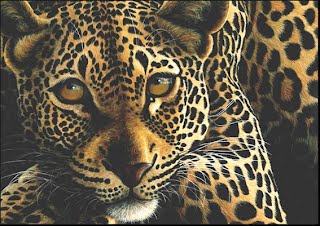
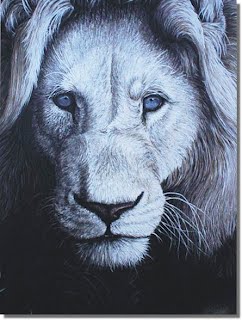
Debbie Lesueur was an avid animal lover from the very beginning. She grew up living and playing in nature on a small homestead south of Johannesburg, South Africa. She also came from a family with a very strong artistic background. Debbie grew up wanting to have a career that involved animals though. Her first thoughts of a career were to be a game ranger, or maybe a veterinarian. But the thought of dealing with injured animals soon caused her to change her mind. It was her grandmother’s influence as an art teacher, who helped Debbie to express her love for wildlife through her artwork.

Debbie however believed at first that her paintings could only be treated as a hobby not as a serious career. So to be safe, Debbie got her Diploma in Commercial art and completed a Computer Graphics course. She started her career as a DTP\Graphic Artist with an added passion for photography. However, her love of painting was never far from her thoughts.

In 1998 Debbie started her career as a wildlife artist. She is a self taught painter and has developed her own unique style by using a technique that makes her paintings very realistic. With this technique she focuses on the eyes, bringing the animal to life as people view her work. Her parent’s influence of meticulous perfection has molded Debbie into being a Realist painter, however she also loves the abstract artwork that her grandfather was known for. Despite being a Realist, some of her work is actually quite graphic which is a reflection of where her art career initially began.

Debbie's wonderful artwork is recognized internationally and she has painted extensively on leather which creates a very unique and rustic look for her paintings. Recently however she has begun to paint more on canvas. Debbie describes her artwork on leather in this way, "My first Wildlife Paintings were done on leather which proved to be a unique and rustic surface to paint on. Due to demands I spent the first 12 years of my career mastering my technique and medium on leather. Occasionally I used a textured leather, even did a commission on an Elephant Ear but I favoured the smooth leather as I could get the sharpest detail! I love using strong contrasts and this made me favour black leather which also developed my technique as opposed to starting with a white background! I originally tried oil paint which was absorbed too much by the surface and did not work as well as Acrylic and that is why even today my self taught technique favours this medium."

Debbie has exhibited with the Japan Wildlife Center at the Machinda City Museum of Graphic Arts in Tokyo in 2009. Then in May of this year, Debbie was chosen to Exhibit at the Mall Gallery London in the DSWF Wildlife Artist Of The Year Competition. Please enjoy some of her wildlife paintings below.


Visit Official Website of Debbie Lesueur

Tribe Poised to Take Control of Badlands South Unit

The South Unit of the Badlands National Park could soon become the first ever tribally run National Park in the country. The Oglala Sioux Tribe is hammering out an agreement to transfer control of half of the Badlands National Park back to tribal control and management. Some hope the move sets a precedent for other tribes around the country. SDPB's Charles Michael Ray reports that tribal officials hope the move brings more visitors to Pine Ridge. He has today's Dakota Digest.

When Gerard Baker walks through the Badlands he keeps an eye out for one thing.

"I grew up in North Dakota in snake country so I always watch for rattlesnakes and any other little things we have around here," says Baker.

Baker Served as the Superintendent of Mount Rushmore before taking a job as the Director of the Oglala Sioux Tribe Parks and Recreation Authority. Baker looks out over the red clay and yellow sandy bluffs of the Badlands. It's a ruggedly beautiful landscape and it is sacred to the Lakota.

"You can come out here for example... and listen to that, and you can hear the same sounds that our warriors and our families heard coming across this area 500 years ago maybe 1000 years ago. And so those sounds are still here, the feelings are still here which means the spirits are still here," says Baker.

Baker is not Lakota but Hidatsa from North Dakota. He points out that where the lower half of the Badlands National Park sits is on tribally owned land. The land was taken by the Department of Defense around World War II for a bombing range. In 1976 the D.O.D. was ready to give back the Badlands, but it came only with the stipulation that the area become a national park. This left the Oglala Sioux Tribe little say in the management of the 133-thousand acres here.

"There has always been a sense of loss for these people here especially those who were on the land and this is one way of getting that back maybe a generation or two later," says Baker.

The agreement being worked on keeps the Badlands National Park intact--but gives the tribe the full authority to manage its portion of the park and to also reap the benefits of visitor traffic and new jobs. Sandra Washington is with the National Park Service.

"Tourism is a big industry all over this country and certainly in an area as poverty stricken as the Pine Ridge Reservation anything that provides an economic lift is a great thing," says Washington.


Washington says the opportunity will open new doors for tribal members who want to become Park Rangers. It will also allow the Oglala Lakota to create their own interpretive and educational programs at the park. Gerard Baker hopes this helps remove stigma around the Pine Ridge Reservation.

"What I want to encourage people to do is come down and it's OK to come south, and I really mean that because in the past we've had a little bit of a problem with even some folks from the state of South Dakota saying do not come down here, the American Indians are having a tough time and they say some more awful things that I completely disagree with," says Baker

Baker says families can come to a place like the White River Visitor Center in the South Unit and get a unique experience including Lakota stories and history of the Badlands.

"I think one of the biggest challenges people have coming down here is that don't know about the places to stay down here, they don't know that we have restaurants down here, they don't know that we have areas where you can go to educate yourself. And, one of our jobs this summer is to let those folks know that come down here and give them a good experience so they can go home and tell their neighbors, friends and relatives and they keep coming back," says Baker.

Tribal members hope this move sets a precedent for other areas of the country where tribal lands fall in parks. Turns out there are a number of iconic landscapes in the United States that are tribally owned. Monument Valley is the setting for the wiley coyote and the road runner. The area is every bit as iconic as any national park -- But it's not a U.S. national park - it's a Navaho Nation Park. The Navaho own Monument Valley and they've managed it as their park for over 50 years. Martin L. Begay is the Director of Navaho Parks and Recreation. Begay says what's happening in the Badlands of South Dakota should open the door for other tribal nations to take over management of National Parks in their areas.

"One case in point is Rainbow Bridge National Monument which is run by the National Park Service and it's actually a sacred site to most of the tribes that are here in this part of the country," says Begay

National Parks Service Officials say they aren't sure if this case will set a precedent elsewhere because each individual tribal nation has unique circumstances. Sandra Washington with the National Park Service.

"I don't know of another place in the National Park System where we have that kind of relationship with a tribe on lands," says Washington.


Back in the Badlands Gerard Baker is still scanning the ground for rattlesnakes as he walks. Baker says he does believe this case should pave the way for the return of other parks on tribal lands. The Oglala Sioux Tribe and the National Park Service plan to sign an agreement by the end of this month that lays out the transfer process, but full approval requires an act of congress. It's congress that created the Badlands National Park. Now those close to this process, hope congress will see fit to give control over part of the park--back to the original owners.
Source
LISTEN AUDIO INTERVIEW


The Earth’s shadow will darken part of the moon next Monday in a partial lunar eclipse, visible from the Pacific Ocean and surrounding areas.

The places that will get the best show, besides the middle of the ocean, include western North America, Australia, New Zealand, and Japan. In most parts of the United States, the eclipse will happen in the predawn hours, and the moon will set before the event ends.

According to NASA’s predictions, the eclipse will begin at 8:48 a.m. GMT (4:48 a.m. EDT, 1:48 PDT) on June 4 and will end several hours later at 1:18 p.m. GMT (9:18 a.m. EDT, 6:18 a.m. PDT).

At first, it won’t be that noticeable—just a vague gray shadow that gradually appears on the full moon’s surface. This is the Earth’s penumbra, or the fuzzy edge of its shadow. But at 10 a.m. GMT (6 a.m. EDT, 3 a.m. PDT), the Earth’s umbra, or full shadow, will touch the edge of the moon.

The shadow will appear to take a black bite out of the moon over the next two hours, but it won’t be that big. Even at the height of the eclipse, less than half the moon’s surface will be shaded.

This event is the counterpart of the solar eclipse that crossed the Pacific in May. Every eclipse occurs two weeks from another eclipse; that is, a lunar eclipse must occur two weeks before or after a solar eclipse. A lunar eclipse can only happen on the full moon, when the sun and moon are on opposite sides of the Earth.

Lunar eclipses can be seen easily with the naked eye, or you can use binoculars for a closer look.

This is the first of two lunar eclipses this year. The second one will be a barely noticeable penumbral eclipse in November.
SOURCE

PHOTOS The lunar eclipse of Dec. 21, 2010, as seen from Ft. Myers, Florida.

The beginning of the Lunar Eclipse around 1.30 AM EST as seen from Ft Myers,Florida (Mark Zou/The Epoch Times)

The Lunar Eclipse around 1.58 AM EST as seen from Ft Myers,Florida (Mark Zou/The Epoch Times)

The moon changes color during the lunar eclipse as seen from Ft Myers,Florida 2.33 AM EST (Mark Zou/The Epoch Times)

More brightness begins to show around the rim of the moon during the lunar eclipse as seen from Ft Myers,Florida 3.22 AM EST (Mark Zou/The Epoch Times)

The lunar eclipse around 3.30 AM EST as seen from Ft Myers,Florida Mark Zou/The Epoch Times)

The lunar eclipse around 4 AM EST (Mark Zou/The Epoch Times)

The moon returns to full Shot taking around 4.30 AM (Mark Zou/The Epoch Times)

Monday

Today is Memorial Day in the U.S. It is a day that is set aside as a holiday in order to honor the war veterans and those who have died while serving for their country. It is a day of speeches and parades and gravesite visitations. Honor, appreciation and respect are words that come to mind when reflecting on those who have fought wars in the name of freedom.

However there is another war hero that has been too often forgotten about. They are the silent soldiers who serve out of love and trust, they are the War Dogs. War dogs serve right along side their handlers in the middle of battle. They are in the thick of war and unflinchingly put their lives on the line. The war dogs have served throughout time in all the recent wars and have died in the service of their country also.

However there is little or no mention of them on Memorial Day in the speeches or in the parades. They are taken for granted for what they do. But the war dogs are without ego and do not care about any of this. All they really want is to be with their handler during military service and after. But for all the work, the military puts into training the dogs, federal law ties the military's hands in protecting the canines afterward.

These dogs have survived running toward death and danger, but too many trained military dogs of war are not making it home. This is because there is a obscure federal rule technically classifying military canines as equipment, not personnel.

Animal advocates say that after war the dogs aren't guaranteed transportation back home or medical care after service. So any potential adopters would have to pay huge fees, many times in the thousands of dollars to pay those bills. The bureaucracy involved can be maddening also, often a year of red tape and unanswered phone calls.

Currently there is legislation to close the federal loophole, to instead classify war dogs as "canine members of the armed forces" instead of equipment. The legislation would require the military to ship the dogs home and allow nonprofits to help adopters foot the steep veterinarian bills. Unfortunately the bill is currently stalled in a gridlocked Congress. Hopefully soon this legislation will be passed so that these long forgotten canine war heroes will be given the only reward they really want - that of a loving home.


VIDEO "The Forgotten Heroes".


Western lawmakers want to elevate the Plains bison to a status similar to that of the iconic bald eagle with legislation to declare the burly beasts America's "national mammal."

Fans of bison are lobbying Congress to declare America's largest land mammal the "national mammal" -- putting it right up there with the bald eagle as an American icon. But bison have their critics, as well as competition: killer whales are mammals, too, and then there's that other widespread mammal: humans.

"The North American Bison is an enduring symbol of America, its people and a way of life," Sen. Michael Enzi, R-Wyo., said in a statement Friday announcing the "National Bison Legacy Act."

"Throughout history, the bison has been the center of the economic and spiritual lives of American Indians and is an important historical symbol of the United States," added co-sponsor Sen. Tim Johnson, D-S.D.

They introduced the bill at the request of an alliance among the Wildlife Conservation Society, the Intertribal Buffalo Council and the National Bison Association.

"The bison is the nation’s most culturally recognizable animal and as such deserves recognition through designation and celebration," the alliance noted. "Bison currently appear on two state flags, on the seal of the Department of the Interior, and on U.S. currency. In addition, bison have been adopted as the state mammal of Wyoming, Oklahoma and Kansas."

Tens of millions of bison, or buffalo, once roamed North America, but the species dwindled to about 1,000 by the early 1900s. The numbers are back to an estimated 20,000 in the wild today. In addition, about 500,000 commercial bison are on 4,000 ranches.

Photo Credit David Burnett

In recent years, efforts have been made to put wild bison on more parts of the West -- including the transfer in March of about 60 Yellowstone bison to Montana's Fort Peck Reservation.

But the symbolic act would not provide added protections for wild bison, which have their enemies.


In Montana, The Associated Press noted, livestock producers and property advocates have filed lawsuits to stop free-roaming bison, arguing they tear down fences, spread disease and compete with domestic cattle for grass.

And Boulder, Colo., this week rebuffed billionaire Ted Turner's donation of a bison herd for public viewing. It cited cost concerns and public opposition.

John Calvelli, spokesman for the Wildlife Conservation Society, told the AP that the effort is meant to transcend such issues.

"This isn't about getting into the middle of these issues of bison and property rights," he said. "No matter what political stripe you come from, we can all agree on the important role that bison have played."
Source

Photo GregRob

VIDEO Senators seek to name bison 'national mammal'


The leopards at Big Cat Rescue are definitely some of the funniest cats at the sanctuary! They're often "break dancing", playing with enrichment, stalking tour guests and just being goofy! But remember despite how cute and cuddly they may look sometimes, they are still very much WILD and their mood can change very quickly from fun to ferocious!

About
Big Cat Rescue, a non profit educational sanctuary is home to over 100 unwanted, abandoned or abused exotic big cats.

Mission
To provide the best home we can for the animals in our care and to reduce the number of cats that suffer the fate of abuse, abandonment or extinction by teaching people about the plight of the cats, both in the wild and in captivity, and how they can help through their behavior and support of better laws to protect the cats.

Big Cat Rescue, a non profit educational sanctuary, is devoted to rescuing and providing a permanent home for exotic (i.e. wild, not domestic) cats who have been abused, abandoned, bred to be pets, retired from performing acts, or saved from being slaughtered for fur coats, and to educating the public about these animals and the issues facing them in captivity and in the wild.

Description
* Big Cat Rescue is the largest accredited sanctuary in the world dedicated entirely to abused and abandoned big cats.
* The nonprofit sanctuary began in 1992.
* The sanctuary is home to more than 100 exotic big cats
* The cats at Big Cat Rescue are here for a variety of reasons, including:
o Abandoned by owners who wrongly thought they would make good pets
o Abused by owners in order to force them to perform
o Retired from performing acts
o Saved from being slaughtered to make fur coats
o Rescued as babies after hunters killed their mothers
* Big Cat Rescue has more than a dozen species of cats, many of whom are threatened or endangered in the wild, including:
o Tigers, Lions, Leopards, Cougars
o Bobcats, Lynx, Servals, Ocelots, Caracals
* Big Cat Rescue’s mission is to provide the best possible home for the animals in our care and try to stop the flow of exotic cats needing sanctuary by educating the public about the plight of the animals and supporting stronger laws to protect them.
* The non-profit organization is:
o Accredited by the Global Federation of Sanctuaries
o Certified by Independent Charities of America as a “Best in America Charity”
o Member of the World Society for Protection of Animals
o The sanctuary is situated on 55 acres in the Citrus Park area of north Tampa.

Source


VIDEO Funny Leopards

After Sasha was saved from the brink of death by a local rescue group, the dog soon returned the favor when she took in a baby raccoon that was brought to the same shelter, nursing it back to health and treating it as her own.

The circle of life takes a beautiful turn after a dog loses a puppy, only to adopt an orphaned baby raccoon.

Dumped at a Missouri shelter, Sasha was facing possible euthanization until local rescue group SNUGGLE stepped in and rescued her. A large lump in her abdomen raised concerns about a possible tumor until an ultrasound revealed that she was pregnant with two puppies. Sadly, when the big day arrived, one of them was stillborn.

At the same time an orphaned baby raccoon was discovered huddling in a carport in St. Charles, MO. The needy baby was brought to the Pet Doctor pet clinic in O’Fallon, MO – the same clinic that was caring for Sasha after she gave birth. Vets were quickly overwhelmed by the feeding schedule of the young raccoon. “We started off bottle feeding it and just couldn’t keep up with its needs,” Dr. Kelly Hogan said.

Dr. Hogan and her staff decided to try an unconventional idea – and introduced the hungry youngster to Sasha. They were thrilled with the outcome.

“She accepted him within an hour. She was fabulous with him. Even when he started making little ‘raccoony’ kind of noises, she didn’t have a problem with it,” Dr. Hogan said. “She loves him. She’s protective of him now…she’s watching him. She’s his momma!”

Now Sasha spends her days caring for her two youngsters, cleaning and grooming each of them – and even letting clinic staff know she’s not happy with them when they take the baby raccoon for exams by jumping and whining until it is returned to her. “It’s kind of amazing you know, two different species like that,” Dr. Hogan said.

SNUGGLES rescuer Sharon Maag said she feels it’s only natural that the arrangement worked out. “Because it’s a baby and she lost a baby; maternal instincts. We saved her life and she saved a life,” she said. Maag points out that in time, the raccoon will be weaned before being released into the wild.
Source


VIDEO Rescue Dog Adopts Baby Raccoon


Sunday

And it’s feared many more have been illegally released into the wild and will have starved to death

Animal sanctuaries in England are caring for hundreds of pet owls that were abandoned by their owners in the past year, a disturbing trend rescuers believe is linked to the end of the "Harry Potter" series.

"Harry Potter" fans enchanted with the boy wizard's owl sidekick Hedwig drove up demand for the birds during book and movie releases, the Mirror reports. But now that all book installments and film adaptations have been released, many owners are abandoning their pet owls into the wild, where they are unprepared to care for themselves.

"Before the films were out I had six owls, now it's 100. It’s all down to ­Harry Potter," Pam Toothill, a rescue workers at the Owlcenter sanctuary in Corwen, North Wales, told the paper. "People saw ­Harry’s owl in the movies and thought how cute and cuddly they looked. Now they are bored and fed-up with all the work involved looking after an owl."

Toothill said that in order to properly to care for owls, owners need to purchase a 20-ft. aviary, which can easily cost more than $1,000. Unfortunately, many unprepared pet owners have kept birds in apartments with limited space -- one owl Toothill rescued had been living in a man's bedroom.

"Harry Potter" author J.K. Rowling has pleaded with fans to sponsor an owl that needs help rather than trying to take one in as a pet, according to the Suffolk Owl Sanctuary.

"If anybody has been influenced by my books to think an owl would be happiest shut in a small cage and kept in a house, I would like to take this opportunity to say as forcefully as I can, 'you are wrong,'" Rowling said.

But if past cases of fan-fueled animal crazes are any indication, people are often undeterred by such advice. When Disney released the live-action film '101 Dalmatians' in 1996, animals rights advocates worked tirelessly to educate prospective pet owners about the breed in order to prevent disastrous adoptions.

Unfortunately, the film's popularity fueled thousands of Dalmatian puppy adoptions that owners later regretted, and shelters were soon overflowing with unwanted dogs, The New York Times reported in 1997.

Careless owners: People are abandoning pets, such as this barn owl

Years earlier, thousands of pet turtles met a similar fate after fans of the animated "Teenage Mutant Ninja Turtles" TV series grew tired of their newly-adopted pets, according to Change.org. Many dumped their turtles in ponds or lakes, where they began to reproduce and outcompete indigenous species of turtles for food.

Pat Morrison, a columnist for the Los Angeles Times, wrote that L.A.-area animal shelters see a rise in pet abandonments whenever a popular animal movie is released. The movie "Babe" spurred unwise pig adoptions, and the movies "Beverly Hills Chihuahua" and "Marmaduke" caused similar upswings in failed adoptions for Chihuahas and Great Danes.

"Every time a cute-dog or cute-cat movie comes out, 5% of the box office take –- gross, not net; I have lived here long enough to know about Hollywood accounting –- should go to animal shelters to take care of these bought-and-abandoned "fad dogs," Morrison wrote. (Source)

Memorial Day weekend, many Americans will head out for the first camping trip of the season. The Winnemem Wintu Tribe will celebrate warriors old and new by conducting a four day War Dance (H’up Chonas in Winnemem). The War Dance is being held in reaction to the failure of the US Forest Service to respond to the Tribe’s request that a portion of the river be closed down during their annual Coming of Age ceremonies. The site was once a Winnemem village, Kaibai, and is home to numerous sacred sites vital to the ceremony.

The Winnemem Wintu is a traditional Tribe of 125 who still practice their ceremonies and traditional healings within our ancestral territory from Mt. Shasta down the McCloud River watershed. In their native language, Winnemem Wintu translates to “Middle Water People” as the McCloud River is bounded by the Upper Sacramento to the West and the Pit River to the East. They believe they were born from water, they are of the water. They are now taking a stance to fight for it.

Chief Caleen Sisk explains, “[O]ur beginning of life comes from Mt. Shasta, so all those stories up and down the river have meaning – from Yellow Jacket Mountain, to Fox Mountain, to the Sucker Pools, all these have stories that belong to the Winnemem people and songs that go with them.”

The 125 are the remnants of a tribe that once thrived in Northern California. Unlike Plains Natives, Californian Native tribes were not rounded up in mass and forcefully relocated. They were however, the victims of a broken treaty with the U.S. government. The U.S. government first recognized the Winnemem Wintu in 1851, when it entered into the Cottonwood Treaty. Through this treaty, the Winnemem Wintu and several other Native American tribes ceded their homelands to the United States in exchange for the creation of a 35-square mile reservation. Due to pressure from California legislators who didn’t want to cede the lands, Congress, however, failed to ratify the treaty and 17 others, and the reservation was never created. The Winnemem Wintu and other tribes were never compensated for the taking of their native lands, and what resulted was an epidemic of homeless, landless Indians throughout California. Many were victims of hunters who earned a “head price” paid by some land owning European settlers. Those tribes that survived split up and integrated into service positions in white settlements.

After asking Regional Forester Randy Moore, to approve the shutting down of the river for the coming of age right for 16 year old Marisa Sisk who is training to be a tribal leader, making it that much more important that there are no lewd interruptions, they have been met with no cooperation. The tribe gave Moore a May 1 deadline to respond to their request, but he has never contacted the tribe, the decision was made to engage in protest through a War Dance.

The tribe last performed a War Dance in 2004 which was the first time the H’up Chonas, or War Dance, had been brought back in over 100 years. It was done in protest of the proposal to raise Shasta Dam, which flooded many important sacred sites, including other puberty rock sites necessary for the Coming of Age ceremonies. The War Dance signifies a commitment to a spiritual and physical resistance to threats to the tribe’s culture. It means the Winnemem are willing to die to protect their tribal way of life.


Said Caleen Sisk, spiritual leader and Chief, “We have been backed into a corner with no other choice. We should be preparing for Marisa’s ceremony, setting down prayers, making regalia, getting the dance grounds ready, making sure it happens in a good way, but instead we have to fight simply to protect our young women from drunken harassment.”

Part of this protest will include a river blockade of 400 yards which protesters will do themselves. Sisk says, “We hope the blockade will let the Forest Service know that boats don’t belong in ceremony and that we will do it ourselves if they won’t take the appropriate measures to protect our young women’s ceremonies,”

The ceremonies are held on the McCloud Arm of Shasta Lake in the Shasta-Trinity National Forest, and in previous years, drunken recreational boaters have ignored the Forest Service’s voluntary closure and have taunted the tribe with racial slurs, flashed them with naked breasts and dumped cremated remains in the river. During the ceremony which marks a young woman’s passage into womanhood.

What they are asking for from the State and Federal Government is a show of respect for a very important passage that helps bond the tribe and families.


In their press release the Tribe states the Forest Service’s position has been that they lack the authority to grant the request for the traditional tribe, though sources within the agency have verified that Mr. Moore has the authority to close the stretch of river necessary for the ceremony.

It is further pointed out that the north end of the ceremony site is private land not accessible to boaters. The river closure would not stop a thoroughfare, but simply cut off a 400-yard corner of the 30,000 square-acre Shasta Lake.

At previous ceremonies, the Forest Service’s law enforcement officers have implemented a mandatory closure of the river on the last day of the ceremony when the young women swim across to symbolize their transition to womanhood. They have cited safety reasons behind the closure.

“I am saddened that Moore does not have the courage to do what’s right,” Tribal leader, Caleen said through the tribe’s press release. “We lost all our land when they built Shasta Dam, and now all we want is four days of peace and dignity for our ceremony, which is vital to the social fabric of our tribe. A peaceful ceremony is our right, and we are not accepting anything short of that.”

The US Forest Service has been contacted in attempts to arrange a discussion with officials and to let them know what to expect and to ensure that everyone will be safe and have their rights respected. The tribe will have lawyers, legal observers, videographers, and the media present at all times during the War Dance and other activities

At the tribe’s ceremonies in 2006 and 2010, the Forest Service enforced only a voluntary river closure, which led to drunken recreational boaters heckling the young Winnemem women and other tribal members with shouts of “It’s our river too, dude/” or “Fat Indians.” One woman flashed her naked breasts at the Tribe, and another boater dumped cremated ashes into the river shortly before a ceremonial swim.

VIDEO Close The River, Randy Moore


In updates the tribe states they are expecting more than 400 people to come out in a show of support for their protest, which will be held without a permit. Things being what they have been of late, it will be interesting to see if the Forestry Dept. takes it upon themselves to break up their peaceful protest like many other protesting groups across the country have experienced.

If so we must ask, why is the Forest Dept. willing to deploy manpower and money to break up a native gathering on traditional tribal land and not willing to keep drunk and disorderly boaters from harassing people? Particularly since drunken boat driving is a crime in California as is harassment. When people can clearly be observed being aggressive, demeaning and hateful as well as identified accurately due to boat license why is there no follow-up occurring if the playing field is level?

Randy Moore brings up the fact that currently the Wintu tribe is not a federally recognized tribe. The Winnemem were federally recognized up until the 1985 when they lost recognition due to Bureau of Indian Affairs clerical error.

Today, they are state recognized. The California Native American Heritage Commission has asserted that the Winnemem Wintu should be federally recognized. The California State Assembly also passed Assembly Join Resolution 39, which urges Congress to restore the Winnemem’s federal recognition.

Also, U.N. Indigenous People’s Act which was signed by President Obama in July of 2010 “emphasizes the rights of indigenous peoples to maintain and strengthen their own institutions, cultures and traditions and to pursue their development in keeping with their own needs and aspirations.” And furthermore, “prohibits discrimination against indigenous peoples and promotes their full and effective participation in all matters that concern them, and their right to remain distinct and to pursue their own visions of economic and social development.”

This certainly covers the Wintu tribe asking for a short-term closure of sacred land for their rituals. In addition, the Forest Service has previously signed a Memorandum of Understanding with the tribe, which states they are the indigenous people from the McCloud River.

“I am saddened that Moore does not have the courage to do what’s right,” Sisk said. “We lost all our land when they built Shasta Dam, and now all we want is four days of peace and dignity for our ceremony, which is vital to the social fabric of our tribe. A peaceful ceremony is our right, and we are not accepting anything short of that.”
SOURCE

Our planet as it REALLY looks from space: Russian satellite captures day turning into night in incredible high-definition video

Russia's latest weather satellite has captured the crispest-ever video of our planet - with unforgettable touches such as the sun reflecting off the sea as day turns to night.

The image was taken by the Electro-L, Russia's latest weather satellite, which has a massive resolution of 121million megapixels.

This is Planet Earth, seen from 36,000km above the surface, with the rich deep blues of the sea contrasting with the sharp outlines of land, as white clouds scurry across the skies.

The satellite captures this kind of stunning image every half-hour as it monitors our weather and, if a strange weather phenomenon is detected, the Russian operators can remotely command the satellite to take images every 10 minutes.

The images, in which each pixel represents 1km, uses a combination of visible and near-infrared wavelengths, so that vegetation shows up in red, rather than the green you might expect.

Electro-L sits in a geo-stationary orbit, which means its speed matches that of the Earth's rotation, making it remain 'motionless' above a fixed point of the planet. It launched in January 2011 and has been beaming down these stunning images ever since.
Source

Out of this world: A photograph of the Earth taken by Russian weather satellite, the Electro-L

The Electro-L, Russia's latest weather satellite, has a massive resolution of 121million megapixels

VIDEO Timelapse of Planet Earth from Russian Electro-L satellite


Written by Maria Varentsova and Nelly Mihill

This winter turned out to be extra cold in Astrakhan, Russia; some days it was -30 degrees C. We remember how we started to feel cold before we even left the building, even though we were wrapped up in so many layers. We were a regular witness to so many stray animals covered in frost trying to dig anything remotely edible from under tens of inches of thick Russian snow. They would run up to us and stare at us with their eyes full of sadness and so much hardship they have to go through every day. Dogs would trustingly start to wag their tails, hoping for some compassion from people.

Some people would feel affection towards the poor souls and buy some food for the animals. Unfortunately, some would kick the animals or even worse, they’d come across one of the Russia’s many dog hunters who wish nothing but death to homeless animals. This is why the eyes of these animals are not only filled with hope, but also permanent fear of humans.

There are so many homeless animals in the streets of Astrakhan, and not many people like it. It really is a huge problem in our country. Our society is divided into two groups that take two very polarized views on how to solve the problem. We all agree that a pack of feral dogs is as dangerous as wolves in the wild, and we must protect ourselves from this danger. But how do we do it? Some think that local authorities should euthanize the dogs and that’s the only solution, but some are strongly against killing the animals.

A True Friend for the Animals

One of the volunteers at the ‘True Friend’ Foundation (NGO Vernii Drug) in Astrakhan has been a witness to a dog being killed by local authorities. When a dog is shot with a dart, it doesn’t simply fall asleep. They use poison that causes indescribable pain and suffering to a dog for 30 minutes. Sometimes the vulnerable members of the society — children that play nearby, pensioners and handicap people — have to witness this horrendous spectacle of unspeakable cruelty towards a live being. This could cause nothing but emotional and mental trauma to people.

There used to be no alternative to this method of control of stray animal population, but now we can see light at the end of the tunnel. It was almost sensational news when we heard about an animal shelter being built in the Astrakhan Region. There are many people who try and help the animals by bringing out scraps of food to feed cats and dogs, but not everyone would take the burden of building and running an animal shelter, especially when there isn’t any materialistic profit to be gained from it.

Aww.

First Animal Shelter

Svetlana Marchenko, a famous journalist from Astrakhan, is the pioneer and founder of the new Vernii Drug (True Friend) shelter. One day, she realized that she could do this. She loved and cared for homeless animals all her life, and even when she was a child, she realized how unfortunate and mistreated they are by humans. Around 30 years ago, she started to pick animals from the streets and foster them in her flat. Her children would help her to feed and look after the animals, and then they would try and find a good home for them. Her flat was constantly filled with injured dogs and cats that had been mistreated, who she couldn’t possibly pass by.

A mother dog cares for her pups at the shelter

Three years ago, Svetlana made the decision to organize a construction of a shelter for homeless animals of Astrakhan Region, Russia, and in March of this year, after all the official paperwork was finally approved, construction began.

We have already re-homed 300 dogs and cats and have another 100 dogs at the shelter, not to mention the hundreds of cats in our foster care program. The animals need all the support that they can get in terms of building materials, food, medicine and warm blankets.

Written by Maria Varentsova and Nelly Mihill Source

Follow their Facebook group page to stay up-to-date

These street dogs have brand new lives ahead of them.


newborn babies...


Vernii Drug (True Friend in English) is a place of hope and healing. Photo by Svetlana Gushina

Stats

Archives

Pages