Showing posts with label China. Show all posts
Monday

After years of requests from the international community Beijing recognizes this practice as a "global threat".

 It involves pandas, rhinos, pangolins and sharks: used in traditional medicine or considered "treats" these animals are in danger of disappearing. The penalties for violating the new law range from 3 to 10 years in prison.

Eating or hunting rare animals for food is now a criminal offense in China. The government has approved an amendment to the Criminal Code which sets 3 to 10 years in prison for those who "knowingly eat or trade ", the meat of the 420 species currently at risk across the Chinese territory. They include the giant pandas, golden monkeys, Asian black bears and pangolins. Shark fins and rhino horns, key elements in traditional Chinese medicine have also been banned.

The decision was made this morning by the Standing Committee of the National People's Congress, which represents the national parliament. After years of requests from the international community, the Standing Committee defined the hunting of endangered species a "global threat".

In addition, the Commission has "blamed" wealthy Asian consumers who, thanks to a high volume of cash, foment trade in rare animals for personal purposes.

In Asian tradition, some breeds are associated with well-being and vigor. Giant turtle soup ensures a long life, bear's paw helps sexuality, and powdered rhino horn is used to heal fever, epilepsy, malaria, poisoning and abscesses.


Given these beliefs, the hunting and trading of these animals are very popular activities: announcing the reform today, state news agency Xinhua claims that "up to now those involved in these practices went unpunished".

China bans wild animals from official dinner tables

After years of requests from the international community Beijing recognizes this practice as a "global threat". It involves pandas, rhinos, pangolins and sharks: used in traditional medicine or considered "treats" these animals are in danger of disappearing. The penalties for violating the new law range from 3 to 10 years in prison.

Beijing ( AsiaNews) - Eating or hunting rare animals for food is now a criminal offense in China. The government has approved an amendment to the Criminal Code which sets 3 to 10 years in prison for those who "knowingly eat or trade ", the meat of the 420 species currently at risk across the Chinese territory. They include the giant pandas, golden monkeys, Asian black bears and pangolins. Shark fins and rhino horns, key elements in traditional Chinese medicine have also been banned.

The decision was made this morning by the Standing Committee of the National People's Congress, which represents the national parliament. After years of requests from the international community, the Standing Committee defined the hunting of endangered species a "global threat". In addition, the Commission has "blamed" wealthy Asian consumers who, thanks to a high volume of cash, foment trade in rare animals for personal purposes.

In Asian tradition, some breeds are associated with well-being and vigor. Giant turtle soup ensures a long life, bear's paw helps sexuality, and powdered rhino horn is used to heal fever, epilepsy, malaria, poisoning and abscesses. Given these beliefs, the hunting and trading of these animals are very popular activities: announcing the reform today, state news agency Xinhua claims that "up to now those involved in these practices went unpunished".
Source


Sunday

Chinese experts ridiculous claim: "Native Americans have descended from the Hunan Chinese"

China's Global Times - that reliable purveyor of the sublimely ridiculous, the terrifyingly nationalistic, and the just generally offensive -- struck again on Wednesday, with a quick nine-paragrapher that may just manage to combine all three offerings in one: "American Indians descend from Hunan, says expert."

The tabloid reports on the findings of Du Gangjian, dean of Hunan University Law School, who, on a recent trip to study Native American tribes in the United States (the article doesn't specify which ones), made the discovery that "American Indians have many rituals, habits and working tools that are very similar to the ones that exist among Hunan people."

The article goes on:

"The history textbooks in the world should be rewritten,"

"According to most of the history textbooks, Columbus was the first person to discover the American continent. This is not true"  he said.

Du's claims rest on the theory that famed Chinese Admiral Zheng He -- who accomplished many incredible things, there's no question! -- also made it all the way to the North American continent (a theory also put forth by British writer Gavin Menzies). This he almost certainly did not do.

As Twitter user @BrianGlucroft put it, in reference to the so-called "nine-dashed line" delineating China's territorial claims in the South China Sea, "Time to add some dashes to that line..."
Source


Friday

1,000 cats saved from Chinese dining table after being discovered in cramped cages when truck crashed

Recently another rescue took place in China of more than 1,000 cats that were found starving, thirsty and crammed into cages in the back of a crashed truck. These cats were destined to become dinner for the patrons of restaurants in Guangdong, China. Luckily the truck was in an accident and therefore delayed the delivery by 24 hours.

This delay allowed around 50 locals the time to rescue them. The cats ended up being stranded on the road for nearly one day. The local people heard the news and drove to the accident site with food and water. Unfortunately some of the cats had already died in the accident.

The cats were originally brought in from the countryside. There they are raised by local villagers as a cheap and easy way of making money. Because it is considered bad luck to eat kittens by the Chinese, the villagers wait until the cats are more than 12 months old before selling them either directly to the markets or to 'middlemen' who trade on their behalf.

Cats in China can spend up to two months squeezed 25 at a time inside small cages which measure just 2ft by 3ft. Many will die long before they reach their final destination as a meal for someone in a restaurant. The cats are usually sold to the restaurant owners for about £1 per pound, or less if they are bought in bulk. They are only fed once a day on a mixture of rice and animal feed.

After the cats are bought at the market, they are usually taken away in mesh nets and plastic bags. Then they are often forced to endure several days' more agony stored in restaurant cupboards. Their future remains very grim as every evening they are then moved to cages outside the restaurant. Then the restaurant customers are encouraged to select the one that takes their fancy. The chef then kills the cat of their choice to serve them for dinner.


Such cruelty while it is inconceivable to western culture, is becoming increasingly commonplace in China. Up to four million cats a year are killed in China for food. Animals Asia Foundation believes the renewed interest in eating cat is linked to the upturn in the economic fortunes of Guangdong which is the most prosperous province in China.

According to Robinson from Animals Asia Foundation,"People have more money in their pockets now, so for many these so-called delicacies have become affordable. Eating cat is probably more popular in the south-east than anywhere else but increasingly we are finding that it is on the menu all over China.'

The lucky cats that survived the Changsha crash have been sent to Changsha Small Animal Protection Association.


Saturday

Helpless lions take cover as group - including children - hurl snow at them (Photos)

 Throwing snowballs at lions does not sound the safest - or kindest - way to enjoy yourself.

But when the animals are contained in a zoo enclosure and you are firing down on them from behind a safety barrier - it is a little easier to be brave.

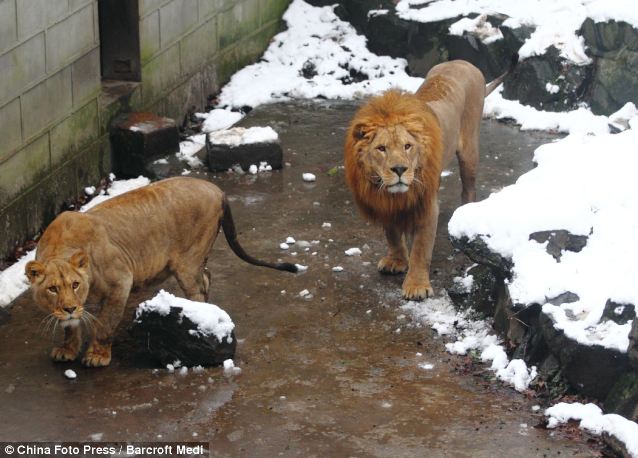
These lions certainly looked less than pleased when they were pelted with snow by laughing visitors, including children, at Hangzhou Zoo in Zhejiang Province, eastern China.

The attack was reportedly launched by one young man, who began to take aim at the big cats with a barrage of snow and ice.

The attack clearly frightened the helpless animals, with the lioness swiftly taking cover under a wooden plank.

The male line used a tree trunk as cover, with both eyes fixed on the visitors, as the missiles rained into the enclosure, ChinaSmack.com reports.


The man apparently laughed as he hurled the snow, with a group of other visitors, including a number of children, also starting to take aim at the lions.

One of them used large chunks of snow and threw them down with all of his strength, according to the website.


The frightened lions took shelter together in the corner of their pen as they tried to escape the new onslaught. The male lion roared in anger at his tormentors as they began to stroll away.

Sadly the lions were not the only animals to be pelted with snow, with some of the crowd also pelting the zoo's alpacas, monkeys, a giraffe, a tiger and other creatures.
Source


Thursday

Chinese soft-shelled turtles pass waste through their mouths, scientists in Singapore have found.

 The Chinese soft-shelled turtle looks like someone glued the snout of a pig onto the face of a fish, with the texture of a scrotum for good measure. But its bizarre appearance pales in comparison to an even more bizarre, and newly discovered, habit: it urinates through its mouth.

When the turtle breaks down proteins in its liver, it ends up with an abundance of nitrogen, which it expels from its body in the form of urea. Humans are the same—we get rid of urea in the form of urine, via our kidneys. But the soft-shelled turtle has an altogether different route.

It’s well-adapted to life in the water, and lives in salty swamps and marshes. But Yuen Ip from the National University of Singapore noticed that when the turtle emerges from water, or is stranded on land during dry spells, it will plunge its head into puddles. While submerged, it rhythmically expands and contracts its mouth. Ip found that the turtle gets rid of most of its urea through its mouth rather than its kidneys, via gill-like studs in its mouth. It can breathe and urinate through the same structures.

It’s not hard to get a hold of Chinese soft-shells in east Asia – they’re raised on several farms and millions are sold in markets as pets or food. Ip bought some for research instead, picking them up from a wet market in Singapore’s China Town. He put them in dialysis, placing them in water and collecting the urine from their rear ends. He also measured the total levels of urine in the surrounding water.

Ip found that just 6 percent of the urea that the turtles produces was ejected via their kidneys. The rest came out through the mouth. When Ip gave the turtles a chance to dip their heads in water, he found that they can sit there sucking, swilling, and spitting out the liquid for up to 100 minutes. This oral route gets rid of urea between 15 and 50 times faster than the kidneys.

Images by Monika Korzeniec

The turtle’s mouth contains rows of tiny studs that are thought to behave like gills, which supplement the animal’s lungs when it stays underwater for protracted bouts. Ip showed that these same studs are also littered with urea transporters – proteins that flush urea out of cells. These proteins are closely related to those found in the kidneys of other turtles. But it’s absent in the Chinese soft-shell’s kidneys; instead, it’s all over the inside of its mouth. And as a result, the level of urea in the turtle’s saliva is a “phenomenal” 250 times greater than that in its blood.

Fish share the same trick – they too can get rid of urea through their gills. But why is this turtle the only other back-boned animal that does so? Ip thinks the answer lies in its salty habitat. To urinate through the normal kidney route, the turtle would need to constantly drink more water to make up for what it lost. And because the surrounding water is so salty, they would soon build up toxic levels in their bodies (especially since reptile kidneys are atrocious at getting rid of unwanted salts).


The Chinese soft-shell has evolved to deal with this problem through oral urination. It doesn’t need to drink anything. It just gargles some surrounding water and spits out its waste.

SOURCE
Reference: Ip, Loong, Lee, Ong, Wong & Chew. 2012. The Chinese soft-shelled turtle, Pelodiscus sinensis, excretes urea mainly through the mouth instead of the kidney. J Exp Biol http://dx.doi.org/10.1242/jeb.068916

VIDEO Chinese Soft Shelled Turtle

Stats

Archives

Pages