Showing posts with label parrot. Show all posts
Friday

Recently, Josemar Milli made a surprising discovery when he noticed his rescued parrot, Louro, spending time over at a hollowed out fencepost on the edge of his farm in Brazil.

Louro’s behavior was strange for the bird as she always slept at home but for three nights she was sleeping elsewhere. Milli went to investigate and was startled to see Louro protecting three tiny kittens!

Louro knows a thing or two about being rescued. She was found by Milli’s family back in 2008. They were walking in the forest when they spotted two orphaned baby parrots on the ground. They took the birds home, raised them without cages, and released them back into the wild. Louro’s sibling flew off but she decided to stay with the family.

Milli took the kittens home where they could be properly cared for. After the kittens were taken out of the fencepost, Louro continued to keep a close watch on her little, furry rescues.

Milli later explained that the hollowed out post is Louro’s part time nesting spot, but it appears to have been taken over by a cat. The bird had been trying to look after the kittens after they were abandoned by their mother, who Milli suspected to be the neighbours cat.

Fortunately, Milli’s cat decided to step up to help.

Parrots are remarkable animals when you learn how intelligent they really are. They excel at problem-solving and can learn by observing. Their social structure also gives them an edge because it fosters cooperation. The next time someone calls you a bird brain, you may want to thank them. You’re in good company with this group of avian Einsteins.

Source

VIDEO

Tuesday

There are some beautiful birds in the world but perhaps none with a name quite as frightening as one species found in New Guinea—the Dracula parrot. This is the nickname for the Pesquet's parrot (Psittrichas fulgidus), which is endemic to the island's hill and montane rainforest. With rich black feathers and a scarlet red underbelly, it has all the coloration of Count Dracula's cape.

The Dracula parrot is a relatively large parrot, measuring a total length of about 18 inches and weighing between 1.5 and 1.75 pounds. Its long hooked beak and bare face, coupled with its large head, make it look a bit like a vulture. For that reason, it's sometimes also called a vulturine parrot. But, don't let these colloquial names fool you—this bird is no flesh-eater.

In fact, the Dracula parrot is a frugivore, which means that fruit is its preferred food. And for this parrot, we're not just talking about any fruit. These parrots only feed on a few species of fig. This helps explain why they aren't migrant and typically stick to one area.

This is also why they're only one of three parrot species without a bare face, as the fruit pulp they eat would cause facial feathers to become matted.

When they are left alone in areas where they aren't hunted, it's not uncommon to see groups of 10 to 14 roosting in the trees. They can almost always be found at least in pairs. Dracula parrots are believed to have a lifespan of 20 to 40 years and they nest in large, hollow trees. Interestingly, only one or two eggs are laid at a time.

These rare birds are the only members of their genus, and this genus is the only member of the subfamily Psittrichadinae, which shows how unique these parrots truly are. Unfortunately, the Dracula parrot has been classified as vulnerable on the IUCN's Red List.

This is mainly due to poaching, as well as habitat loss. Poachers go after the Dracula parrot for their feathers, which are highly prized by collectors. It's believed that between 20,000 and 50,000 Dracula parrots exist in the wild and their population continues to decrease.

Source

VIDEO


Thursday

This little bird has a whole lot of love to give — and most of it is for his stuffed bunny. Marnie was celebrating his birthday, and his family got him Exactly what he wanted: a bunch of stuffed bunnies.

Why this cute little guy loves bunnies so much is a mystery, but he has the SWEETEST way of talking to them, that's for sure.

Marnie is a blue mutation of an indian ringneck parakeet, which is a bright green in the wild. Because of their hooked beak and long tail, and their small size, they are classified as a parakeet, but are true parrots.

Marnie debuted to the public in the YouTube video 'Parrot Wants Kiss from Cockatiel'. Marnie definitely has his own ideas on how to relate to the world. He is a natural charmer, a polite cassanova who is not shy to ask for what he wants...which is often a kiss! And he likes to have fun! It has been said that Marnie sounds something like Piccachu, Elmo or some other television character. Yet Marnie is not imitating any of them. His voice is his own sound. (Source)


VIDEO

Wednesday

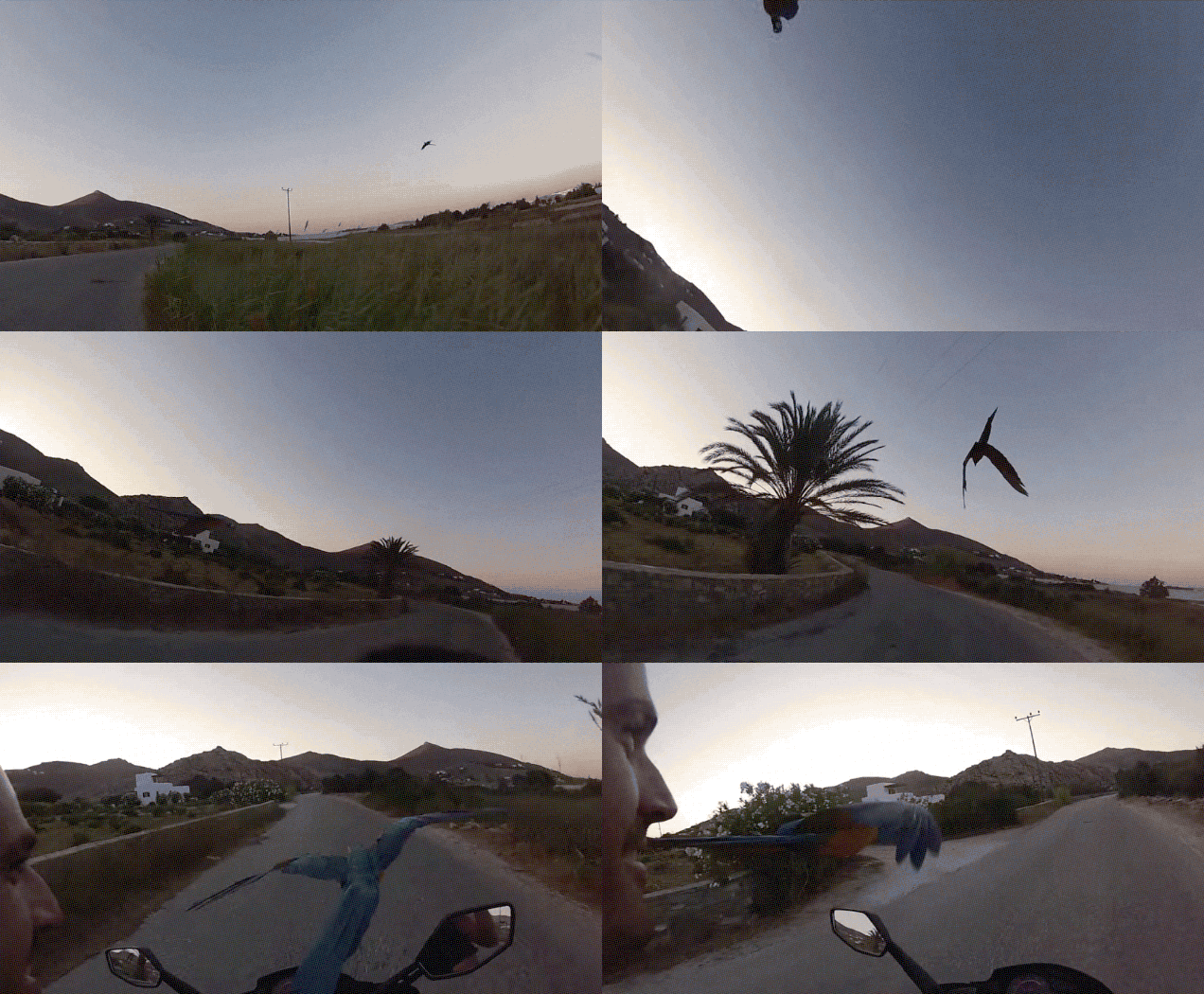
Ladies and gentlemen, meet Vito the macaw.

This Is What It's Like To Race A Macaw

YouTuber waterskizone has a pet macaw named Vito that loves to fly. But where another parrot might be perfectly content to stretch its wings circling above a field, Vito, it seems, has a distinct preference for the open road – especially when his owner comes along for the ride.(Via io9.com)

Vito likes nothing more than going out for a ride with his owner on the appropriately named Greek island of Paros (sounds a bit like 'parrots')

Paros is a Greek island in the central Aegean Sea. One of the Cyclades island group, it lies to the west of Naxos, from which it is separated by a channel about 8 kilometers (5 miles) wide. It lies approximately 100 mi (161 kilometers) south-east of Piraeus.


The Municipality of Paros includes numerous uninhabited offshore islets totaling 196.308 square kilometers (75.795 sq mi) of land. Its nearest neighbor is the municipality of Antiparos, which lies to its southwest.

Historically, Paros was known for its fine white marble, which gave rise to the term "Parian" to describe marble or china of similar qualities. Today, abandoned marble quarries and mines can be found on the island, but Paros is primarily known as a popular tourist spot.

 VIDEO


Thursday

Raucous parrots have been accused of being drunk and disorderly by residents living in Palmerston, Australia.

The birds are thought to get into their inebriated state by eating a particular plant that makes them exhibit all the tendencies of having overdone it on the sauce.

According to Ark Animal Hospital vet Dr Stephen Cutter, the birds act in a drunken manner and then fall over: ‘It’s probably a plant with alcohol, or toxins in a plant making it worse’.

The birds typically start out by making a lot of racket on a Friday night at the Palmerston Markets, followed by more loud drunken behaviour before they eventually fall over.

The morning after is said to be very bad for the seriously hungover parrots, who can be sick for up to three days.

Dr Cutter added that the birds’ drunken behaviour has made them very unpopular with locals.

It’s not the first time that this phenomenon has occurred , with the birds noted for engaging in their drunken antics around early May.

The Ark Animal Hospital has been feeding the birds sweet porridge and fresh fruit to nurse them back to health before releasing them.
Source


VIDEO

Friday

Now, for the first time ever, a parrot has successfully trained a human to design and build robots specifically for the parrot's use and entertainment

Proving that robots aren't just for people any longer, African grey parrot, Pepper, has learned to drive a robot that was specially designed for him. Pepper, whose wings are clipped to preventing him from flying around his humans' house and destroying their things, now manipulates the joystick on his riding robot to guide it to where ever he wishes to go.

This robotic "bird buggy" was the brainchild of his human companion, Andrew Gray, a 29-year-old electrical and computer engineering graduate student at the University of Florida. It was inspired by Pepper's growing frustration with his human family's rude behaviours.

The behaviour that most annoyed Pepper was when his human family left him alone in a room -- how dare they ignore him? After living with these humans for more than ten years, was he not a member of the family too?

Pepper decided to pursue a bold course of action to remedy this situation: he would attempt to train his humans to never abandon him. A simple goal, but addressing it was a daunting task -- so challenging that he would often scream in sheer frustration. Eventually, Pepper's screams of loneliness and frustration had the desired effect: Mr Gray began designing a variety of objects to occupy the parrot's time and energies whilst his humans roamed through the house, out of his sight.

The first toy was a sound-activated squirt gun. This toy sprayed water on Pepper whenever he screamed. After an initial period of silent astonishment at his human companion's sheer ingenuity, Pepper tested the toy thoroughly and grew to love it. Of course, Pepper's shrieks were rewarded so he screamed more than ever, although now, his frustration was tempered with long moments of soggy, shrieking delight.

"He started using it as a bird bath", admits Mr Gray, who originally designed this particular toy to quiet Pepper. He added: but "then he'd scream just to be squirted."


Inspired, Pepper wanted to know what sort of parrot toy his human companion might design next, so he began screaming even more frequently.

Mr Gray, who isn't deaf yet and who claims to value his hearing, then designed a noise-making device to amuse Pepper.

"The next thing I tried was a rattler. It's a drum on a stick and it has two little beads on string", Mr Gray continued. "I attached that to a [remote-controlled] motor and I would push a button and [the motor] spins that around."

At first, Pepper didn't find this toy amusing, oh no, not in the least.

"It really scared him the first couple times but then he got used to it because he'd just keep screaming", sighed Mr Gray, oblivious to the irony of this situation.

Finally, Pepper's human companion experienced a flash of insight. A true Eureka moment -- well, for a human.


"What's the underlying issue here? What's the problem?" Mr Gray asked himself since Pepper was, by this time, non-communicative and sulking in utter frustration.

"The problem is he's not in the room with us. When he's in the room with us, he's fine."

Like, duh, Pepper responded later in an interview. What I have I been telling you for the past ten years?

This time, Mr Gray knew what he had to do. He designed a toy that would relieve Pepper's loneliness -- a stylish toy that would make any parrot proud. His very own robot!

Basically, this toy is a parrot perch on wheels, equipped with a joystick that allows its parrot driver to commandeer this contraption around the house, and a newspaper-sized deck to catch Pepper's occasional tokens of appreciation.

Dubbed the "bird buggy" by Mr Gray, this robot is the most sophisticated toy that Pepper has received so far. It meets his goal by allowing him to follow his much larger and clumsier human family members around the house without fear of being trampled underfoot.

When later asked about this invention, Pepper said he was pleased to see that his extensive efforts to train his human companion had finally paid off, and so handsomely, too.

Pepper the grey parrot then added with a familial pride that he and this particular human were like siblings since he had first joined his human family when Mr Gray was a teenaged boy, so they had "practically grown up together".

This video captures Pepper demonstrating what his parrot buggy can do:


Pepper the grey parrot concluded this interview by providing some advice to other similarly-frustrated companion parrots: "Never give up! If you are persistent and determined, your human family may eventually understand what you must have to be truly happy. Further, if we properly motivate our human care-givers, who knows what intellectual and technological heights they may attain in their quest to meet our needs."
Source


"If You Love Parrots You Can Also Watch This Video"
Parrot Opens Beer Can

Parrot Paints Abstract Parrot Portraits, For Parrots

The Blue-throated Macaw is a very rare and on the verge of extinction parrot. It is originally from Bolivia but because of the illegal bird pet trade and loss of habitat due to land clearing, these parrots are almost gone from the wild. The capitive population in zoos around the world is much larger. Currently it is listed in the IUCN Red List as Critically Endangered as there are only 100-150 left in the wild.

But if their future is up to Blu Lu, a female Blue-throated Macaw, who lives at the Bird Endowment in Texas there just might be a chance yet to help these parrots. Blu Lu has a talent for painting other parrots. With the help of her trainer, Barbara Heidenreich, Blu Lu has proven to be quite the prolific painter of abstract portraits of other parrots -- and it's all for a good cause too. The Bird Endowment has begun selling raffle tickets for a chance to win Blu Lu's one-of-a-kind works of art. The proceeds from the raffle will go towards protecting the world's few remaining wild Blue-throated Macaws.

As Barbara Heidenreich explains it, “We started with just touching the handle of the brush at firs. Over time she learned to hold the brush, touch it to paper, and eventually add more strokes. Her training is based in positive reinforcement. This kind and gentle method of teaching creates eager participants. Blu Lu flies right over when she sees the painting supplies are out.” See the video below.

The Blue-throated Macaw ~

The Blue-throated Macaw (Ara glaucogularis; previously Ara caninde) is a macaw endemic to a small area of north-central Bolivia known as Los Llanos de Moxos. Recent population and range estimates suggests that about 100-150 individuals remain in the wild. The main causes of their demise is capture for the pet trade and land clearance on cattle ranches. It is currently considered critically endangered and the parrot is protected by trade laws. The Blue-throated Macaw lives in the savanna of the Beni Department of Bolivia, nesting in "Islas" (islands) of palm trees that dot the level plains. It is not a forest dwelling bird.


The Blue-throated Macaw is about 85 cm (33 in) long including the length of its tail feathers, and weighs about 750 g (27 oz). It has vivid colours with turquoise-blue wings and tail, and bright yellow underparts and blue undertail coverts. The throat is blue and continuous with its blue cheeks. It has a large black bill. Bare skin at the base of the beak is pink and pale bare skin on the sides of the face is partly covered with lines of small dark blue feathers. The adults have yellow irises and the juveniles have brown irises. It can be separated from the slightly larger Blue-and-yellow Macaw by the blue (not black) throat, the blue (not green) forehead and the lack of contrast between the remiges and upperwing coverts.


In the wild the Blue-throated Macaw often competes for nesting-holes in trees with the Blue-and-yellow Macaw, large woodpeckers and toucans. The number of suitable nest trees has been reduced by land clearing in its range.

They are relatively easy to breed in captivity, and the captive population is many times larger than the wild population. Individuals are kept in several zoos around the World, among them the Santa Cruz zoo in Bolivia. Several breeding and conservation schemes in zoos have now been set up to save this species. Other projects have been started to protect the remaining wild population, but at present numbers are still decreasing.

In the wild, within the palm groves of Bolivia, birds nest in tree hollows created in dead palm trunks, rotten knot-holes and dead limbs of trees. There is some evidence that parents maintain the third chick of a clutch with minimal food as an insurance against the loss of the older dominant chicks. If disaster should befall the larger chick the parent can switch to feeding the youngest and it will exhibit a constant growth curve from the day of active feeding. It is this physiological response that enables researchers to raise the third chick of a clutch in captivity and then return them to the wild nests when they are nearing fledge.

Blue-throated Macaws are early nesters and utilize these rare resources of nest holes before the other macaws are in breeding condition. This species has a very small population and is on the verge of extinction in the wild. It is listed on the IUCN Red List as Critically Endangered.
Source - Wikipedia


VIDEO Parrot Paints for Conservation


Blu Lu is a highly endangered blue-throated macaw. There are less than 300 birds left in the wild. Hatched in captivity, Blu Lu is an avian ambassador for the conservation project The Bird Endowment. (http://www.birdendowment.org/) Her artwork raises money for parrot conservation and other charities. She is named after blues singer Blu Lu Barker. She is trained by Barbara Heidenreich (http://www.goodbirdinc.com/)

Blu Lu specializes in imagery that features parrot species commonly kept as companion animals. Each piece is unique. Here is your chance to own an original framed piece by Blu Lu and to help Bird Endowment in breaking the extinction vortex into which the Blue-throated Macaw has been thrust.

Blu Lu has generously created 15 original pieces which are to be raffled to benefit the Bird Endowment.

Stats

Archives

Pages