Thursday

The Trump administration released on Wednesday its long-overdue recovery plan for Mexican gray wolves, one of the most endangered mammal species in North America with an estimated wild population of just over 100.

However, the plan charts a course for extinction rather than recovery, cutting off wolf access to vital recovery habitat and failing to respond to mounting genetic threats to the species.

"It's a 'recovery plan' in name only. Without additional habitat and greater genetic diversity, the wolves will continue to teeter on the brink of extinction. The plan provides none of these essential needs," said Heidi McIntosh, an attorney with the nonprofit environmental legal organization, Earthjustice, which sued the federal government on behalf of conservation organizations.

The Trump administration refused to listen to the tens of thousands of people who asked them to fix their awful draft plan before finalizing it. Among the people who weighed in asking for stronger protections for the wolves were concerned citizens, business owners and scientists.

"Lobos waited decades for a plan to save them, only to be given one that does not guarantee recovery," said Bryan Bird, Southwest director for Defenders of Wildlife. "The U.S. Fish and Wildlife Service had the opportunity to build a plan on a foundation of science and conservation, but instead decided to let politics rule."

"Instead of moving forward with a plan based on legitimate, science-based recommendations, the Service collaborated exclusively with the very states that have gone to extraordinary lengths to obstruct Mexican wolf recovery," said Maggie Howell of the Wolf Conservation Center. "Critically endangered lobos deserve better."


"The Fish and Wildlife Service published over 250 pages of supporting 'scientific' justification, used a sophisticated model to predict extinction probabilities, then tossed the science aside and asked the states how many wolves they would tolerate with no scientific justification whatsoever," said David Parsons, former Mexican wolf recovery coordinator for the Fish and Wildlife Service. "Using the states' arbitrary upper limit as a population cap in the population viability model and forcing additional recovery needs to Mexico, the plan will guarantee that from now to eternity no more than a running average of 325 Mexican wolves will ever be allowed to exist in the entire U.S. Southwest. This plan is a disgraceful sham."


The best available science indicates that recovery of the Mexican gray wolf requires at least three connected populations totaling approximately 750 individuals, a carefully managed reintroduction effort that prioritizes improving the genetic health of the animals and the establishment of at least two additional population centers in the southern Rockies and in the Grand Canyon area.

"This isn't a recovery plan, it's a blueprint for disaster for Mexican gray wolves," said Michael Robinson, conservation advocate for the Center for Biological Diversity. "Limiting recovery to south of Interstate 40 keeps wolves out of the Grand Canyon and southern Rocky Mountains, areas that would greatly benefit from having wolves back and that scientists have determined are absolutely essential to their recovery."


The recovery plan just released by the Trump administration ignores the science and falls short in several key and interrelated ways:

Fails to establish the additional population centers and limits wolves to inadequate habitat with low recovery potential;

Does not provide for sufficient releases of wolves into the wild;


Fails to ensure conservation and enhancement of genetic diversity to ameliorate inbreeding;

Relies excessively on Mexico for recovery, where habitat is unpromising.

"It is critical for the health of the Mexican wolf population to obtain a sound, scientifically reviewed and based recovery plan. Politics should not play a role in management of an endangered species," said Virginia Busch, executive director of the Endangered Wolf Center.

The critically endangered Mexican gray wolf almost vanished from the face of the earth in the mid-20th century because of human persecution. The entire population of Mexican wolves alive today descends from just seven individuals that were captured and placed into a captive breeding program before the species was exterminated from the wild.

In 2014, Earthjustice on behalf of the Center for Biological Diversity, Defenders of Wildlife, retired Fish and Wildlife Service Mexican Wolf Recovery Coordinator David R. Parsons, the Endangered Wolf Center and the Wolf Conservation Center, filed a lawsuit against the U.S. Fish and Wildlife Service for failing to develop a recovery plan.
Source

Coachella Valley Region: A huge victory for the Agua Caliente Band of Cahuilla Indians Monday as the Supreme Court decides the tribe does have rights to ground water in the Coachella Valley.

In 2013 the tribe sued both the Desert Water Agency and the Coachella Valley Water District, accusing them of allowing water levels to dwindle and replenishing the aquifer with lower quality water. The Ninth Circuit Court of Appeals ruled in favor of the tribe and the Supreme Court backed that ruling.

In the past, groundwater in the desert was a shared resource. But the Supreme Court's decision just changed that.

"The decision today gave the Agua Caliente a superior right to all other users," said Aashley Metzger, Outreach and Conservation Manager for the Desert Water Agency.

Down the road, that could mean consumers will pay more for water.

"If you're talking about a supply of water and it may become more and more finite, then that's something that will have an impact on our ability to provide water," Metzger said.


The ruling is only the first phase of the tribes lawsuit. A federal court will next decide if the tribe has rights to storage space within the aquifer and then finally how much ground water the tribe is entitled to.

"I would tend to agree with the decision. The results of it may be very difficult to a lot of people, but as I said, I think that tribes in general have been treated very shabbily for the last couple hundred years," said Palm Springs resident Bill Noren.


The courts will likely need to divide all ground water between the Agua Caliente Tribe, residents and businesses.

"I don't agree with that. I don't think that's right. It's underground and comes from other sources. Everyone can say they claim and own the water underground. So I think the Indians are trying to take advantage," said Indio resident Jim Linker.


The tribe issued a statement saying part, "Because of the Supreme Court's decision, the favorable rulings from the Federal District Court and the Ninth Circuit Court of appeals recognizing and protecting the Reservation's federal water right are now settled law."

The tribe did not address any concerns in the community about what the ruling will mean for water rates nor did they mention their intentions for the groundwater in the future.
Source
VIDEO
Palm Springs News, Weather, Traffic, Breaking News

A bobcat miraculously survived being hit by a car after becoming lodged into the vehicle's grill for 50 miles as the driver headed to work.

Richmond Animal Care and Control (RACC) said on Facebook that a woman was driving on Thanksgiving Day when she struck 'something'.

'When she parked at VCU she found that 'something' was a Bobcat still stuck in the grill of her car,' the center said.

Photos showed the terrified bobcat hanging in the grill of the woman's car. It's feet were dangling on the sidewalk when the woman made the shocking discovery.

A represtentative from the RACC and a police officer were then able to 'sedate and free' the bobcat from the car. The adorable creature was taken to the Wildlife Center of Virginia for treatment and release.

'None of us can believe that this happened and that the Bobcat only suffered from a small scrape on his back.


'Proud and thankful for everyone that had a hand in saving this life today!' the RACC said on Facebook. Dr Alexa Ortiz, a veterinarian intern at the Wildlife Center of Virginia, told NBC that they haven't treated an adult bobcat at the center since 2011.

'She's very ferocious,' says Ortiz, adding that the animal should have suffered more than just a small wound on her back.


Representatives at the center said the 19-pound cat should have had broken bones and serious head trauma. The animal will not be returned to the wild until next month.

The Wildlife Center of Virginia said on Facebook that they were thankful for all of the people who helped to save the bobcat.


'Things we're thankful for: someone cared enough to call to get help for this Bobcat that was hit by a car.'

VIDEO

"Somewhere a good man must rise from the young ones among us" Crazy Horse (Elder)

Whenever thrash metal is recognized by the mainstream world, we rejoice! Testament vocalist Chuck Billy was not only recently acknowledged, but celebrated by Jim Frazier of the California State Assembly for the positive influence he has made in the Native American community and the general public.

Chuck Billy is proud of his Native American heritage, with songs such as ‘Trail of Tears,’ ‘Allegiance’ and ‘Native Blood’ written by Billy in honor of his ancestral heritage. Billy is a descendant of the Pomo Native American tribe and the singer actually spent much of his youth on the Hopeland Indian Reservation just north of San Francisco.

“The world of music is inhabited by creative and talented individuals whose work enhances the quality of life for all who are fortunate enough to have entered their sphere of influence,” says Jim Frazier.

“Not only does Chuck Billy embody all of these admirable qualities, he also personifies the strength and enduring spirit of Native Americans.”

Testament’s 2012 music video for ‘Native Blood’ actually earned them a Video of the Year award at the Native American Film Festival. Billy was also recognized by the Smithsonian’s American Indian’s exhibit and was given the distinction of being the first Native American entertainer to be permanently featured in the memorabilia display of the Hard Rock Hotel  in Albuquerque, N.M.


Testament’s ‘Dark Roots of Earth’ was met with critical acclaim in 2012 and set Nuclear Blast’s record for highest first week album sales, coming in with just under 21,000 copies sold.

VIDEO

Wednesday

A burrowing owl was photographed making an audacious attempt to put an American badger on its dinner plate.

It’s an animal that’s around double its size – and is easily capable of killing it. The brazen mission was carried out in Badlands National Park, South Dakota, as the badger approached its nesting site.

Claws out-stretched and eyes fixed on its prey, the owl swoops in. But the badger proved to be far too big and powerful for it and the owl flew off empty-clawed.

For those familiar with badgers, the outcome of the battle will come as no surprise

They are renowned for their sturdy frame, thick fur - and fearlessness. They’ve even been known to stand their ground against adult bears.

When threatened they don’t hesitate to bite and claw their attacker and sometimes release an unpleasant odour to further deter predators.


The diminutive burrowing owl, meanwhile, is far more suited to killing small rodents and insects. This one clearly had delusions of grandeur.


This Navajo code talker spoke about diversity strengthening the USA — right in front of Trump. Peter MacDonald was born in Arizona, U.S.A in may of 1928. His clan is Hashk’aa ( Yucca Fruit) born to Bitahníí (They are within themselves).

He grew up in the Teec Nos Pos, Four corners area. He went to boarding school in Shiprock,NM and dropped out in the 6th grade because all the teachers were mean to the Navajos. Raised among traditional sheepherders and trained as a medicine man for 1 year.

MacDonald entered the Marine Corps as a Navajo language code talker during World War II. After the war, MacDonald earned an electrical engineering degree at the University of Oklahoma. Upon graduation, his acumen secured a job with Howard Huges at the Hughes Aircraft Company,

He was first elected Navajo Tribal Chairman in 1970. MacDonald served as Navajo Nation Tribal Chairman for four terms between the years 1970 to 1986.

Because Navajo has a complex grammar, it is not nearly mutually intelligible enough with even its closest relatives within the Na-Dene family to provide meaningful information. It was still an unwritten language, and Johnston thought Navajo could satisfy the military requirement for an undecipherable code.

 Navajo was spoken only on the Navajo lands of the American Southwest. Its syntax and tonal qualities, not to mention dialects, made it unintelligible to anyone without extensive exposure and training. One estimate indicates that at the outbreak of World War II, fewer than 30 non-Navajo could understand the language.


The Navajo code talkers were commended for their skill, speed, and accuracy demonstrated throughout the war. At the Battle of Iwo Jima, Major Howard Connor, 5th Marine Division signal officer, had six Navajo code talkers working around the clock during the first two days of the battle. These six sent and received over 800 messages, all without error. Connor later stated, "Were it not for the Navajos, the Marines would never have taken Iwo Jima.

VIDEO

Tuesday

This is Miss Alicia. Alicia is a flying fox that was rescued in Queensland, Australia. She was hit by a car and in need of rehabilitation.

Nothing was broken and all four limbs are in working order. Alicia is expected to make a full recovery. Flying foxes have a diet of fruits, nectar and flowers. She sure does love bananas!

The young flying fox, lovingly named ‘Miss Alicia,’ was rescued in Queensland, Australia, after a scary encounter with a car left her in need of urgent care.

She was taken into the loving arms of bat conservationist Denise Wade (Batzilla The Bat), and is poised to make a full recovery with no major injuries sustained. She’s also still managed to look adorable as hell in the aftermath, if you haven’t noticed.

While little Miss Alicia was resting and recharging, swaddled in a cozy blue towel, Wade shot a video of her feeding time.

Given the fact that flying foxes have a known sweet tooth (their diet consists mostly of fruit and nectar), you can imagine how Alicia reacted when a fresh banana was presented to her.


You can see the panic in Miss Alisha’s eyes as she realises she’s gone for a bigger bite than perhaps she should have, and she pauses her chewing to turn to the camera with pleading eyes, before she somehow manages to eventually swallow it all.

VIDEO

ANCHORAGE, Alaska - An Italian energy company has received permission to drill oil exploration wells in U.S. Arctic waters.

The Bureau of Safety and Environmental Enforcement announced Tuesday it approved an application from Eni (EN-ee) U.S. Operating Co. Inc. to drill in the Beaufort (BOH-fort) Sea.

Exploratory drilling could start next month.

The drilling will take place from Spy Island, a gravel artificial island near Prudhoe Bay.

Eni already has 18 production wells on the island that extract oil from submerged state lands.

Eni will use extended-reach drilling techniques to reach federal submerged lands.


Environmental groups oppose additional Arctic Ocean drilling.

Kristen Monsell of the Center for Biological Diversity in a statement says a major spill would threaten coastal communities and Arctic wildlife.

Multinational oil company with insatiable appetite for profit and little concern for the environment targets the Arctic, estimated to contain 30% of the planet’s undiscovered natural gas and 13% of its undiscovered oil. On cue Indigenous peoples join forces with environmental activists to oppose the proposed exploitation of one of the last great unspoilt natural regions on Earth.

In 1995, Roy Disney decided to release an animated movie about a Powhatan woman known as "Pocahontas". In answer to a complaint by the Powhatan Nation, he claims the film is "responsible, accurate, and respectful."

Powhatan Nation said disagree. The film distorts history beyond recognition. Their offers to assist Disney with cultural and historical accuracy were rejected.

"Pocahontas" was a nickname, meaning "the naughty one" or "spoiled child". Her real name was Matoaka. The legend is that she saved a heroic John Smith from being clubbed to death by her father in 1607 - she would have been about 10 or 11 at the time. The truth is that Smith's fellow colonists described him as an abrasive, ambitious, self-promoting mercenary soldier.

Her name at birth was Matoaka, which means “flower between two streams,” and according to Mattaponi history was likely given to her because she was born between the two rivers of Mattaponi and Pamunkey (York).

The truth of the matter is that the first time John Smith told the story about this rescue was 17 years after it happened, and it was but one of three reported by the pretentious Smith that he was saved from death by a prominent woman.

Yet in an account Smith wrote after his winter stay with Powhatan's people, he never mentioned such an incident. In fact, the starving adventurer reported he had been kept comfortable and treated in a friendly fashion as an honored guest of Powhatan and Powhatan's brothers. Most scholars think the "Pocahontas incident" would have been highly unlikely, especially since it was part of a longer account used as justification to wage war on Powhatan's Nation.


Euro-Americans must ask themselves why it has been so important to elevate Smith's fibbing to status as a national myth worthy of being recycled again by Disney. Disney even improves upon it by changing Pocahontas from a little girl into a young woman.

The true Pocahontas story has a sad ending. In 1612, at the age of 17, Pocahontas was treacherously taken prisoner by the English while she was on a social visit, and was held hostage at Jamestown for over a year.


During her captivity, a 28-year-old widower named John Rolfe took a "special interest" in the attractive young prisoner. As a condition of her release, she agreed to marry Rolfe, who the world can thank for commercializing tobacco. Thus, in April 1614, Matoaka, also known as "Pocahontas", daughter of Chief Powhatan, became "Rebecca Rolfe". Shortly after, they had a son, whom they named Thomas Rolfe. The descendants of Pocahontas and John Rolfe were known as the "Red Rolfes."

Two years later on the spring of 1616, Rolfe took her to England where the Virginia Company of London used her in their propaganda campaign to support the colony. She was wined and dined and taken to theaters. It was recorded that on one occasion when she encountered John Smith (who was also in London at the time), she was so furious with him that she turned her back to him, hid her face, and went off by herself for several hours. Later, in a second encounter, she called him a liar and showed him the door.


Rolfe, his young wife, and their son set off for Virginia in March of 1617, but "Rebecca" had to be taken off the ship at Gravesend. She died there on March 21, 1617, at the age of 21. She was buried at Gravesend, but the grave was destroyed in a reconstruction of the church. It was only after her death and her fame in London society that Smith found it convenient to invent the yarn that she had rescued him.

History tells the rest. Chief Powhatan died the following spring of 1618. The people of Smith and Rolfe turned upon the people who had shared their resources with them and had shown them friendship. During Pocahontas' generation, Powhatan's people were decimated and dispersed and their lands were taken over. A clear pattern had been set which would soon spread across the American continent.

Source: Powhatan Nation

FACTS
Pocahontas had a Native husband and Native child; never married John Smith

Pocahontas’ Mother, Also Named Pocahontas, Died While Giving Birth to Her

John Smith Came to the Powhatan When Pocahontas Was about 9 or 10 

Pocahontas Never Saved the Life of John Smith 

Pocahontas Never Defied Her Father to Bring Food to John Smith or Jamestown 

Pocahontas Was Kidnapped, Her Husband Was Murdered and She Was Forced to Give Up Her First Child 

John Rolfe Married Pocahontas to Create a Native Alliance 

Pocahontas Was Brought to England To Raise Money and Was Then Likely Murdered 

A full-length portrait of Pocahontas, which was done after she traveled overseas to England. Jamestown Museum.

Pocahontas - Gravesend near London

The Baptism of Pocahontas (1840). A copy is on display in the Rotunda of the US Capitol.

“In this day and age, all tribal nations still battle insensitive references to our people. The prejudice that Native American people face is an unfortunate historical legacy,” Navajo Nation president Russell Begaye said.

 The head of the Navajo Nation said his people are still facing prejudices after President Donald Trump referenced his nickname for Sen. Elizabeth Warren, "Pocahontas," during an event honoring Navajo code talkers.

Begaye was in the Oval Office when Trump made the comment.

Trump hosted the Native American code talkers, who used their native language to help protect communications during World War I and II.

“It was our code talkers that ensured the freedom of the United States and that’s what is important to remember here,” Begaye said.

Trump acknowledged their history before using the comment.


"I just want to thank you because you are very, very special people. You were here long before any of us were here," Trump said. "Although, we have a representative in Congress who has been here a long time ... longer than you -- they call her Pocahontas!"

“It was our Code Talkers that ensured the freedom of the United States and that’s what is important to remember here,” Begaye said.

“We honor the contributions of Pocahontas, a hero to her people, the Pamunkey Indian Tribe in Virginia, who reached across uncertain boundaries and brought people together. Once again, we call upon the President to refrain from using her name in a way that denigrates her legacy.” —Jefferson Keel, lieutenant governor of the Chickasaw Nation and president of the National Congress of American Indians, which asked Trump to stop describing Sen. Elizabeth Warren as Pocahontas

“The reference is using a historic American Indian figure as a derogatory insult and that’s insulting to all American Indians.” —John Norwood, general secretary of the Alliance of Colonial Era Tribes


Monday

President Donald Trump, during an event at the White House honoring Navajo code talkers Monday, referenced his nickname for Sen. Elizabeth Warren, "Pocahontas," a label he has long used about the Massachusetts Democrat.

 "I just want to thank you because you are very, very special people. You were here long before any of us were here," Trump said. "Although, we have a representative in Congress who has been here a long time ... longer than you -- they call her Pochahontas!"

He then turned to one of the code talkers behind him, put his left hand on the man's shoulder and said: "But you know what, I like you. You are special people."

Trump was recognizing Native American Code Talkers who served during World War II

Native American Code Talkers were largely Navajo Marines who transmitted commands over the radio to soldiers overseas in their native language during World War II, after both sides became more adept at decoding encrypted messages.

Native American code talking became more reliable than Morse code in the war, notably aiding U.S. efforts in the Battle of Iwo Jima.


Trump made his comments Monday while standing in front of a portrait of Andrew Jackson, the former president who signed the Indian Removal Act of 1830 that resulted in the tragic Trail of Tears. Thousands of Native Americans died of cold, starvation and disease during the harrowing trek to the undeveloped Western territories.


I am no more proud of my career as an athlete than I am of the fact that I am a direct descendant of that noble warrior [Chief Black Hawk]. Jim Thorpe

The "world's greatest athlete" was much more than that, and remains an inspiration to the communities he so rigorously advocated for.

Despite securing two gold medals in the 1912 Summer Olympics in Stockholm—in the pentathlon and decathlon—Thorpe's life was relatively unremarkable for a Native American man living in what is now Oklahoma before 1924. That is to say before the Indian Citizenship Act, which finally granted him United States citizenship.

Thorpe, of the Sac and Fox and Potawatomi nations, was born in Indian Territory in the spring of 1888—no birth records exist—and attended three Indian boarding schools: Sac and Fox Agency Indian School, Haskell Institute (now Haskell Indian Nations University), and Carlisle Indian Industrial School. His twin brother died of pneumonia when they were nine, his mother during childbirth when he was 11, and his father followed six years later.

A lack of records and verifiable sources make it hard to chart Thorpe's rise as "sports' first star" on an accurate timeline. But Thorpe's first track and field records are from 1907 at Carlisle, where Thorpe was quickly recruited to the football squad by famed coach Glenn Scobey "Pop" Warner.

Thorpe's early football days at Carlisle are besot with achievements. He scored all 18 points in an 18-15 win over top-ranked Harvard, scored a 97-yard touchdown during the Carlisle-Army game in 1912 (a 27-6 Carlisle win), injured future-president Dwight D. Eisenhower during an attempted tackle, scored 25 touchdowns in a single season, and attained All American status in both 1911 and 1912. Thorpe went on to compete and excel in practically every sport he attempted: baseball, basketball, lacrosse, tennis, golf, bowling, swimming, handball, boxing, gymnastics and, yes, ballroom dancing.


The thing about Thorpe, as it is with most people who are "supremely endowed" with athletic ability—Eisenhower's words in 1961—is that he wasn't trying to be anything more than what he already was: a country boy from Indian Territory, from Indian schools, who simply and genuinely loved sports.


"I never was content unless I was trying my skill in some game against my fellow playmates or testing my endurance and wits against some member of the animal kingdom," Thorpe famously said.

This was most evident in 1913 when Thorpe was stripped of his gold medals during a controversial inquiry into his amateur status during the 1912 Olympics. In 1909 and 1910, Thorpe had left Carlisle to play baseball in North Carolina and was paid approximately $2 per game, making him, technically, a professional.


"I hope I will be partly excused," said Thorpe of the accusations, "by the fact that I was simply an Indian schoolboy and did not know all about such things. In fact, I did not know that I was doing wrong, because I was doing what I knew several other college men had done." Those other men had known better than to use their real names on team rosters.


Newspapers at the time (and some still today) readily used the r-word, often describing Thorpe with language more appropriate for animals than humans. For instance, Carlisle was often written to be "scalping" their opponents. Racism like this was common practice. But after the 1912 Olympics, Thorpe's image was regularly appropriated as a mascot for America's strength and superiority.


Newspapers of the day readily embraced the image of a physically powerful, but intellectually-wanting Indian, and never hesitated to make a point of Thorpe's ethnicity: "an unequal conflict between the white man's brawn and the red man's cunning," said the Boston Post of the Carlisle v. Harvard game.


Despite this rampant racism, Thorpe's athletic career thrived. But athletes' careers end early in life, and Thorpe's work after retirement is no less an important part of his legacy. According to Kate Buford, author of Native American Son: The Life and Sporting Legend of Jim Thorpe, he actively worked in Hollywood to dismantle those stereotypes.


"Once there, because he was so famous, he was not only sought out as a spokesman for Indian causes," said Buford at "Carlisle Journeys: American Indians in Show Business," a conference held this past October exploring images of American Indians in mainstream media and entertainment (and originally reported on by Indian Country Today Media Network). "He formed his own casting company to pressure the Hollywood studios to hire real Indians to play Indians in the admittedly stereotypical Westerns of the time. The studios were not fussy: they'd hire Italians, Greeks, Mexicans to play Indians. Thorpe was an important advocate in the 1930s for the Indian stuntmen and women with the studios."


Thorpe's work as an athlete, as well as an advocate, make him an unparalleled role model for all people, but especially for young Native American athletes. Thorpe paved the way for athletes like Billy Mills and Sonny Sixkiller in the 60s to prominent figures today like Chris Wondolowski, Sam Bradford, and Shoni and Jude Schimmel.
Source


Sunday

“The Committee acknowledges the North Carolina Wildlife Resources Commission’s request that the [Fish and Wildlife] Service end the Red Wolf recovery program and declare the Red Wolf extinct,” it said.

The red wolf, Canis rufus, currently exists only as a small population in one part of North Carolina. It’s listed under the International Union for Conservation of Nature (IUCN) as critically endangered, which means it’s one step away from being extinct in the wild.

That’s why it strikes us as odd that, hidden in a Senate report related to funding for the Department of the Interior, is an order to end the red wolf recovery program that’s currently being run by the federal government.

It cites impacts on “landowners and other species” as being the reason, also noting that “the program has failed to meet population goals for the red wolf.” The text contains no citations to any research that backs up these claims.

Despite this, the aforementioned North Carolina Wildlife Resource Commission has for several years now wanted to end the recovery program for the reasons cited in the report. Landowners and hunters generally support the move to push red wolves into extinction.

Most scientists and conservationists, however, disagree, and it seems the FWS has been on their side until the recent changing of the guard.


“It is morally reprehensible for Senator Murkowski and her committee to push for the extinction of North Carolina’s most treasured wild predator.” Perrin de Jong, staff attorney at the Center for Biological Diversity, said in a statement.
Source

The three tiny puppies were stuck for hours in rock-solid tar and unable to move, even an inch.

The stray puppies were encased in the solidified tar, which proved incredibly challenging for the rescuers of Animal Aid Unlimited. One puppy even had her mouth stuck open. Realizing they couldn’t pull the puppies out, the rescuers decided to take the entire slab of tar with them.

The cries of the poor puppies pierced my heart, but thanks to the dedication of these wonderful rescuers the puppies were eventually reed from their tar prisons.

“It took many hours over several days for our team to soften the tar by massaging oil and giving many baths, but these three puppies had incredibly strong spirits,” Animal Aid Unlimited writes.

Not only did the puppies survive, but rescuers found their mama! Just watch this incredibly heartwarming reunion at 5:03

Animal Aid is a vital rescue center, hospital and sanctuary for injured and ill street animals in Udaipur, Rajasthan, India. They rescue thousands of hurt and sick animals each year and provide sanctuary to those who need life-long care.


The Animal Aid Sanctuary is home to animals permanently disabled from accidents, fragile, blind, and those in need of long-term medical care. They have given permanent sanctuary to over 150 disabled and special needs dogs, 40 cows and bulls who were left to die on the street by dairy farmers, and over 30 handicapped donkeys rescued from abusive owners.
Source
VIDEO

Saturday

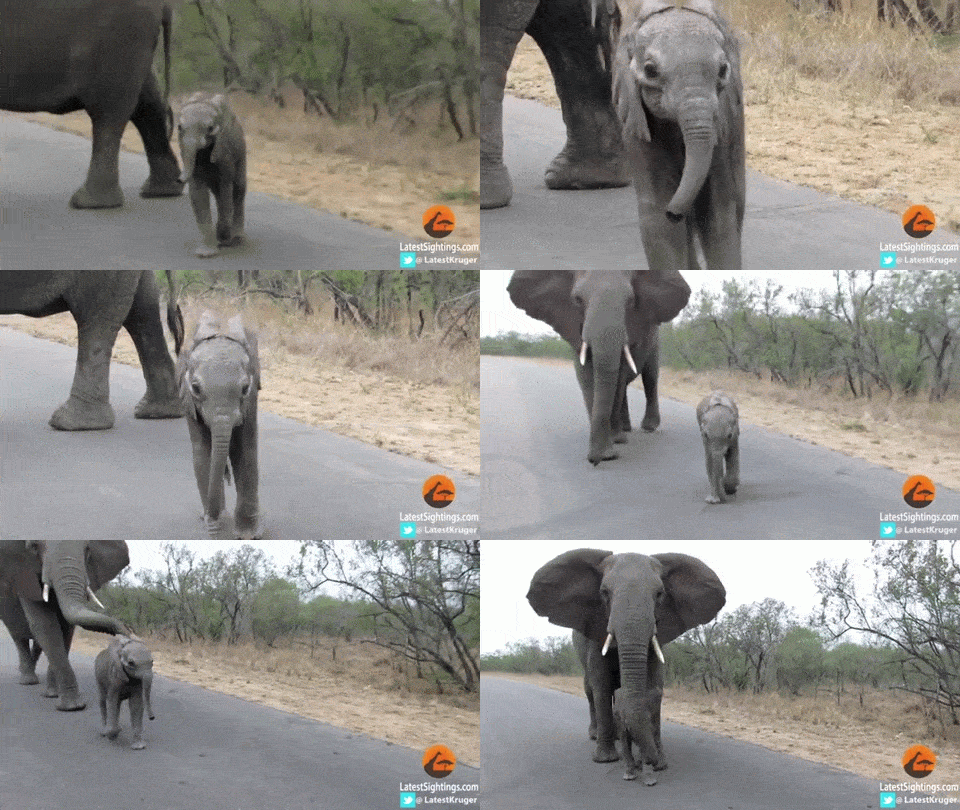
Incredible video showing how a mother elephant stops her calf from going any closer to spectating tourists. Almost as if she is saying "Don't talk to strangers".

Baby elephants are nothing if not curious. They’re either trying to figure out why they can’t squeeze themselves into their old bathtubs, refusing to leave their favorite mud spot, or trying to determine why they have such a long nose.

So, when the baby elephant in the video below discovered some tourists, it wanted to investigate. The mother, though, was having none of that.

The protective mama elephant quickly pulled her baby away from the tourists. As the park wrote beneath the video, it's "almost as if she is saying, 'Don't talk to strangers.'"

The curious baby was excited to see the tourists, but ultimately followed his mom — after all, mom always knows best.

Nice job of parenting there. The mom didn’t make a big deal out of it—she wasn’t being a hero—but she calmly and effectively redirected her child’s attention elsewhere to steer it potentially out of danger. Now the baby elephant can go back to doing what it does best—playing with birds.


Kruger National Park, in northeastern South Africa, is one of Africa’s largest reserves. Its high density of wild animals includes the Big 5: lions, leopards, rhinos, elephants and buffalos. Hundreds of other mammals make their home here, as do diverse bird species such as vultures, eagles and storks.


 VIDEO


Stats

Archives

Pages