Monday

Nessy the cat is the surrogate mother for two premature puppies.

A pregnant Chihuahua who arrived at SPCA of North Brevard went into premature labour and gave birth to four puppies. Sadly two puppies passed away shortly after, but two survived and weighed only a few ounces. The tiny puppies were rejected by their mother and, at only a few hours old, needed a mother.

Luckily, a cat named Nessy had given birth to four kittens 5 days earlier. When the SPCA staff introduced the two puppies to Nessy, the nursing mother accepted the pair right away.

Note: SPCAis a no-kill shelter, so animals stay with them until they find their forever home.

They strive to protect animals and find them loving homes through our shelter and veterinary clinic. Their shelter allows animals to find loving homes and our clinic provides low-cost veterinary care including neutering. (Source)


VIDEO Surrogate Mama Cat Nurses Preemie Puppies

A 14-year-old boy digging a trout pond in the backyard of his father's Salt Lake City home stumbled across a surprise: The remains of a Native American who lived about 1,000 years ago.

Experts from the Utah Department of Heritage and Arts spent Friday removing the remains, which were confirmed by medical examiners as those of a person from a millennium ago, and investigating the site for archaeological clues after ninth-grader Ali Erturk's discovery earlier in the week.

"Humans have occupied this valley for up to 10,000 years," department spokesman Geoffrey Fattah told The Salt Lake Tribune. "We do run into situations where progress runs into the ancient past."

A forensic anthropologist will analyze the remains to try to learn more, including the person's sex and cultural affiliation. A report will go to the state Division of Indian Affairs, which will try to determine whether the remains are linked to current tribes, Fattah said. A tribe may claim the remains and perform interment rites.

Other private property in Salt Lake City occasionally has yielded Native American graves. The department typically receives about six reports of ancient remains statewide each year, Fattah said.

Native American groups have lived in the area for thousands of years. 

Erturk said he had been working on the trout pond for a couple of weeks until he discovered what he initially thought was just an animal bone.

"When I saw it looked like a human skull, then it definitely was a bit creepy," he told KTVX-TV. "I really do think there's other bones nearby, and I don't think that it's that unlikely or that lucky that I stumbled across this."

Fattah urged the public to contact law enforcement authorities if human remains are unearthed so they can be removed professionally and respectfully. Erturk's father notified Salt Lake City police after his son's discovery.
Source

VIDEO

World famous and inspirational Duncan Lou Who the two legged boxer puppy goes to the beach for the first time

Duncan Lou Who is a pup born with two deformed hind legs that had to be removed. While the boxer has a wheelchair to help him get around, he much prefers the au naturel look.

So his caregivers at Panda Paws Rescue in Vancouver, Wash., happily obliged, letting Duncan go wild at the beach, where he hobbled along on his front two legs.

But having two legs definitely doesn't slow Duncan down. "There is some slow motion in this video, but NONE of the video has been sped up," according to a description of the YouTube video, above. In other words, Duncan really runs that fast.


Now this is what happiness looks like.
 Source

VIDEO

Sunday

A Yellowstone earthquake today 2014 struck Montana. A Yellowstone earthquake today March 30, 2014 was the strongest to strike since 1980. Officials are now asking local residents for assistance with the matter.

 Officials report that a 4.8 magnitude Yellowstone earthquake struck just after 8:15 am MDT today. The quake was shallow. It started twenty-three miles east of West Yellowstone and sixty-five miles southwest of Bozeman. It was eighty-six miles northeast of Rexburg, Idaho as well.

Thereafter officials issued a news statement describing the activity. The University of Utah Seismograph Stations reports that the “epicenter of the magnitude 4.8 shock was located 4 miles north-northeast of Norris Geyser Basin in Yellowstone National Park, Wyoming. This earthquake is part of a series of earthquakes that began in this area on Thursday.” They added “As of 8:15 am today, this series has included at least 25 earthquakes in addition to the main shock, with the largest of magnitude 3.1. The magnitude 4.8 main shock was reported felt in Yellowstone National Park and in the towns of West Yellowstone and Gardiner, Montana.”


Officials are asking the public to submit details to a survey website. “Anyone who felt the earthquake is encouraged to fill out a survey form on either the Seismograph stations web site: www.quake.utah.edu or the U.S. Geological Survey web site: earthquake.usgs.gov.”

USGS tells news that Sunday’s quake was significant. Namely it was “the largest earthquake at Yellowstone since February 22, 1980, and occurred near the center of a region of recent ground uplift described in a YVO Information Statement on February 18, 2014. The Yellowstone Volcano Observatory has been tracking this uplift episode for about 7 months.” Reps added “seismicity in the general region of the uplift has been elevated for several months. A previous period of uplift in this area occurred between 1996 and 2003, and it was also accompanied by elevated seismicity.”

Issues may include Basin changes. “A USGS field team is in Yellowstone and will visit the area near the earthquake’s epicenter today. The team will look for any surface changes that the earthquake may have caused, and for possible effects to the hydrothermal system at Norris Geyser Basin.” But they added “Based on the style and location of today’s earthquake, at this time YVO sees no indication of additional geologic activity other than continuing seismicity.”
Source

Yellowstone Bison Running for their lives

You would have thought that size matters when it comes to the food chain, but judging by this funny clip you may want to think again

They say it's not the size of the dog in the fight... and they'd be right.

This video shows how it's all about how much fight is in the dog, as a teeny-tiny canine takes on a much bigger rival in a battle for the food bowl.

The pair are seen at loggerheads over a bowl of food, but despite his considerable size advantage he doesn't seem to be getting any change from his adversary and is going hungry as a result.

Fortunately the whole hilarious episode has been caught on camera and uploaded online for all to see.


The clip has proved a roaring success online with over half a million people tuning in in the last week.
 Source

VIDEO

Saturday

One lucky pooch's day just got a whole lot better.

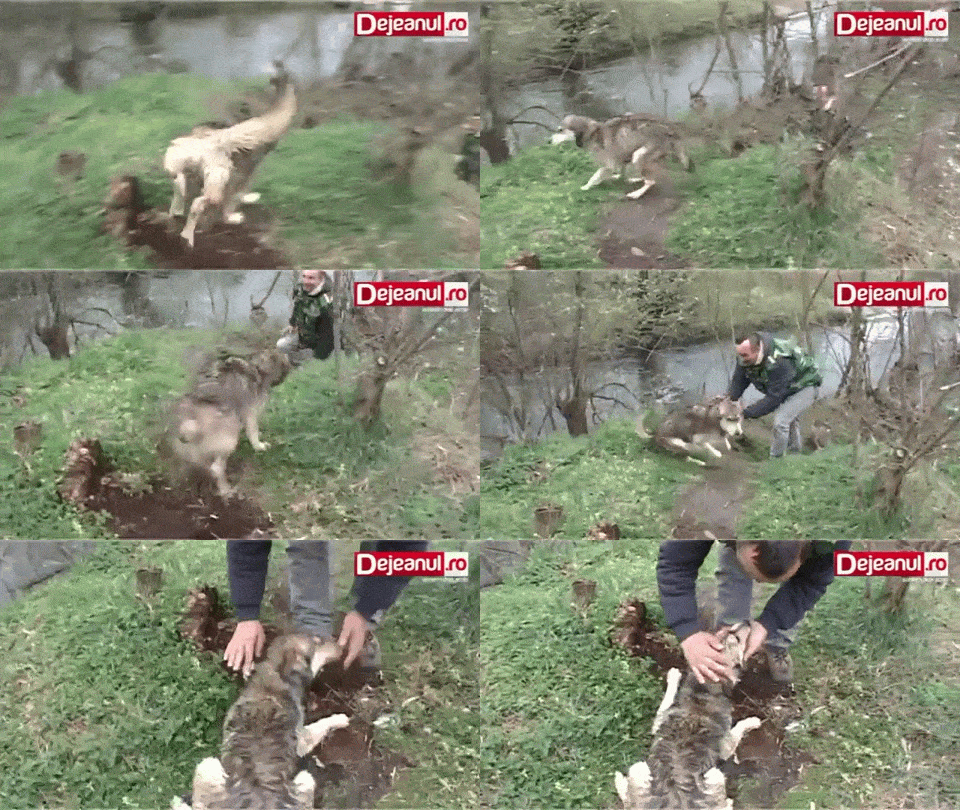
When a dog became stranded in a canal in Romania, some passersby jumped in to pull the soaking wet pup from the icy water. But it's what happens after the dog was freed that makes the recorded rescue so remarkable.

In a video, posted on YouTube this week, several men pull the dog to safety by the scruff of its neck -- something canine mothers often do to their pups to carry them. After the dog is freed, it appears to act as most humans would and shows its gratitude to the rescuers by showering them with nuzzles and licks.

Whether dogs are capable of showing emotions like humans has been a recurrent topic in scientific studies (though most pet owners would probably agree that dogs are capable of showing a wide range of emotions.)


In October, a professor of neuroeconomics published an editorial following two years of research on the human-canine connection with the conclusion: "Dogs are people, too." More recently, another study indicated that, within the brain, dogs process voices and emotions just like humans.


So while this rescued dog may just be excited to be back on dry land, we're inclined to believe it's grateful for the assist.
Source

VIDEO

Last year the U.S. Fish and Wildlife Service (FWS) stirred up a serious controversy when it formally proposed removing federal protections for gray wolves throughout the U.S., but lawmakers and wolf advocates are continuing to speak up for wolves as time runs out.

Wolf advocates continue to raise concerns about what will happen if they lose federal protection in the lower 48. Officials said states could handle wolf management and would do so responsibly, but so far they’ve shown that if management is left to them, wolves will be right back where they started on the brink of extinction. Thousands of wolves have already been brutally slaughtered in the Northern Rockies and Great Lakes region after they lost federal protection and management was turned over to the states.

If they’re delisted now they will be left even more vulnerable than they already are and may never establish new territories in the Pacific Northwest, California, the southern Rocky Mountains and the Northeast, which is critical to their successful recovery. Yet, instead of doing its job, which is to ensure wolves are not subjected to out of control hunting policies, politics and intolerance or the persecution of very vocal ag groups and hunters, the FWS wants to turn its back on wolves as states continue to call for more to die.

Just last week Idaho passed a bill that would create a board to administer a fund to support killing an estimated 500 wolves who are already being gunned down and trapped. State leaders reportedly intend to reduce the state’s wolf population to 150 and 15 breeding pairs, which is just above the threshold that would get them relisted. The bill is expected to be signed by Governor Butch Otter, who has already made it publicly clear that he’s out for wolf blood.

That move came after the state drew the ire of conservationists for hosting a predator killing contest that targeted wolves and coyotes and for sending a hired assassin into the woods to shamelessly kill entire packs. What’s happened in states that are hostile to predators, and is continuing to happen, is further proof that they need continued protection.

Fortunately, wolves are not without heroes. Last week Peter DeFazio, ranking member of the House Natural Resources Committee, sent a letter that was co-signed by 73 members of Congress to Interior Secretary Sally Jewell urging her to direct the FWS to withdraw its flawed proposal.

The Endangered Species Act (ESA) requires decisions to list or delist a species to be made solely on the best available science, which the FWS has clearly not done. Even with the agency’s tampering with the process, last month a panel of independent scientists unanimously concluded that the proposal does not currently represent the ‘best available science.’

“Because it is not based on the best available science, the proposed role undermines decades of conservation work done to protect the gray wolf, and sets a bad precedent for future ESA delistings,” wrote DeFazio.

The panel rejected the government’s claim that there are two separate species of wolves and that the eastern wolf, not the gray wolf, is native to the Northeast. If the claim had held up, it would make it unnecessary to restore gray wolves in those areas, but the panel concluded that the idea was based on a study that was written by scientists on the government’s payroll and wasn’t widely accepted.

Because the process has been called out as flawed, wolf advocates believe the only conscionable thing for the FWS to do is to withdraw its proposal, but time to speak up on behalf of these iconic predators and get an official comment in to the FWS is running out.

TAKE ACTION!

 Please take a moment to submit one in support of continued federal protection for gray wolves throughout the U.S. at regulations.gov.
Source


Watching this cute video of a puppy and a bird playing together is a great reminder: Some things are universal and simple, joyful playtime tops the list.

It's not often you see a bird on its back, with a puppy pouncing it.

But as the video rolls on, you quickly realize that the bird is very much this puppy's playmate — the little dog is quite gentle, and the bird is actually often the instigator of their mischief.

Switching from silliness to curiosity, from sitting together to running around, you witness a wonderful example of animals just plain old having a good time together. And that is undeniably cute!

This is a great example of interspecies communication, of understanding body language of a very different species well enough to get along and be joyful together, of understanding when play is simply play.


In fact, it is communication among three species — the bird and dog playing, and the humans on the scene who are also able to read that this is just another morning in the sun for these two and there's nothing about their interaction to fret over. It is fun to witness play among members of the same species — and downright wonderful to witness it between members of different species. It reminds us that play — the expression of happiness and carefree joy — is universal.
Source
VIDEO

Friday

A slow-motion video of an eagle-owl shows the second by second process of a landing by the majestic bird.

Though the landing would have only taken seconds in real life, the high quality camera allowed the camera-person to spread the process out over the course of a minute.

Because the camera, a Photron SA2 high definition camera, captures 1,000 frames per second, intricate details that would never be visible to the naked eye are startlingly clear.

At several points, you can even see the flapping of individual feathers on the bird's massive wings.

The animal in question is thought to be a Eurasian Eagle Owl, which is slightly smaller than a Golden Eagle and bigger than a Snowy Owl.


An average Eagle Owl has a wingspan between 160 and 188 centimeters (between 5 and 6 feet). Their large ears and orange eyes are also distinctive features.Far from being extinct, the Eagle Owl is one of the largest species in existence.

Playing with the natural pace of things appears to be a hobby of the uploader, as the majority of their videos show activities either slowed significantly down or sped up.
Source

VIDEO Amazing eagle owl slow motion


A giant panda named Lun Lun gave birth Monday at Zoo Atlanta to two tiny cubs, the first twin pandas born in the United States since 1987, zoo spokeswoman Keisha Hines announced.

The 15-year-old panda went into labor Monday afternoon and gave birth to the first cub at 6:21 p.m. EDT and the second two minutes later. Hines said zookeepers who had been anticipating only one cub based on a recent ultrasound were surprised by the first-ever twin panda births at Zoo Atlanta.

"We have twins!" Zoo Atlanta announced on its website.

An ultrasound on June 30 determined that Lun Lun was pregnant with her fourth cub. Hines says zookeepers weren't expecting the tiny duo, however.

The twin cubs are the first giant pandas to be born in the United States in 2013, Hines added.


Zoo officials are working with animal care workers from the Chengdu Research Base of Giant Panda Breeding, where Lun Lun and her 15-year-old partner, Yang Yang, were born. There was no immediate report on the size or weight of the cubs at birth, nor the condition of the offspring and mother.

Zookeepers said Lun Lun is caring for one of the cubs while animal management and veterinary teams from the Arthur M. Blank Family Foundation Giant Panda Center care for the other in a nursery center. Officials said they will likely rotate the cubs between the nursery and Lun Lun's care to ensure they each get enough maternal nurturing without overexerting the 15-year-old giant panda.
 Source

 VIDEO
WFSB 3 Connecticut

Thursday

This ridiculously cute otter knows the importance of being well groomed especially when there is a camera capturing his every move.

The adorable animal was snapped preening itself to perfection and pulling a series of adorable expressions during its moment in the spotlight.

Sea otters have a reputation for being meticulously clean, spending hours every day grooming their dense fur, but this spotless mammal appears to have taken things to another level.

The animated creature provided some memorable moments for husband and wife Pat and Tom Leeson, who have travelled the globe capturing wildlife images.

‘Otters can be quite funny while they are grooming,’ explained 62-year-old Mr Leeson.


‘They are constantly turning or rolling completely over in the water, then using their front paws almost as we use hands to groom and clean themselves.

‘At times they almost looking like a person putting on make-up or someone preening in front of a mirror.’


He added: ‘But these expressions are fast and fleeting for the most part and we sometimes get a bigger laugh when we view the photos later.

‘There is a lot of sitting and waiting around for a few short minutes of panic and action on our part.’

Sea otters have very little blubber and must rely on their fur to keep them warm in the winter months.
Source

VIDEOS

“I think we’re opening doors and generations to come will have traditional musicians who can make a living at it,”

More than three decades ago, the drum group Northern Cree made its unlikely and accidental debut in 1982 on Idaho’s Nez Perce reservation. The 53-year-old Wood, a founding member, has seen the group grow from three members to nearly 60, and its music now reaches audiences from London’s Trafalgar Square to the isolated villages of northern Canada.

One of the brothers borrowed a drum from a local museum and they performed songs they learned from their father and uncles. When the arena director asked for the name of the group, they looked down at the drum, which read in faded letters, “Northern Cree.”

Wood credits the group’s success to the drumbeat, which speaks to everyone, regardless of their background, he said. “No matter where they come from, they’ve heard that song somewhere else before,” he said. “It was in the womb with their mother, and they can relate to it.”


Wood has seen the drum connect with people all over North America and beyond. During pow wow season, which runs from May to September, the group plays almost every weekend. As the group continues to gain momentum, Wood hopes the larger music industry is paying attention.

Wood believes the best part about Northern Cree is connecting with people.

“It’s a gift to be touching people we’ve never even met,” he said. “When you can help people feel better, it really is a source of healing. It’s hard to put this into words: We let our drum do the talking for us.”
 Source

VIDEOS


Wednesday

Enjoy spectacular wildlife photos of Tom and Pat Leeson

 Great Artists in Their Own Words

"Tom and I are a husband and wife team whose photographs appear in hundreds of U.S. and foreign publications each year.

Our passion is photographing a single wildlife species in an intimate and in-depth style, recording its key behaviors in every season ending with a complete story package.

We have sold photo story packages on grizzlies, black bear, wolves, beaver, badger, mountain goats, and most other North American wildlife. In recent years, we have also focused on international endangered species including: pandas in China, penguins in Antarctica, elephants in Africa, tigers and rhinos in India.

During our 35 years in the field, we have worked on assignment for numerous magazines including: National Geographic, national Wildlife Federation, Audubon, Sierra. Our work has also appeared in Bbc Wildlife, Defenders of Wildlife, Reader's digest, Time, WWF, GEO (U.S., German, and Korean), Terre Sauvage, and das Tier.

Photos Tom and Pat Leeson

Some of our corporate clients include Kodak, Nikon, Nike, Inc., Hallmark, American Airlines, Boeing, Chevron, Chrysler and the U.S. Postal Service.

Through our images, we desire to encourage others to be good stewards of this incredible resource--Earth. We make our home in Vancouver, Washington, with our daughter, Laura."
 Source


Visit Official Website http://www.leesonphoto.com/

Video: Baby moose freed after getting front hooves stuck in a gate in Quesnel, B.C.

A homeowner got the shock of a lifetime when he learned there was a baby moose trapped in his fence gate. The poor creature didn't clear the jump, and it was up to these kind men to save him!

While moose are a common sight in northern B.C., they don’t usually make house calls.

Last month, a baby moose was trying to jump a residential fence in Quesnel when its front legs got stuck in the wooden slats.

A group of residents jumped into action when they heard the moose struggling and went outside with an ax to free the animal.


“You get around the corner to see two hooves sticking out of the fence… and on the other side, the longest, distressed little face, with the biggest brown eyes ever seen,” Parkin said in the video description.

The men were able to free the moose, who was stuck for about 20 minutes in total. After pausing briefly as if to thank its rescuers, the moose ran down the road to freedom.
 Source

VIDEO


Visions of the Other World

So I dressed myself in a sacred manner, and before the dance began next morning I went among the people who were standing around the withered tree. Good Thunder, who was a relative of my father and later married my mother, put his arms around me and took me to the sacred tree that had not bloomed, and there he offered up a prayer for me. He said: "Father, Great Spirit, behold this boy! Your ways he shall see!" Then he began to cry.

I thought of my father and my brother and sister who had left us, and I could not keep the tears from running out of my eyes. I raised my face up to keep them back, but they came out just the same. I cried with my whole heart, and while I cried I thought of my people in despair. I thought of my vision, and how it was promised me that my people should have a place in this earth where they could be happy every day. I thought of them on the wrong road now, but maybe they could be brought back into the hoop again and to the good road.

Under the tree that never bloomed I stood and cried because it had withered away. With tears on my face I asked the Great Spirit to give it life and leaves and singing birds, as in my vision. Then there came a strong shivering all over my body, and I knew that the power was in me.

Good Thunder now took one of my arms, Kicking Bear the other, and we began to dance. The song we sang was like this:


page 185

"Who do you think he is that comes? It is one who seeks his mother!"

It was what the dead would sing when entering the other world and looking for their relatives who had gone there before them. As I danced, with Good Thunder and Kicking Bear holding my arms between them, I had the queer feeling that I knew and I seemed to be lifted clear off the ground. I did not have a vision all that first day. That night I thought about the other world and that the Wanekia himself was with my people there and maybe the holy tree of my vision was really blooming yonder right then, and that it was there my vision had already come true. From the center of the earth I had been shown all good and beautiful things in a great circle of peace, and maybe this land of my vision was where all my people were going, and there they would live and prosper where no Wasichus were or could ever be.

Before we started dancing next day, Kicking Bear offered a prayer, saying: "Father, Great Spirit, behold these people! They shall go forth to-day to see their relatives, and yonder they shall be happy, day after day, and their happiness will not end." Then we began dancing, and most of the people wailed and cried as they danced, holding hands in a circle; but some of them laughed with happiness. Now and then some one would fall down like dead, and others would go staggering around and panting before they would fall.

While they were lying there like dead they were having visions, and we kept on dancing and singing, and many were crying for the old way of living and that the old religion might be with them again. After awhile I began to feel very queer. First, my legs seemed to be full of ants. I was dancing with my eyes closed, as the others did.

page 186

Suddenly it seemed that I was swinging off the ground and not touching it any longer. The queer feeling came up from my legs and was in my heart now. It seemed I would glide forward like a swing, and then glide back again in longer and longer swoops. There was no fear with this, just a growing happiness.

I must have fallen down, but I felt as though I had fallen off a swing when it was going forward, and I was floating head first through the air. My arms were stretched out, and all I saw at first was a single eagle feather right in front of me. Then the feather was a spotted eagle dancing on ahead of me with his wings fluttering, and he was making the shrill whistle that is his. My body did not move at all, but I looked ahead and floated fast toward where I looked.

There was a ridge right in front of me, and I thought I was going to run into it, but I went right over it. On the other side of the ridge I could see a beautiful land where many, many people were camping in a great circle. I could see that they were happy and had plenty. Everywhere there were drying racks full of meat. The air was clear and beautiful with a living light that was everywhere. All around the circle, feeding on the green, green grass, were fat and happy horses; and animals of all kinds were scattered all over the green hills, and singing hunters were returning with their meat.

I floated over the tepees and began to come down feet first at the center of the hoop where I could see a beautiful tree all green and full of flowers. When I touched the ground, two men were coming toward me, and they wore holy shirts made and painted in a certain way. They came to me and said: "It is not yet time to see your father, who is happy. You have work to do. We will give you something that you shall carry back to your people, and with it they shall come to see their loved ones."


page 187

I knew it was the way their holy shirts were made that they wanted me to take back. They told me to return at once, and then I was out in the air again, floating fast as before. When I came right over the dancing place, the people were still dancing, but it seemed they were not making any sound. I had hoped to see the withered tree in bloom, but it was dead.

Then I fell back into my body, and as I did this I heard voices all around and above me, and I was sitting on the ground. Many were crowding around, asking me what vision I had seen. I told them just what I had seen, and what I brought back was the memory of the holy shirts the two men wore.

That evening some of us got together at Big Road's tepee and decided to use the ghost shirts I had seen. So the next day I made ghost shirts all day long and painted them in the sacred manner of my vision. As I made these shirts, I thought how in my vision everything was like old times and the tree was flowering, but when I came back the tree was dead. And I thought that if this world would do as the vision teaches, the tree could bloom here too.

I made the first shirt for Afraid-of-Hawk and the second for the son of Big Road.

In the evening I made a sacred stick like that I had seen in my first vision and painted it red with the sacred paint of the Wanekia.

On the top of it I tied one eagle feather, and this I carried in the dance after that, wearing the holy shirt as I had seen it. Because of my vision and the power they knew I had, I was asked to lead the dance next morning. We all stood in a straight line, facing the west, and I prayed: "Father, Great Spirit, behold me! The nation that I have is in despair. The new earth you promised you have shown me. Let my nation also behold it." After the prayer we stood with our right hands raised to the west, and we all began to weep, and right there, as they wept, some of them fainted before the dance began.

page 188

As we were dancing I had the same queer feeling I had before, as though my feet were off the earth and swinging. Kicking Bear and Good Thunder were holding my arms. Afterwhile it seemed they let go of me, and once more I floated head first, face down, with arms extended, and the spotted eagle was dancing there ahead of me again, and I could hear his shrill whistle and his scream. I saw the ridge again, and as I neared it there was a deep, rumbling sound, and out of it there leaped a flame. But I glided right over it. There were six villages ahead of me in the beautiful land that was all clear and green in living light. Over these in turn I glided, coming down on the south side of the sixth village. And as I touched the ground, twelve men were coming towards me, and they said: "Our Father, the two-legged chief, you shall see!"

Then they led me to the center of the circle where once more I saw the holy tree all full of leaves and blooming. But that was not all I saw. Against the tree there was a man standing with arms held wide in front of him. I looked hard at him, and I could not tell what people he came from. He was not a Wasichu and he was not an Indian. His hair was long and hanging loose, and on the left side of his head he wore an eagle feather. His body was strong and good to see, and it was painted red. I tried to recognize him, but I could not make him out. He was a very fine-looking man.

While I was staring hard at him, his body began to change and became very beautiful with all colors of light, and around him there was light. He spoke like singing: "My life is such that all earthly beings and growing things belong to me. Your father, the Great Spirit, has said this. You too must say this."


page 189

Then he went out like a light in a wind. The twelve men who were there spoke: "Behold them! Your nation's life shall be such!" I saw again how beautiful the day was — the sky all blue and full of yellow light above the greening earth. And I saw that all the people were beautiful and young. There were no old ones there, nor children either — just people of about one age, and beautiful. Then there were twelve women who stood in front of me and spoke: "Behold them! Their way of life you shall take back to earth."

When they had spoken, I heard singing in the west, and I learned the song I heard. Then one of the twelve men took two sticks, one painted white and one red, and, thrusting them in the ground, he said: "Take these! You shall depend upon them. Make haste!" I started to walk, and it seemed as though a strong wind went under me and picked me up. I was in the air, with outstretched arms, and floating fast. There was a fearful dark river that I had to go over, and I was afraid. It rushed and roared and was full of angry foam. Then I looked down and saw many men and women who were trying to cross the dark and fearful river, but they could not. Weeping, they looked up to me and cried: "Help us!" But I could not stop gliding, for it was as though a great wind were under me. Then I saw my earthly people again at the dancing place, and fell back into my body lying there. And I was sitting up, and people were crowding around me to ask what vision I had seen. I told my vision through songs, and the older men explained them to the others. I sang a song, the words of which were those the Wanekia spoke under the flowering tree, and the air of it was that which I heard in the West after the twelve women had spoken.

page 190

I sang it four times, and the fourth time all the people began to weep together because the Wasichus had taken the beautiful world away from us.

I thought and thought about this vision. The six villages seemed to represent the Six Grandfathers that I had seen long ago in the Flaming Rainbow Tepee, and I had gone to the sixth village, which was for the Sixth Grandfather, the Spirit of the Earth, because I was to stand for him in the world. I wondered if the Wanekia might be the red man of my great vision, who turned into a bison, and then into the four-rayed herb, the daybreak-star herb of understanding. I thought the twelve men and twelve women were for the moons of the year.

VIDEO Black Elk Quotes (Medicine Man)

Tuesday

This week’s video features an adorable French Bulldog singing her heart out. Diagnosed with advanced spinal arthritis at only 6 months old, Chili learned an alternate way to enjoy life!

The French Bulldog is a small breed of domestic dog. "Frenchies" were bred in the 1800s by lace makers first in England then in France when displaced by the Industrial Revolution.

Frenchies are playful and affectionate. Their loyal, loving nature makes them wonderful companion dogs. French Bulldogs can be a challenge to train due to their willful, stubborn nature. They require patience, repetition and early socialization.

The origin of the modern French Bulldog breed descends directly from the dogs of the Molossians, an ancient Greek tribe. The dogs were spread throughout the ancient world by Phoenician traders. British Molossian dogs were developed into the Mastiff. A sub-family of the Mastiff were the Bullenbeisser, a type of dog used for bull-baiting.


The French Bulldog, like many other companion dog breeds, requires close contact with humans. They have fairly minimal exercise needs, but do require at least daily walks. A flat-faced breed, French Bulldogs cannot live outdoors. Their bulk and their compromised breathing system makes it impossible for them to regulate their temperature efficiently. In addition, they are top heavy and therefore have difficulty in swimming. Precautions must be taken when exercising during hot or humid weather, as they are prone to heat strokes.
(Source: Wikipedia)

VIDEO

What other language but Icelandic could capture the depths of what it's like to exist atop a volcano?

The haunting music accompanying this videoscape of ethereal sights at Yellowstone National Park could not be more fitting. Together the melody and the cinematography capture the sacred beauty of this most ancient of sites, and it's as if one is there.

At the same time, the primordial landscape of Yellowstone would not be visible in this way without modern technology. We fly above the Grand Tetons, watch full moons and Milky Ways speed by, and see clouds flit to and fro like wisps in the wind.

The video is mentioned in the one made by George Monbiot showing how wolves may influence the very geography of Yellowstone.


The glimpse it gives us into that which is way beyond our ken is awe-inspiring and phenomenal, as through the lens of technology we see this miracle born of Mother Earth in ways we could not experience if we were there on the ground.
SOURCE

VIDEO
Primordial ---- Yellowstone / Grand Tetons from Voortex Productions on Vimeo.
.

An off-duty police officer rescued a fawn Tuesday morning that was tangled in Christmas lights.

Hudson Police Officer Kevin Sweet was stopping by his mother's house Tuesday morning when he spotted a small fawn wrapped in Christmas lights hiding in the back yard.

"It's ok, little guy," Sweet coaxed. "If you stand still, I can help you."

But the fawn was too frightened to stand still, so Sweet patiently talk to the fawn. He recorded the encounter on his cell phone.


"No, no, no. Good boy," he encouraged the fawn. "It's okay."

Sweet said the fawn tried to run away, but it couldn't because the lights were wrapped around its neck and legs at the same time. Sweet was finally able to get close enough to the grab the plug after a few minutes.


"It's okay," Sweet said. "Easy, easy buddy."

The fawn sat still with nowhere to run until all the lights were cut away.

"It's okay, buddy," Sweet continued. "Can you get up? Come on. Stand up."

The fawn stood up, but didn't run away. Instead, the fawn gave one last look to the man who saved him.
 Source

Monday

In many ways, a pack of wolves and a tribe of Indians have significant similarities. 

They both work for the greater good of the pack or tribe, they hunt for all to eat, and are both led by a single leader. It isn’t surprising that because of these similarities, the Native American Indians had a great respect for wolves and viewed them as a significant part of the world with which they lived harmoniously.

Misconceptions at times arise over the dangers a pack of wolves present. In reality, a healthy, thriving pack of wolves presents no real danger to humans and threaten only livestock. However, a pack of wolves hunts only what it needs to feed the pack and doesn’t hunt just for the kill. In fact, ranchers near Yellow Stone National park during the period following the reintroduction of wolves to the park in 1996 stated that the loss of livestock caused by a particular pack of wolves only accounts for a small portion of their overall loss.

Nonetheless, wolves remain a protected species in the United States and the reintroduction to wilderness areas in the U.S. is difficult. Much like their harmonious friends the Native American Indians, the wolf has been allocated only specific areas in which they can live. The adaptation of a pack of wolves into semi-wilderness is difficult as they often hunt domesticated animals like cats and dogs. This practice is naturally upsetting to people near areas where the reintroduction is attempted.

Though the US population of wolves is significantly less than what it was even a hundred years ago, North America is still home to many wolves, even the Timber Wolf and the Grey Wolf. Canada supports over an estimated 50,000 individual wolves with its vaster wilderness areas. It is presently illegal to hunt a pack of wolves in the United States, but the coyote, a close relation to the wolf, does have an open season. Coyotes are also pack animals, but are known to stray singly more so than wolves. Their population is denser and they have adapted better to human interference.
 Source

When this determined puppy finds a ball on the tennis court, he decides to claim it as his new toy. 

Watch as he struggles to pick up the ball with his tiny mouth, and carefully carries it off the court and to the safety of the grass. Mission accomplished!

No-one can deny how magnificent the Siberian Husky looks, the body shape, the distinctive face markings and the haunting eyes that seem to look straight into your soul.

But beauty is not all that this wonderful breed has to offer, this dogs has brains too! Once you have owned a Siberian for a while and got to know their personality, you will marvel at the way the Siberian Husky mind works. They will continually keep you challenged in working out what they will do next.

The Siberian Husky is a breed with a wonderful temperament. They must, their original use was in a harness, eight or more dogs together pulling a sled/sledge. Aggressiveness towards the 'musher' or the other dogs, could not and would not be tolerated.


The Siberian Husky has a gentle nature but is also active, alert and outgoing. They are good with children, but being a pack animal, new babies should be socialised with the dogs.

This breed loves to run, and can certainly outrun any person and once off the lead, they're off! No amount of calling, whistling etc, will stop them if that's not what they want to do. This is an independent breed and they'll do something if its in their best interest, not just because you ask them to.
Source

VIDEO


“My experience, along with my passion for artistic expression, has given me a unique eye and perspective for the camera as a professional portrait photographer and artist.” ~ Kim Robbins.

Kim Roberts In Her Own Words:

"I am a digital photographer, my work is translated to a computer environment where I can use image editing and special effects software to perform darkroom type manipulations. Then I use the highest quality pigment ink printers to create fine art prints. Digital art is much like other forms of art, it is just created using different tools than the more traditional arts.

Understanding the tools is important but equally important to my process is the vision, message and emotion that I want to convey. My cameras and computers are tools for expressing these visions of line, form, color, composition, and rhythm."

Photos: Kim Robbins

"The message that I would hope to convey in my art is one of ‘Affirming Life’ through images that I find to be beautiful, graceful, and imaginative with a hint of humor."

"I spent any extra hours photographing and learning how to print and retouch all of my own work. I have enjoyed photographing all ages of people and helping new models make their portfolios. Over the last three years I have begun a more intentional collection of photography that focus’s not only on different cultures of people but also on an assortment of subject matter which includes: Flowers and Plants, Metals (cars, oil rigs etc.), Animals, and Urban Landscapes."


Check out the amazing photographs of Kim Robbins relating to Native Americans Please email Kim if you are interested in purchasing any of the Native American pieces.


Visit Official Website

Sunday

Amazing footage of newborn wild wolf pups learning to howl will make your day

Wolf pups are whelped from late March to early May. In northern climates litters may arrive as late as June, and in Southern climates as early as late February. Litter size ranges form one to eleven puppies; with an average of four to six.

In areas where there have been intense activities to eradicate Wolves, average litter sizes tend to increase.Puppies that die during or after birth are usually buried by the mother.

Sometimes the mother will carry a dead puppy around in her mouth, showing the little corpse to the members of the pack. It has even been observed where pack members will take turns doing this until someone finally buries the dead puppy. In captivity dead puppies might be eaten, this behavior has never been observed in the wild.

For the first few weeks, Wolf puppies nurse five or six times a day in feeding sessions lasting three to five minutes each. Wolf pups are weaned at five to eight weeks. During weaning, the puppies are fed regurgitated food brought to them by their pack mates when they return from hunting.


The puppies will nuzzle and lick at the adults muzzle and lips to trigger regurgitation. At a couple months of age mothers will move their puppies away from the den site to what some call a "rendezvous site." This area is usually less than an acre in size, is near water, and is a place for the pups to play, romp, harass lazy adults, and learn their initial skills. Gradually the puppies start eating solid food and at twelve weeks begin to accompany adults on hunts.

VIDEO

How are the Wolves doing in the Cold?

Adult wolves have the ability to regulate there body temperatures to adapt to changes in the weather. The puppies can not, so they must stay close to the warmth of their mothers.

Gray wolves can survive in many biomes as long as food is plentiful and the climate is relatively cold. The Siberian Taiga, one of the habitats they are best suited to, is a boreal forest with long, cold winters and short summers.

It covers part of northern Russia, the place where wolves are most plentiful. All wolf packs defend a territory, which can greatly vary in size.

The gray wolf has many special adaptations. Their coats are made up of wooly fur to provide insulation and long guard hairs to keep out moisture. The gray wolf's large paws have fleshy pads and claws for traction and can spread to provide better support in snow.


They were able to develop an anatomy that allowed them to adapt to the extremely cold temperatures. They also learned how to survive on fat stored in the body instead of needing food as often as other species of wolves do.


Today, gray wolves have populations in Alaska, northern Michigan, northern Wisconsin, western Montana, northern Idaho, northeast Oregon and the Yellowstone area of Wyoming.

This low maintenance otter is perfectly content juggling a rock around and carrying it wherever he goes.

Sea otters have become icons of marine conservation on the West Coast of the U.S. With their furry bodies, whiskered faces and propensity to lay on their backs on the water, they are an easily-recognized marine mammal. Learn some fascinating facts about sea otters below.

Sea otters often use rocks to dislodge prey from their shells, such as shellfish and crustaceans, making them one of the only mammals to use tools to hunt and eat

Unlike some marine mammals like whales, who would die if they were on land for too long, sea otters can go up onto land to rest, groom or nurse. They spend most of their lives in the water, however, and can live their entire lives in the water if they need to. Sea otters even give birth in the water.


Sea otters eat fish, and marine invertebrates like crabs, urchins, sea stars, and abalone. Some of these animals have hard shells, making it difficult to get the meat inside. This isn't an issue for the sea otter, which uses rocks as tools to crack the shells of its prey.

Sea otters have a baggy patch of skin under their forelimbs, and this is used for storage. They can keep extra food in this spot, and also store a favorite rock for cracking the shell of their prey.
Source
VIDEO An otter plays with a rock

A senior Labrador Retriever mix is alive thanks to a Good Samaritan and two Arizona Humane Society's Emergency Animal Medical Techninicians (EAMTs).

The Lab, who only has one eye, fell into a canal in Phoenix last Friday morning. A passer-by heard a dog barking from the canal but could not see him and called for help.

When the EAMTs arrived, they spotted the dog in the water. The dog swam toward Andy Gallo, one of the rescuers, who used a large pole with a rope on its end to pull the canine to safety.

"EAMT Andy Gallo immediately called out to the dog who let out a yowl and swam over. Weak and tired, the old guy who only has one eye, was shivering from the ordeal," said HS spokesperson Bretta Nelson.


The dog wasn't microchipped and was found without identification or a collar. Currently, there is no update as whether the dog's owners were located after 72 hours wait period or if the rescued dog will soon be up for adoption through the Arizona Humane Society.
Source


VIDEO

Saturday

Canadian activist Ta'Kaiya Blaney calls for protection of water for World Water Day.

Water unifies us all says young Canadian activist, Ta’Kaiya Blaney. On March 22nd, join the world in the Synchronized Global Water Ceremony. At 3:00pm in your local time and 3:00pm pacific. Unifying with the world to restore our relationship with this sacred medium of life.

No Water, No Life. Know Water, Know Life.

UNIFY.org is a platform create to support the emergence of the Spiritual Renaissance happening on the planet.

Love Water is a year long campaign that will transform our specie’s relationship to water in every way possible.


Unify calls for a global movement of beauty, love and truth.

Go to www.unify.org to learn more. Check out Ta’Kaiya Blaney’s website.

This video shows the dynamics of the Exhibit as yearlings begin maturing into adults. Aidan has a very definitive response to Boltz's testing behavior. The video also shows the effects of old age on the retirees as Shadow struggles to hit the high pitched rally howls.

Ritual dominance behavior among wolves can be very intense, but rarely results in injuries to the animals.

Like a family, the Wolf pack is a social unit. The pack consists of the breeding pair, or parents, called the alphas and their daughters, sons, sisters, and brothers. The alphas are not always the biggest Wolves in the pack, but are generally the toughest and most respected. Wolf packs have from two to an undetermined number of individuals.

The average Wolf pack consists of four to seven individuals, with packs having as many as thirty-six members documented, and packs having over fifty members rumored about. In Europe, Wolf packs are smaller, having just three or four Wolves each.


The pack is led by the alpha male and/or female. The term "alpha" was coined in 1974 by Rudolph Schenkel, a Swiss animal behaviorist. The alpha male usually controls the activities of the other Wolves in the pack, but occasionally a very strong female who has usurped control from him. The pack structure benefits Wolves greatly in places where they may act unrestricted by human beings. As the old saying goes, "there is power in numbers," and this especially comes into play when Wolves hunt as a group or collectively care for and teach their puppies.

VIDEO

Zookeepers are hand-rearing this amazingly cute sloth bear cub. They're doing it because the cub's mom Khali ate the baby girl's two siblings.

The three cubs were born at the National Zoo on Dec. 29, 2013. The first cub was "ingested," as the zoo put it in a news release, about 20 minutes after being born -- which was not, evidently, especially alarming since "it is not uncommon" for sloth bears and other carnivores "to ingest stillborn cubs, or even live cubs if they or the mother are compromised in some way."

Seven days later, Khali then ate the second cub. "At that point," said the zoo in its news release, "keepers decided the only way the remaining cub would likely survive was to retrieve her from Khali’s den."

A veterinary examination found the remaining cub to be weak and dangerously cold, perhaps due to not having been cuddled by her mother. She was treated and stabilized, then on Jan. 9, when it was time to leave the veterinary hospital, the zoo felt it would be best to find her a different environment.


Zookeepers have been staying with the ursine youngster around the clock, bottle-feeding her and wearing her in a sling to simulate the contact she would have had with her mother (sloth bear mothers carry their cubs on their backs).


Now that she is a little older, zoo staff also spend time playing with the cub, who is living in the sloth bear habitat, in a separate pen from the other bears.
Source

VIDEO

Orphaned Baby Rhino Loves To Run With Her Rescuers

This poor little rhino was victim of some illegal hunters. It got a serious gunshot wound but luckily it survived and it was rescued by a wildlife veterinarian. Now we can see how the wound heals as the veterinarian takes care and plays with the rhino.

A gunshot wound to the head leaves a white rhino calf clinging to life, but a caring wildlife veterinarian steps in to help, and a special bond is formed.

The South African government says a record 668 rhinos were killed in the country in 2012, an increase of nearly 50 percent over the previous year.

Demand is growing in Vietnam and elsewhere in Asia where rhino horn is believed to have medical benefits despite evidence to the contrary. The horn is made of keratin, a protein also found in human fingernails.


Veterinarians say there are no reliable statistics for the number of rhinos injured by poachers, partly because some game reserve owners prefer to keep quiet for fear other criminals will flock to any location known to harbor rhino.

Those involved in the protection of rhinos are skittish, and suspicion that people are colluding with poachers is plentiful. (Source)

VIDEO

Women played a very important role in the life of the Native American. 

They were more than just mothers of the tribes’ children. They were builders, warriors, farmers, and craftswomen. Their strength was essential to the survival of the tribes.

 In most cases, the women were actually in charge of gathering materials and then building the homes for everyone. They maintained their homes’ roof, and created new houses for tribes to live in. This is an astonishing achievement, particularly for the women of their time.

The men knew that women were the source of life, and provided a feeling of strength and consistency to their lives. The women in Native American tribes often helped their men to hunt down buffalo. Then, when the buffalo were harvested, the women were responsible for skinning, cutting, and cooking the animal. They also gathered firewood, cooked, and repaired clothing and shoes.

But Native American women were not simply homemakers. In fact, they served a great deal of important purposes and were essential to the tribe in other ways as well. Women made tools and weapons out of animal bone, which were absolutely necessary for everyone’s’ survival.


Not only was there medicine men in the tribes but there were medicine women as well. In fact, many Native American tribes believed that the women had more healing power and were able to soothe ill souls with their chants and connection to the spirit world.


Medicine women gathered herbs to create healing medicines for those who fell sick within the tribe. Additionally, most Native American women were master craftsman who made beautiful blankets, baskets, and pottery. Jewelry was another favorite. There was a feeling of mutual respect between the men and women of the tribes. They cared for their children and husbands, just like the modern woman does today. Without their help, it would have been very difficult for the Native Americans to survive.
 Source

VIDEO

Stats

Archives

Pages