Showing posts with label China. Show all posts
Monday

After years of requests from the international community Beijing recognizes this practice as a "global threat".

 It involves pandas, rhinos, pangolins and sharks: used in traditional medicine or considered "treats" these animals are in danger of disappearing. The penalties for violating the new law range from 3 to 10 years in prison.

Eating or hunting rare animals for food is now a criminal offense in China. The government has approved an amendment to the Criminal Code which sets 3 to 10 years in prison for those who "knowingly eat or trade ", the meat of the 420 species currently at risk across the Chinese territory. They include the giant pandas, golden monkeys, Asian black bears and pangolins. Shark fins and rhino horns, key elements in traditional Chinese medicine have also been banned.

The decision was made this morning by the Standing Committee of the National People's Congress, which represents the national parliament. After years of requests from the international community, the Standing Committee defined the hunting of endangered species a "global threat".

In addition, the Commission has "blamed" wealthy Asian consumers who, thanks to a high volume of cash, foment trade in rare animals for personal purposes.

In Asian tradition, some breeds are associated with well-being and vigor. Giant turtle soup ensures a long life, bear's paw helps sexuality, and powdered rhino horn is used to heal fever, epilepsy, malaria, poisoning and abscesses.


Given these beliefs, the hunting and trading of these animals are very popular activities: announcing the reform today, state news agency Xinhua claims that "up to now those involved in these practices went unpunished".

China bans wild animals from official dinner tables

After years of requests from the international community Beijing recognizes this practice as a "global threat". It involves pandas, rhinos, pangolins and sharks: used in traditional medicine or considered "treats" these animals are in danger of disappearing. The penalties for violating the new law range from 3 to 10 years in prison.

Beijing ( AsiaNews) - Eating or hunting rare animals for food is now a criminal offense in China. The government has approved an amendment to the Criminal Code which sets 3 to 10 years in prison for those who "knowingly eat or trade ", the meat of the 420 species currently at risk across the Chinese territory. They include the giant pandas, golden monkeys, Asian black bears and pangolins. Shark fins and rhino horns, key elements in traditional Chinese medicine have also been banned.

The decision was made this morning by the Standing Committee of the National People's Congress, which represents the national parliament. After years of requests from the international community, the Standing Committee defined the hunting of endangered species a "global threat". In addition, the Commission has "blamed" wealthy Asian consumers who, thanks to a high volume of cash, foment trade in rare animals for personal purposes.

In Asian tradition, some breeds are associated with well-being and vigor. Giant turtle soup ensures a long life, bear's paw helps sexuality, and powdered rhino horn is used to heal fever, epilepsy, malaria, poisoning and abscesses. Given these beliefs, the hunting and trading of these animals are very popular activities: announcing the reform today, state news agency Xinhua claims that "up to now those involved in these practices went unpunished".
Source


Sunday

Chinese experts ridiculous claim: "Native Americans have descended from the Hunan Chinese"

China's Global Times - that reliable purveyor of the sublimely ridiculous, the terrifyingly nationalistic, and the just generally offensive -- struck again on Wednesday, with a quick nine-paragrapher that may just manage to combine all three offerings in one: "American Indians descend from Hunan, says expert."

The tabloid reports on the findings of Du Gangjian, dean of Hunan University Law School, who, on a recent trip to study Native American tribes in the United States (the article doesn't specify which ones), made the discovery that "American Indians have many rituals, habits and working tools that are very similar to the ones that exist among Hunan people."

The article goes on:

"The history textbooks in the world should be rewritten,"

"According to most of the history textbooks, Columbus was the first person to discover the American continent. This is not true"  he said.

Du's claims rest on the theory that famed Chinese Admiral Zheng He -- who accomplished many incredible things, there's no question! -- also made it all the way to the North American continent (a theory also put forth by British writer Gavin Menzies). This he almost certainly did not do.

As Twitter user @BrianGlucroft put it, in reference to the so-called "nine-dashed line" delineating China's territorial claims in the South China Sea, "Time to add some dashes to that line..."
Source


Friday

1,000 cats saved from Chinese dining table after being discovered in cramped cages when truck crashed

Recently another rescue took place in China of more than 1,000 cats that were found starving, thirsty and crammed into cages in the back of a crashed truck. These cats were destined to become dinner for the patrons of restaurants in Guangdong, China. Luckily the truck was in an accident and therefore delayed the delivery by 24 hours.

This delay allowed around 50 locals the time to rescue them. The cats ended up being stranded on the road for nearly one day. The local people heard the news and drove to the accident site with food and water. Unfortunately some of the cats had already died in the accident.

The cats were originally brought in from the countryside. There they are raised by local villagers as a cheap and easy way of making money. Because it is considered bad luck to eat kittens by the Chinese, the villagers wait until the cats are more than 12 months old before selling them either directly to the markets or to 'middlemen' who trade on their behalf.

Cats in China can spend up to two months squeezed 25 at a time inside small cages which measure just 2ft by 3ft. Many will die long before they reach their final destination as a meal for someone in a restaurant. The cats are usually sold to the restaurant owners for about £1 per pound, or less if they are bought in bulk. They are only fed once a day on a mixture of rice and animal feed.

After the cats are bought at the market, they are usually taken away in mesh nets and plastic bags. Then they are often forced to endure several days' more agony stored in restaurant cupboards. Their future remains very grim as every evening they are then moved to cages outside the restaurant. Then the restaurant customers are encouraged to select the one that takes their fancy. The chef then kills the cat of their choice to serve them for dinner.


Such cruelty while it is inconceivable to western culture, is becoming increasingly commonplace in China. Up to four million cats a year are killed in China for food. Animals Asia Foundation believes the renewed interest in eating cat is linked to the upturn in the economic fortunes of Guangdong which is the most prosperous province in China.

According to Robinson from Animals Asia Foundation,"People have more money in their pockets now, so for many these so-called delicacies have become affordable. Eating cat is probably more popular in the south-east than anywhere else but increasingly we are finding that it is on the menu all over China.'

The lucky cats that survived the Changsha crash have been sent to Changsha Small Animal Protection Association.


Saturday

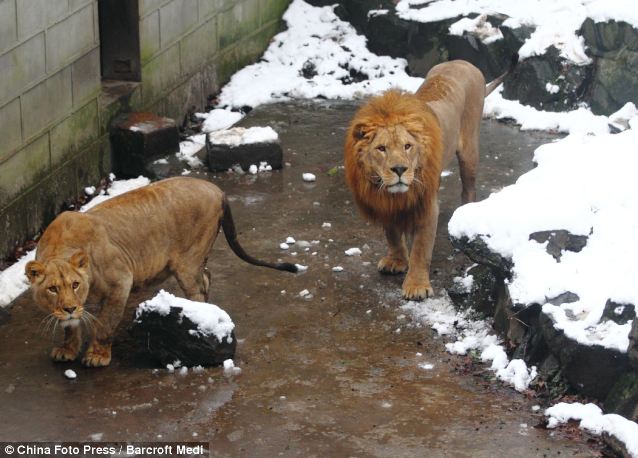
Helpless lions take cover as group - including children - hurl snow at them (Photos)

 Throwing snowballs at lions does not sound the safest - or kindest - way to enjoy yourself.

But when the animals are contained in a zoo enclosure and you are firing down on them from behind a safety barrier - it is a little easier to be brave.

These lions certainly looked less than pleased when they were pelted with snow by laughing visitors, including children, at Hangzhou Zoo in Zhejiang Province, eastern China.

The attack was reportedly launched by one young man, who began to take aim at the big cats with a barrage of snow and ice.

The attack clearly frightened the helpless animals, with the lioness swiftly taking cover under a wooden plank.

The male line used a tree trunk as cover, with both eyes fixed on the visitors, as the missiles rained into the enclosure, ChinaSmack.com reports.


The man apparently laughed as he hurled the snow, with a group of other visitors, including a number of children, also starting to take aim at the lions.

One of them used large chunks of snow and threw them down with all of his strength, according to the website.


The frightened lions took shelter together in the corner of their pen as they tried to escape the new onslaught. The male lion roared in anger at his tormentors as they began to stroll away.

Sadly the lions were not the only animals to be pelted with snow, with some of the crowd also pelting the zoo's alpacas, monkeys, a giraffe, a tiger and other creatures.
Source


Thursday

Chinese soft-shelled turtles pass waste through their mouths, scientists in Singapore have found.

 The Chinese soft-shelled turtle looks like someone glued the snout of a pig onto the face of a fish, with the texture of a scrotum for good measure. But its bizarre appearance pales in comparison to an even more bizarre, and newly discovered, habit: it urinates through its mouth.

When the turtle breaks down proteins in its liver, it ends up with an abundance of nitrogen, which it expels from its body in the form of urea. Humans are the same—we get rid of urea in the form of urine, via our kidneys. But the soft-shelled turtle has an altogether different route.

It’s well-adapted to life in the water, and lives in salty swamps and marshes. But Yuen Ip from the National University of Singapore noticed that when the turtle emerges from water, or is stranded on land during dry spells, it will plunge its head into puddles. While submerged, it rhythmically expands and contracts its mouth. Ip found that the turtle gets rid of most of its urea through its mouth rather than its kidneys, via gill-like studs in its mouth. It can breathe and urinate through the same structures.

It’s not hard to get a hold of Chinese soft-shells in east Asia – they’re raised on several farms and millions are sold in markets as pets or food. Ip bought some for research instead, picking them up from a wet market in Singapore’s China Town. He put them in dialysis, placing them in water and collecting the urine from their rear ends. He also measured the total levels of urine in the surrounding water.

Ip found that just 6 percent of the urea that the turtles produces was ejected via their kidneys. The rest came out through the mouth. When Ip gave the turtles a chance to dip their heads in water, he found that they can sit there sucking, swilling, and spitting out the liquid for up to 100 minutes. This oral route gets rid of urea between 15 and 50 times faster than the kidneys.

Images by Monika Korzeniec

The turtle’s mouth contains rows of tiny studs that are thought to behave like gills, which supplement the animal’s lungs when it stays underwater for protracted bouts. Ip showed that these same studs are also littered with urea transporters – proteins that flush urea out of cells. These proteins are closely related to those found in the kidneys of other turtles. But it’s absent in the Chinese soft-shell’s kidneys; instead, it’s all over the inside of its mouth. And as a result, the level of urea in the turtle’s saliva is a “phenomenal” 250 times greater than that in its blood.

Fish share the same trick – they too can get rid of urea through their gills. But why is this turtle the only other back-boned animal that does so? Ip thinks the answer lies in its salty habitat. To urinate through the normal kidney route, the turtle would need to constantly drink more water to make up for what it lost. And because the surrounding water is so salty, they would soon build up toxic levels in their bodies (especially since reptile kidneys are atrocious at getting rid of unwanted salts).


The Chinese soft-shell has evolved to deal with this problem through oral urination. It doesn’t need to drink anything. It just gargles some surrounding water and spits out its waste.

SOURCE
Reference: Ip, Loong, Lee, Ong, Wong & Chew. 2012. The Chinese soft-shelled turtle, Pelodiscus sinensis, excretes urea mainly through the mouth instead of the kidney. J Exp Biol http://dx.doi.org/10.1242/jeb.068916

VIDEO Chinese Soft Shelled Turtle

Big Names in China Stand Up for Animals

Good news for the many persecuted animals in China and those animals destroyed because of a Chinese appetite for superstitious medicinal remedies. Not only is the developing middle class in China learning to appreciate dogs and cats as family pets now, but also more Chinese celebrities are speaking up and taking a stand against animal abuse. And it is not a minute too late!

Several celebrities in China, including pop singer Yu Kewei, artist Ai Weiwei, actress Sun Li, and former NBA star Yao Ming, following in the footsteps of actor Jackie Chan (who has spoken out against bear-bile farming), have joined forces with Chinese animal welfare activists to raise awareness of animal abuse in China.

Even though China had passed a Protection of Wildlife law in 1988, a similar law for the protection of domesticated animals (including companion animals) has never been passed. In 1949, dogs were outlawed in China’s urban areas as decadent and extravagant at a time of shortages. But the growing popularity of dogs and cats as pets today, however, has forced local governments to relax these regulations. A growing concern for all animals in China has also started to develop due to much frustration over the slow pace of proposed legislation. This frustration has been coupled with a fondness for pets in the more affluent China of today.

The number and vitality of animal welfare organizations, such as the Chinese Animal Protection Network and Animals Asia Foundation, has also greatly increased. Petition drives, rallies, and protests promoting animal welfare are becoming much more common now. And it is the involvement of high-profile celebrities that has been a big contributing factor to all this change for the better.

Former NBA star Yao Ming filmed an anti-poaching documentary by the organization WildAid, to help raise awareness of the slaughter of elephants and rhinos for tusks and horns. Yao has also brought attention to the anti-shark fin campaign and also protested against the bear bile industry in China. He has probably been the most recognized Chinese celebrity around the world for speaking out for the animals. Chinese actress Sun Li has also participated in an anti-fur ad for People for the Ethical Treatment of Animals (PETA) Asia in Beijing. She actively opposes the use of fur and bear bile farms in China.

Also recently, the Chinese pop singer Yu Kewei photographed a truck in the southwestern province of Sichuan loaded with dogs headed for a slaughterhouse in Guangxi province to the southeast. She posted the photo on Weibo (a Chinese equivalent of Twitter where reportedly she has hundreds of thousands of followers) and received a flood of support to try and stop this truck.

In 2009 and 2010 a filmmaker and animal rights activist, Guo Ke, wrote and filmed the documentary San Hua, depicting the cat meat industry in China. It was produced by the famed Ai Weiwei Workshop, Ai Weiwei himself an advocate for animals. Since China has become the country which has produced the most severe atrocities against both domestic and wild endangered animals in the world, it is with great thanks that we applaud these brave and outspoken Chinese celebrities that we have focused on today. Hopefully many more will soon join them and be able to help put out this great firestorm of animal abuse by their country.


VIDEO Chinese Star an Angel to Animals

Chinese Star an Angel to Animals par NTDTV

Friday

Lightning Strikes And Rainbows Clash In China Skies (PICTURES)

These stormy skies above Haikou, China, are pictured being punctuated by flashes of spidery lightning and bizarrely, a rainbow.

The phenomena were captured clashing dramatically amidst the ominous purple clouds during a rainstorm earlier this week.

Lightning generally occurs during storms, while rainbows tend to form after the rain has stopped, making this simultaneous appearance of both relatively rare.

An estimated 24,000 people are killed by lightning strikes around the world every year, and around 240,000 are injured.

Earlier this year student Matt Wilkes survived being struck by lightning twice – a feat he put down to the £3 umbrella hat he was wearing at the time.(Source)

A rainbow appears in the sky as lightning strikes during a rainstorm on May 13, 2012 in Haikou, China. (Photo credit: China Foto Press/Barcroft Media)


Wednesday

Stray Dog's Incredible Journey with Chinese Cyclists

In May of this year cyclists in China went on a daunting trip of more than 1100 miles (1700km) through the mountainous Tibetan Plateau from China's Sichuan Province to Lhasa, Tibet. Few racers can complete this overwhelming cycling challenge, but this year, one did it without a bike... or even shoes. What took place is a tribute to the love and loyalty of dogs around the world.

This love story all started when 22-year-old Zhang Heng made a pit stop with his cycling group at the start of the trek from China to Tibet. He had no idea what the consequences of a simple action of sharing would be. He saw a small stray dog lying in the street, exhausted and hungry. Zhang Heng felt compassion for her and tossed her a piece of his food. After this simple act, the little dog then joined the bikers for three days before they decided to make her an official part of the team. At first they thought she was just following them for the food, but as cyclist Xiao Yong, remarked," I can now see a bond between us from the way she looks at me. I think we have definitely moved beyond food."

She ran with the cyclists, sometimes taking the lead as they trudged up and down a grand total of 10 mountains, each mountain higher than the next for 24 days. The cyclists rode 30 to 40 miles a day, up and down mountains as high as 14,700 feet, and sometimes through heavy storms. The little dog, now known as Xiao Sa, kept up, and sometimes even led. She once ran 37 miles in one day, going uphill. The cyclists were all very impressed by Xiao Sa's persistence and she inspired them all the way to their destination. Sometimes she would even run back down the road to round up the stragglers. Some of Xiao Sa's followers in China began calling her 'Forrest Gump'.

Of course, sometimes she also got a ride in a makeshift box on the back of Zhang Heng's bike at certain times like when the group was about to cruise down a steep hill, much faster than a dog could run, or if she was exhausted. Once they were chased by a pack of big dogs, so Xiao Sa rode safely in her little box on the bike until they got away from the dogs.

Now that their trip to Tibet is over, their journey together is only just beginning. Zhang Heng has decided to adopt her and give her a permanent home. He has also taken her to a vet where she was declared healthy and about 2 years old. Xiao Sa has also become a celebrity in China, dubbed, "The dog with determination," as Chinese bloggers have described her. She now has more than 82,000 followers on Weibo, China's version of Twitter. But little Xiao Sa doesn't know about that or would care if she did. All she cares about is that she now has a home and someone to love which she well deserves. She is an amazing little dog with a huge heart and a great spirit.


VIDEO Stray dog runs to Tibet with Chinese cyclists


Thursday

Chinese Woman Adopts 1,500 Stray Dogs and 200 Cats

Many of the animal stories that come out of China are tales of horror. Eating dogs and cats, slaughtering endangered animals for their body parts, skinning alive dogs,foxesm etc. for their fur, milking bile from moon bears kept in tiny cages their whole life. The list goes on and on. It is hard to believe sometimes that the people who do this are really human? But as much as these stories tend to overwhelm us there is as always another side to these stories from China.

Ha Wenjin is a dog lover from China who has sacrificed her own life and lifestyle to help the homeless and marked for consumption dogs and cats there. She has had to give up her job, sold her house, car and jewelry to take care of over 1,500 dogs and 200 cats. Despite these large numbers that she cares for it is still just a drop in the bucket for the homeless animals in China. But this fact does not deter her and the resourceful woman has managed to keep the facility going outside Nanjing until now.

The middle-aged woman started out with just a few dogs that she could take care of in her spare time, but as their numbers increased, she had to give up her career and spend her entire day taking care of their needs. Before long, she had her own personal animal shelter, along with 10 workers who look after the dogs, and 2 more who take care of the cats. She also had a number of volunteers coming in at least once a week to check on the dogs, and people donated most of the food she needed.


But now she is being forced to move the 1,500 dogs and 200 cats to a new home. The Chinese government officials have reclaimed the land the shelter is built on and are threatening to close the place down. Ha Wenjin had to act quickly to find an inexpensive but large enough space where she could relocate her beloved pets to. She managed to find it in the Houyu village, which is far away enough away from other people, because she is the first to admit that 1,500 dogs are not quiet.


She has also acquired four buses to move the animals in but still needs to find enough volunteers to help move and then clean the buses afterward. Ha Wenjin definitely has her work cut out for her, but she has no intention of giving up in her fight to save as many stray dogs and cats as she can. She is a shining example of what the human spirit can accomplish when they are passionate about something despite the overwhelming odds against her. And in China that is saying a whole lot.


Shelter filled with dogs saved from slaughter

More than 500 dogs destined for the slaughterhouse -- and the dinner plate -- were saved when the truck that was transporting them was intercepted by about 200 animal lovers in China last week, China Daily reports.

The rescue effort began on the night of April 19th, when a message went viral on Weibo -- a social media platform akin to Twitter -- urging people to stop a dog-filled truck that was driving along the the Fumin-Kunming Highway in Yunnan Province.

Within 30 minutes, hundreds of people and local police had gathered at the highway's toll station where the truck was due to pass through, Chinese newspaper Yunnan News reports.

When the truck finally arrived, those gathered were horrified at the sight of 505 dogs trapped in 156 small cages.

"They were crammed together. A cage could be stuffed with seven to eight. Our hearts were broken in seeing that," said one activist.

Unable to free the dogs immediately due to police protocol, volunteers spent the night feeding and treating the animals, the Daily Mail reports.

According to China Daily, many of the animals were discovered to be sick or injured and more than 20 of them were found dead.

The following day, the police stunned the volunteers when they announced that the truck driver had legitimate documents and that the transportation of the dogs had not been illegal, Yunnan News reports.

China is one of nine countries were the consumption of dogs is legal.

Many animal lovers, however, have remained unconvinced and believe that the dogs were being trafficked illegally.


"More than 100 dogs are family pets, like a golden retriever. Why would a factory raise such pets for food? They are obviously stolen," said an organizer of an animal shelter named Yao, who declined to give his full name.

Refusing to let them go, a local businessman and animal lover who wanted to remain anonymous, then bought the dogs for $9,500. Volunteers have since also raised almost $8,000 to provide food and shelter for the animals until homes can be found for them.

"Many of them are suffering from dehydration, malnutrition or infectious diseases and they are very weak," said Zhao Yue, a veterinarian at the shelter and an associate professor of the college, adding that he hopes the dogs will all soon be healthy and ready for adoption.

Last year, the Associated Press reported a similar dog rescue that occurred on a Beijing highway, when about 200 volunteers saved 580 dogs from death.

These two rescues are examples of successful social activism in a country where animal rights is still an almost unrecognized issue and animal welfare legislation is practically non-existent.

However, with celebrities like basketball star Yao Ming helping to energize China's animal rights movement, it is hoped that positive changes are in the near future for China -- and its animals. (Source)


VIDEO


Monday

What’s Killing China’s Rare River Porpoises?

Once again China is at the forefront of more animal deaths and a species headed toward extinction because of their actions. 16 endangered finless porpoises have been found dead since the beginning of this year. This porpoise lives mainly in China’s Yangtze River and two lakes linked to the waterway and has been there for more than 20 million years. Experts blame water pollution by the Chinese and climate change for pushing the species toward extinction. The freshwater porpoise is referred to in Chinese as the “river pig”.

In the year 2006, China was estimated to have only 1,200 finless porpoises left. That same year, the Baiji, a freshwater dolphin also native to the Yangtze River was declared extinct. Now earlier this year a survey found just 65 “river pigs” in Dongting Lake and only 300-400 in Poyang Lake. Experts have warned the species will be extinct within a matter of a decade and a half at the rate they are dying off.

According to Wang Kexiong, a researcher at China’s Institute of Hydrobiology, water pollution, shipping, sand dredging and illegal fishing were all possible contributing factors to the recent deaths. Added to that is the fact that many waterways in China are heavily contaminated with toxic waste from factories and farms. This is all pollution as a result of more than three decades of rapid economic growth and lax enforcement of environmental protection laws. China is an ardent believer in the old adage that says "The end justifies the means".

Another possibility is that climate change also could be to blame since disrupted weather patterns have caused water levels to drop and make it more difficult for the porpoises to find food.
Tests have shown that some of the porpoises are believed to have died of starvation. However following these recent deaths, residents of Yueyang City have vowed to investigate and increase protection of the remaining porpoises in Dongting Lake. That however will remain to be seen.


VIDEO China’s Rare River Porpoises


Saturday

China is well known for it's cruel tactics to obtain body parts and fluids from animals for it's psuedo medicinal purposes. Aside from the horrors of poaching and farming these animals in order to do this, many of them are already extremely indangered. In the case of bear bile farming, the Moon bears used are kept in tiny, cramped cages where a permanantly implanted tube is inserted into their liver. The area where the tube enters often becomes infected. Currently there are 68 licensed bear farms in China. Many Chinese believe that bear bile can cure liver and eye ailments, remove toxins and eliminate fevers.

China however is slowly starting to awaken from these long used, torture inducing customs against innocent animals. Just recently in China, dozens of drug stores have stopped selling bear bile products after a company accused of torturing bears to extract bile became the center of a storm of criticism over a shares issue plan. Animal welfare groups and members of the public have been protesting against the shares issue plan by Fujian Province-based Guizhentang Pharmaceutical Development Co Ltd. Currently it keeps 470 bears to extract bile for traditional Chinese medicine. The issue at stake is that the company plans to use cash raised from selling shares to expand the size of its farm and increase the number of bears to 1,200.

In trying to defend the company's actions of bear bile extracting and the need to add more bears, the company's founder, Qiu Shuhua, said the method used to extract bile was legal and replaced one where bears had to be killed. The company's website says it can collect bile in five to eight minutes "without causing the bears pain." In response to back this up, The China Association of Traditional Chinese Medicine defended the company last week, comparing bile extraction to "turning on a tap."

The Animals Asia Foundation vehemently disagrees and said bile extraction, which involves inserting a catheter into a bear's abdomen, causes great suffering. Also recently former NBA star Yao Ming visited a center in Sichuan Province which has 277 moon bears rescued from bear bile farms to call on the public to protect the animals. This practice is horrendous and the rest of the world does not buy into China's false claims of this being a noncruel and normal procedure against innocent bears who spend their entire lives enduring this. Please take a moment and sign the petitions below to let Chinese officials know that you strongly oppose this.


VIDEO A bear bile farm in China.


Please voice against this inhuman act and in support sign the petitions.


Monday

Four reptile-eating Chinese nationals face deportation from Zimbabwe this week for keeping an endangered species of tortoise for their dinner table.

Four Chinese nationals have been arrested in Bikita for contravening the Prevention of Cruelty to Animals Act after they killed more than 40 tortoises. Tortoises are listed as an endangered species.
The four Zhang Hong Yuan, Chen Caijan, Lin Guibin and Shi Jiahua were arrested at Chiwara homestead near Gambakwe Village in Bikita.
According to a statement issued by Zimbabwe National Society for the Prevention of Cruelty to Animals chairman Mr Ed Lance, the four were arrested following a joint raid by police, National Parks and Wildlife Management Authority and The Save Valley Conservancy Anti-Poaching Unit.
"When we raided the Chinese homestead we also recovered 13 live tortoises, meat together with the skeletal remains of a further 40 tortoises," Mr Lance said.
He said the four Chinese had procured the Bells Hinged Tortoises from the local community for personal consumption.
"The Bells Hinged Tortoise is listed under CITES (Convention on International Trade in Endangered Species) Appendix II and its numbers in the wild have dwindled significantly over recent years."
The tortoises were kept stored in two empty 200 litre steel drums with no provisions for food or water.
Written statements from members of the community stated that the tortoises were dropped into boiling water while alive in order to separate the shell from the meat. Tortoise meat was also recovered during the raid.
The ZNSPCA said such actions were a clear violation of the Animal Welfare Act.
"Officers were dispatched to Bikita in order to undertake investigations into the matter and charges of cruelty were laid against the four."
When interviewed, the ZNSPCA said that the four Chinese all admitted to contravening the Prevention of Cruelty to Animals Act.
Further investigations also revealed that these four had been employed locally without relevant immigration documentation.
"The four men are now detained pending deportation," Mr Lance said.
The ZNSPCA commend the joint efforts undertaken by the Police, National Parks and Wildlife Management Authority, The Tikki Hywood Trust and The Save Valley Conservancy Anti-Poaching Unit.
"As an organisation we are concerned with the increasing cases of cruelty to all animals within Zimbabwe.
"Our wildlife remains a legacy for future generations of Zimbabweans and we should jealously guard their well being."
"In accordance with our mandate we will vigorously pursue and prosecute any individuals found guilty of contravening the Prevention of Cruelty to Animals Act," the ZNSPCA said.
According to the state-run Zimbabwe Herald.

The rare Bell's Hinged tortoise Photo: ALAMY

Bell’s hinged tortoise (Kinixys belliana) is unique, they are amongst the longest living animals on earth.

Friday

It is now possible to enjoy seeing "live" giant pandas in their birthplace in southwestern China, with one site showing a flow on the Internet ("streaming") of video images taken on site by webcams, the project announced Wednesday.


The flow can be found at "http://explore.org/" and was born of an agreement between the NGO and Explore the Bifengxia Panda Reserve in Sichuan Province, the main sanctuary for the region's giant pandas.

For the first time, China diffuses flow images on the Internet of some of it's pandas, animals that are considered their "national treasures" of the country, said Jason Damat, one of the leaders of Explore, an NGO non-profit organization that specializes in multimedia.

Two high definition cameras are filming live in their enclosure a selected few pandas, among whom are young, while the website also offers video clips of the best compilations of Ursidae. Users can post comments.

The project's proponents hope to assist in the advocacy for endangered species, a case that the pandas are a symbol of.


Webcam pandas in China


Monday

Once again the use of the internet came to the rescue of a 1,000 dogs who were going to be sent to slaughter on Oct. 14th of this year in China. The rescue call went out - "Urgent: at Zigong, Sichuan, thousands of dogs are now being transported to the slaughterhouse! Please forward.” This message was sent out on "Weibo", a Chinese form of ‘Twitter’, and stirred up public attention across the country. Before long, hundreds of rescue volunteers arrived at the dog market on Oct. 15th where 1,000 dogs were found to be crammed into small overcrowded cages. Each cage is only 10 sq.ft and packed with up to 20 dogs.

Many of the dogs were injured or dehydrated or sick with disease. They had not been fed or given any water and were going to be shipped to Canton over 1,000 miles away to be slaughtered for food consumption. Most of the dogs were strays but there were also many dogs that had been stolen from pet owners or those who were being used as guard dogs. Sadly some of the dogs had already died of hunger and the cold. The volunteers began to administer water from water bottles to the dogs and fed them food from the palms of their hands. Negotiations were going on with the owner of the dog market and the dog dealers by rescue organizations to release the dogs over to them. However, the dog dealers were insisting on being financially compensated for the dogs and would not release them without it.

The rescue volunteers had accused the dog dealers of violating the Epidemic Prevention Law, which inhibits trading and consuming of unvaccinated dogs. But local Chinese officials quickly showed up and the Bureau of Animal Husbandry soon issued a certificate to the dog dealers, stating that all the dogs were vaccinated and healthy. This unethical action once again proved to discredit the local government and the country of China at large.

For awhile it was uncertain as to what was going to happen with the dogs but eventually the rescue organizations, The Love of Home Animal Rescue Center and the Qiming Animal Protection Center were able to negotiate a deal with the dog dealers. They were able to purchase the dogs and the cages and the dogs were then sent to animal shelters that night.

This was the 2nd large rescue of dogs going to slaughter that has taken place in China within the last 6 mos. The first rescue had taken place in April where a truck packed with over 500 dogs was apprehended by rescue volunteers after the word was sent out to help. Rescue volunteers have relied on a communication system of Weibo and the use of cell phones to organize these rescues since the two large social networks, Twitter and Facebook are currently banned in China. But where there is a will there is always a way.

Saturday

The revolution continues to march on in China step by step. This week a 600 year old dog eating festival in Qianxi, was banned after a huge social media outcry against it. Traditionally fifteen thousand dogs were killed and butchered at the festival. The festival commemorated a long ago battle where an invading army crept into town and killed all the dogs to keep them from barking once they invaded it. Afterwards the army ate the dogs to celebrate their victory.

Ever since that time, dogs have been slaughtered and butchered on the spot at the festival before being cooked and eaten. Then in the 1980's this practice was stopped but it had since slowly crept back into the festival. Photos from this carnage soon made their way to the internet causing many people to become upset. This year many of those people took to the internet calling for a stop to this. The Chinese government responded by issuing a ban against the festival.

The Chinese culture has become increasingly sympathetic to protesting against these types of dog eating situations. Pet ownership has steadily increased since the ban of pets during the Cultural Revolution and many Chinese have become totally against this. There were rumors of banning the consumption of dogs and cats earlier this summer in China. This recent action by the Chinese government might be a signal that it is ready to follow through on this ban in the near future. The rest of the world can only hope.

Friday

For most of us around the world when we think of cats and kittens we think of loving and wonderful pets. In fact in the U.S. alone cats outnumber dogs as the preferred pet of choice. This is because not only do cats make great companions but also because they are more independent than dogs and allow an owner more freedom in not having to rush home to walk the cat as with a dog. Cats are also very intelligent and can be very compatible with other animals and children too.

But as much as most of the world has this great affection for cats, this feeling is not shared everywhere. In fact in most of Asia, cats are many times viewed as a source of human consumption. Not only is this incomprehensible to most people but the manner in which cats are often kept and then killed for consumption is beyond horrific and inhumane. But this deep dark secret is slowly being exposed to the light of media attention.

Recently in China in the city of Guangzhou, the capital of the southern province of Guangdong, a cat market known as the Xin Yuan market was exposed by the The Daily Mail, a british publication. The story was about the appalling conditions that hundreds of cats had to endure while waiting to be killed for food. The Mail's report was then followed up by newspapers and magazines around the world.

Not only was the Chinese embassy in London flooded with calls, letters and emails (many from Chinese residents of Britain) but many also wrote to the animal welfare organization, Animals Asia Foundation. Jill Robinson, director of Animals Asia Foundation, who was armed with hundreds of letters opposing the cat market set up a meeting with Chinese government officials to press for a change in the law. The Chinese officials bowing to pressure ordered police officers to raid the market last week and close it down.

The conditions that were discovered by the Mail were described as finding hundreds of cats on display, crammed in cages stacked up to 12ft high in some cases. Many times up to 25 cats were squeezed into small 2ft by 3ft cages. Some of them remained there for up to two months inside these cages and many died before reaching their final destination. These cats were normally fed once a day on a mixture of rice and animal feed. The cats were initially reared by villagers who sold them to the market where they were then bought by restaurant owners.

Many of the cat traders were stunned by the closing down of this market. One trader, Yanwu Peng expressed his confusion about the concerns of the treatment of his cats by saying, "I do not think it is wrong to keep them this way. They will die soon anyway." At one restaurant in Guangzhou the cats are kept in cages outside and customers are invited to make their selection. The chef then kills the cat they have chosen by cutting its throat.

Jill Robinson (Animals Asia Foundation director), gratefully sent her thanks to the Mail for exposing the cruel methods of this cat market and starting the international chain reaction to end it. She was very surprised but delighted that the Chinese authorities acted so quickly to shut it down.

So the wheels of change are beginning to turn even in a country like China. A country where centuries old customs of viewing cats as food and therefore not requiring any concern for humane treatment is quite commonplace. Maybe someday, even cats in China will also be seen as the wonderful and loving animals that they are as seen in the video below.


Tuesday

As modern China continues to prosper economically and the middle class becomes larger, a common theme is becoming more apparent that is causing the widening gap between the rich and poor when it comes to the outlook toward animals. For thousands of years the people in China have consumed cats and dogs as food. More specifically it was the huge class of the poor who could not afford other kinds of meat.

Then there was the Cultural Revolution where owning a pet was considered a capitalist activity. It was widely felt that only the rich and arrogant had dogs and cats as pets. The implication was that if you treated pets well, you will treat humans who are weaker very badly. But with the middle class now growing in China, many are accepting pets as a wonderful necessity.

So when a trucker with over 500 dogs in his truck was forced off the road recently and made to turn over the dogs to animal activists for a sum that was quickly raised of $17,000, many in China felt this was against the old way. China does not have any anti - cruelty laws against animals, and it is estimated that as many as 10 million dogs are sold for consumption each year and are often kept under horrible conditions. Many of these dogs are stolen pets or strays.

After this huge rescue of dogs took place, a man named Zhu Guangbing from Guangzhou, China posted on his twitter account that he protested the rescue money being raised for the dogs and that he felt it should have been given to the poor and needy. He then made the outrageous claim that starting in June he would kill one dog a day until the $17,000 was turned over to the poor. The old saying that "you reap what you sow" quickly came into play as he received more than 200 threats against him. Even his name, cellphone number, office number and his parents’ number were posted online.

Recently Zhu was forced to quit his job as his company was also receiving threats against him. Quickly back peddling, Zhu tried to say that he really wasn't going to kill the dogs but rather was just making a point. He also spoke against the animals activists who he said, " claimed to have the moral high ground, but look what they did to him."

But the animal activists have defended their stance as a necessity to move forward in China. They say it is a question of civilization and not what some people in China are saying that it is silly to protect animals. Activist, Wang, stated that, "By teaching people in this country to love little animals, maybe we can help them to love their fellow human beings better."

So the Revolution has began in China in a determined effort to make the lives of so many suffering animals there better. As with all major societal changes, the road will be long and hard. But let's stand behind the activists in China, which is not a open society by any means. There are many risks still in a country that opposes any opposition. But the seed of long overdue change for animals has been planted and it must continue to grow. Let it grow quickly!

Saturday

A most amazing event took place in China this past week. Amazing because China has a well deserved reputation for being one of the cruelest countries when it comes to it's treatment of animals. China is leading the way in the world as being the largest producer and exporter of inexpensive goods. But it's brutal treatment of animals ranging from it's taste for shark fin soup to it's bear bile farming to endangering animals on the verge of extinction with it's support of poaching has greatly tarnished it's image in the eyes of the world.

So when a major rescue of dogs took place on the 15th of April, the world responded with shock and amazement. It all happened rather quickly when a man sent out a call for help on a micro-blogging site after seeing a truck packed with hundreds of terrified dogs on a highway. About 200 people responded to his pleas to help force the driver to release the dogs. The truck contained about 580 dogs that were on their way to be slaughtered for the meat industry in China.

The rescue took place after effectively blockading the truck at a toll booth for 15 hours. The rescuers were able to negotiate the release of the dogs for about $17,000, saving them from being slaughtered and served as food. Many of the dogs (many were wearing collars) were dehydrated, injured and suffering from distemper and parvovirus. Dongxing Animal Hospital in Beijing, treated up to 68 dogs who were very ill and dozens of volunteers were helping Tuesday to clean and disinfect cages and mop floors.

The rescue was a revolutionary case of social activism in China, in a country where authorities are still waging brutal crackdowns on dissent. But over the last decade changes have been taking place in Chinese society where a new middle class with different values has developed because of China's rapid economic growth. Whereas pet ownership was once unheard of before because of affordability and the Communist Party's condemnation of it, now people in China are raising dogs and developing bonds with them.
The sparks of this change brought on by the rescue have set off new discussions of the divide between age-old customs of seeing dogs and cats as food only and China's growing animal rights movement. This time is long overdue but very welcome in the eyes of the world.

Save the Dogs : PETITION

Video : China Dogs' Rescue Shows Growing Animal Activism


Stats

Archives

Pages