Thursday

Amateur photographer Marc Mol, flew in a microlight aircraft to take aerial shots of a pink hippo after hearing rumors of its presence in Zambia, Africa.

According to Marc, "I was on holiday at the time and after hearing about the hippo, I couldn't wait to try and photograph it. Our pilot had known about the hippo for the past five years but he had not yet seen it that season, I was incredibly lucky to see it in the flesh. "

"Pink hippos are a rare animal to see and it stood out like a beacon amongst all the other hippos. Being at least five years old, one can deduce that it was surviving fairly well out in the wild despite being a leucistic animal. Taking a picture was incredibly difficult whilst sitting on the back of the microlight, especially when you have multiple cameras hanging from you neck."

The picture Marc captured was of a rare pink hippo bathing in the waters in South Luangwa, Zambia, Africa, while surrounded by many of his normal-colored hippo relatives. Contrary to popular belief, this hippo is not an albino but is leucistic, a condition where the pigmentation of cells fail to develop properly.

Leucism is a rare mutation because it can often affect an animals chances of survival as it makes them visible to predators as well as being at risk of sunburn. However, hippos do have an advantage in that they are big enough to defend themselves against attackers as well being able to use their sweat as sun screen.

The image of the hippo was taken in November 2011, but it is still known to be in the area. May it live a long life!


University students in America have been told not to wear "offensive" halloween costumes including cowboys, indians and anything involving a sombrero.

Students at the University of Colorado Boulder have also been told to avoid "white trash" costumes and anything that portrays a particular culture as "over-sexualised" - which the university says includes dressing up as a geisha or a "squaw" (indigenous woman).

They are also asked not to host parties with offensive themes including those with “ghetto” or "hillbilly" themes or those associated with "crime or sex work."

In the letter sent by a university official students are asked to consider the impact that their costumes could have.

According to a student news website Christina Gonzales, the dean of students, wrote: "Making the choice to dress up as someone from another culture, either with the intention of being humorous or without the intention of being disrespectful, can lead to inaccurate and hurtful portrayals of other people's cultures.


People have also chosen costumes that portray particular cultural identities as overly sexualised, such as geishas, "squaws," or stereotypical, such as cowboys and Indians.

Additionally some students have hosted offensively-themed parties that reinforce negative representations of cultures as being associated with poverty ("ghetto" or "white trash/hillbilly"), crime or sex work.

A university spokesman called cowboy costumes a "crude stereotype" Students at the University of Minnesota-Twin Cities have also been asked to make sure their Halloween costumes are politically correct.


In a letter, officials said: "please keep in mind that certain Halloween costumes inappropriately perpetuate racial, cultural, and gender stereotypes."

The move comes at a time when pressure is mounting on one of the most famous American football teams to change their name because of the offense it causes Native Americans.

The campaign for the Washington Redskins to change their name is building momentum, because the term redskin is deemed to be a racist insult.

Earlier this month President Obama said the team should think about changing their name.
SOURCE


Teddy Bear the talking porcupine is back with another video to tell us about munchin' on a pumpkin!

We aren't quite sure what he's saying but judging by his general love for food, he's probably saying something good. Teddy Bear is from Zooniversity, a traveling wildlife company that educates people about animals.

According to National Geographic, there are about two dozen species of porcupines and they are the prickliest of rodents!

The porcupine is the prickliest of rodents, though its Latin name means "quill pig." There are about two dozen porcupine species, and all boast a coat of needle-like quills to give predators a sharp reminder that this animal is no easy meal. Some quills, like those of Africa's crested porcupine, are nearly a foot (30 centimeters) long.

Porcupines have soft hair, but on their back, sides, and tail it is usually mixed with sharp quills. These quills typically lie flat until a porcupine is threatened, then leap to attention as a persuasive deterrent. Porcupines cannot shoot them at predators as once thought, but the quills do detach easily when touched.
Source


VIDEO Teddy Bear, the talking porcupine, likes pumpkin, too!
Teddy Bear, gets to try his first pumpkin. Listen carefully and he'll tell you what he thinks of this holiday treat.

Wednesday

In an age when 100,000 species become extinct each year, sometimes it seems that all there is left to do is to count up the losses. But as it turns out the age of discovery might not yet be over. In August of this year, Smithsonian scientists announced that they had discovered a new species of mammal: the raccoon-like Olinguito.

Although the discovery of new species of invertebrates or amphibians isn't unusual, the discovery of a new species of carnivorous mammal is. Especially since a mammal hasn’t been discovered in the Western Hemisphere since 1978. The last, most recent discovery of a mammal on Earth was in 2010 with the discovery of the Durrell’s Vontsira in Madagascar.

According to Smithsonian zoologist Kristofer M. Helgen, who led the effort to identify the Olinguito, “The discovery of the olinguito shows us that the world is not yet completely explored, its most basic secrets not yet revealed.”

The newly discovered Olinguito was found in the cloud forests of South America, in the western Andes of Colombia. A full-grown Olinguito, which has been described as "a cross between a teddy bear and a house cat," is said to grow up to 14 inches long. These animals eat mostly fruit and only have one baby at a time. Their long claws and padded feet help them grip branches as they walk among trees in the cloud forest.

Fortunately, unlike so many other species, Olinguitos are not at risk of extinction any time soon. Enjoy the pictures of this cute little creature below.


Episode of "The Walking Dead" dedicated to the Native American legend of the Cherokee rose - Most Popular TV Series of the year.

There is a key to the doorway of a meaningful life.
The key lies within every soul.
It is hope, don't let it go.


The Walking Dead Cherokee Rose Quotes

Carol Peletier: A flower?

Daryl Dixon: It's a Cherokee Rose. The story is that when American soldiers were moving Indians off their land on the Trail of Tears, the Cherokee mothers were grieving and crying so much 'cause they were losing their little ones along the way from exposure and disease and starvation. A lot of them just disappeared. So the elders, they said a prayer; asked for a sign to uplift the mothers' spirits, give them strength and hope. The next day this rose started to grow where the mothers' tears fell. I'm not fool enough to think there's any flowers blooming for my brother. But I believe this one bloomed for your little girl.


The Legend of the Cherokee Rose

In the latter half of 1838, Cherokee People who had not voluntarily moved west earlier were forced to leave their homes in the East.

The trail to the West was long and treacherous and many were dying along the way. The People's hearts were heavy with sadness and their tears mingled with the dust of the trail.

The Elders knew that the survival of the children depended upon the strength of the women. One evening around the campfire, the Elders called upon Heaven Dweller, ga lv la di e hi. They told Him of the People's suffering and tears. They were afraid the children would not survive to rebuild the Cherokee Nation.

Gal v la di e hi spoke to them, "To let you know how much I care, I will give you a sign. In the morning, tell the women to look back along the trail. Where their tears have fallen, I will cause to grow a plant that will have seven leaves for the seven clans of the Cherokee. Amidst the plant will be a delicate white rose with five petals. In the center of the blossom will be a pile of gold to remind the Cherokee of the white man's greed for the gold found on the Cherokee homeland. This plant will be sturdy and strong with stickers on all the stems. It will defy anything which tries to destroy it."

The next morning the Elders told the women to look back down the trail. A plant was growing fast and covering the trail where they had walked. As the women watched, blossoms formed and slowly opened. They forgot their sadness. Like the plant the women began to feel strong and beautiful. As the plant protected its blossoms, they knew they would have the courage and determination to protect their children who would begin a new Nation in the West.

VIDEO


Tuesday

After weeks of protest against a dolphin park in the state of Kerala and several other marine mammal entertainment facilities which were to be built this year, India has officially recognized dolphins as non-human persons, whose rights to life and liberty must be respected. Dolphin parks that were being built across the country will instead be shut down.

India's Ministry of Environment and Forests has informed state governments to ban dolphinariums and other commercial entertainment that involves the capture and confinement of cetacean species such as orcas and bottlenose dolphins. They issued a statement that said, "research had clearly established cetaceans are highly intelligent and sensitive, and that dolphins "should be seen as 'non-human persons' and as such should have their own specific rights."

India becomes the fourth country in the world to ban the capture and import of cetaceans for the purpose of commercial entertainment - along with Costa Rica, Hungary, and Chile. Three years ago, the movement began to recognize whale and dolphins as individuals with self-awareness and a set of rights. The movement gained momentum in Helsinki, Finland when scientists and ethicists drafted a Declaration of Rights for Cetaceans. "We affirm that all cetaceans as persons have the right to life, liberty and well-being," they wrote.

It has been shown that dolphins can recognize their own reflection, use tools and understand abstract concepts. They develop unique signature whistles allowing friends and family members to recognize them, similar to the way human beings use names. "They share intimate, close bonds with their family groups. They have their own culture, their own hunting practices - even variations in the way they communicate," said FIAPO's (Federation of Indian Animal Protection Organizations) Puja Mitra.


Belinda Wright from the Wildlife Protection Society of India summed the ban up this way,"I hope this will put some energy into India's Action Plan for the Gangetic Dolphin, which is supposed to run until 2020. But there's been very little action."

She added that the ban was a good first stop, but warned against excessive optimism. "I'm very proud that India has done this," she said. "I'm not trying to be cynical but I have been a conservationist in India for four decades. One gets thrilled with the wording, but I don't think it's going to turn to the tables. But dolphins for now are safe from dolphinariums, and that's a good thing."

Sicangu Lakota hip hop artist Frank Waln—who’s also a Gates Millennium scholar—has an incredible new video out. The lyrics to his track AbOriginal reference his home on the Rosebud Reservation, Idle No More, and the plague of reappropriation.

Filmed on the Rosebud Reservation and in the American Indian Center of Chicago.

AB Original Lyrics

Pickup

Look at all around look around at the whole thing
If your skin is brown then you’re down for the old pain
Look at all around look around at the whole thing
If your skin is brown then you’re down for the old pain


Verse 1

Young boy I’m leaving home (all alone)
On the rez I grew up unknown (with my stone)
The world said I couldn’t be king (they disown)
But in the city I can see a throne
Feeling like/ the king of the dammed in a kingdom of sand
Building castles as my freedom expand
Just to watch them fall down as the tides roll in
I’ve never seen a storm come with idle wind
And so I’m Idle No More rap the plight of the poor
Cuz educated warriors are vital to war
And we battling oppression/ got me stressing
Wondering if I’ll ever learn my lesson
Cuz I can’t let me people go (oh no)
And I can’t let my weakness show (You’ll never know)
Even when I’m hopeless and I pitiful
I keep going knowing that I’m AB Original


Chorus A
I got this AB Original flow/ I got this AB Original soul
I got this pain that I can’t shake/ ties to my people I can’t break
Got this history in my blood/ got my tribe that shows me love
So when I rise/ you rise/ come on let’s rise like (Read More)

VIDEO

Monday

Roxy is a red fox that survived a close brush with a terrible death. She was rescued by the staff at Nuneaton and Warwickshire Wildlife Sanctuary in the UK, after being found almost strangled hanging off a bridge with a rope around her neck.

While she was being nursed back to health, the staff noticed that Roxy had some canine tendencies and seemed to be used to human interaction. So when Roxy was ready to be released back into the wild, they were worried that she might be too domesticated to survive in the wild.

According to Geoff Grewcock, who runs the sanctuary: "We found Roxy dangling from a bridge, caught in a rope. She was very lethargic, and obviously very ill. She seemed to be used to human interaction, so we believe someone had tried to hand rear her for a time. As we nursed her back to health, we realized she was far too tame to ever survive in the wild, so she made her home here."

Because of this the staff felt it necessary to keep her at the sanctuary permanently. Note: The RSPCA advises against hand rearing foxes unless absolutely necessary, because they become 'imprinted' and lose the ability to fend for themselves.


Luckily for Roxy, she now enjoys a dog's life there. She loves playing with squeaky dog toys, chasing balls, and chewing on bones in the sanctuary's gardens. She also goes on a daily walk with the center's dogs, and has learned to heel on leash. Roxy has been living there for 13 years now.

Rosie Clinton,the assistant manager at the sanctuary says, "She's ever so friendly, and loves playing with all the dogs we have here. We have six foxes at the sanctuary, and although Roxy will occasionally have a sniff as she walks past them, she much prefers playing with the other dogs."


"But she seems to love human interaction most of all. She's very spoiled but she's such a lovely girl she deserves it. She's a bit of a diva - she turns her nose up at raw meat, and will only eat cooked chicken."

"We do get a lot of funny looks walking her around Nuneaton town centre on a lead with the other dogs - people tend to do a double take. She might not be your average fox, but she'll have a home for life here, and she's a delight to be around."

VIDEO

Saturday

With the recent happy news of Los Angeles’ ban on bullhooks, animal advocates and lovers can now rejoice again as the UK announces its soon-to-be official ban on ALL wild animals in circuses, joining other European nations like Austria, Greece, Croatia and Bosnia and Herzegovina. The ban is intended to be fully instituted starting in December 2015.

Prior to the all-country ban announcement, over 200 UK local authorities had placed bans on animal circuses with over two-thirds banning all performing animals, according to Animal Defenders International.

Leading animal protection nonprofits and associations such as the RSPCA, Born Free Foundation, the British Veterinary Association and the Captive Animals Protection Society worked together on the campaign to bring UK’s ban from dream to reality.

To ease circuses off from the use of animals, the RSPCA and Born Free Foundation have offered to help circus owners re-home their animals, reports the Daily Express.

An official date for the legislation still needs to be passed but the government is confident that it will. When it does, anyone who breaks the law after December 2015 will receive a heavy £5,000 ($8,000) fine, according to the BBC.


Earlier this year, there was some struggle in moving the ban forward as many felt a prohibition of all wild animals from circus went too far.

Some argued, including the Environment, Food and Rural Affairs (EFRA) select committee, that the ban should be limited to big cats and elephants only and that the government should still allow other species, like zebras and snakes, to be featured, as reported by the BBC.

Members of the British parliament decided that such an exception makes little sense as there is no basis for protecting just a select group of animals. And they’re right — no wild animal belongs in a circus — they belong in the wild.

From LA’s announcement to the UK’s, today is certainly a grand day for circus animals and the animal protection movement!
Source

The United Nations has called on Canadian Prime Minister Stephen Harper’s government to end mistreatment of Aboriginal peoples, calling the current situation a crisis, Press TV reports.

“The Canadian Human Rights Commission has consistently said that the conditions of Aboriginal peoples make for the most serious human rights problem,” said UN Special Rapporteur on the Rights of Indigenous Peoples James Anaya during a visit to Ottawa on Monday.

The UN official criticized the Canadian government for failing to build trust with the First Nations people, and to narrow the disparity between Aboriginal members and non-indigenous people.

Anaya stated that Harper’s government needs to address certain issues, including the government-run residential schools, poor education and health of Aboriginals, and investigate the missing and murdered Aboriginals.

On October 15, the UN rapporteur urged the Canadian government to launch a “comprehensive and nationwide” inquiry into the case of missing and murdered Aboriginal women, something the Canadian government has refused to do.


Aboriginals are not happy with their situation in Canada and say it is unacceptable that the government does not consult them before exploiting the resources on their lands.

Violent conflicts have also erupted in cities across Canada, including Halifax, Montreal, Ottawa and Thunder Bay, as well as in New York in the United States, and at the Canadian Embassy in Washington over the past week, with demonstrators protesting against gas exploration on Canada’s native lands.

According to a 2011 census, Canada has 1.4 million Aboriginals, which is nearly 4.3 percent of its overall population.
 Source

VIDEO

Animals all get sick of decorations at this time of year - so this fed-up tiger took matters into her own hands.

Siberian big cat called Soundari was determined to bring down a carved pumpkin which her keepers had suspended from a tree at Longleat Safari Park, Wiltshire.

The tiger was joined by her two sisters, Shouri and Svetli, but none were successful in bringing the seasonal squash to the floor.

The trio were given the tasty snack by their keepers at the Longleat.

The vegetables had been hollowed out and filled with treats, providing a mental and physical work-out for the animals.


Staff also treated other animals, including the macaque monkeys, who clambered all over their pumpkin and used it like a swing.

The pumpkins were given to red pandas and anteaters, one of which used its elongated snout to investigate.

Keeper Ian Turner said: 'It’s become something of a tradition for us to have a competition to see which members of staff can come up with the best carved pumpkin.


'For the animals, the pumpkins’ appearance was of a lot less interest than what was inside as we had hidden a variety of treats within them.

'The tigers in particular got very excited and were literally leaping off the ground to get to theirs.

'The anteaters made good use of their extra-long tongues to give the inside of their pumpkin a thorough inspection.


He added: 'Once again though it was the monkeys who seemed to get the most from the experience.

'They not only got all the treats inside but also used the pumpkin as a swing before then breaking it up in to smaller segments and sharing it amongst them.'

The Amur tiger is better known as the Siberian tiger and is the largest of all the big cats. Fully grown females can weigh up to 25st and measure more than 6ft 6in from head to tail. They are native to far east Asia and are critically endangered after their numbers dropped to around 40 in the 1940s. Their current population is about 500, the highest in 100 years.
 Source

VIDEO

Friday

In northern Ontario, Canada 2 baby mountain lion cubs and a baby skunk have struck up an out-of-the-ordinary friendship despite being enemies in the wild.

Peanut the skunk and Annabelle and Lester the lion cubs were brought together after Peanut was found orphaned in Northern Ontario, Canada. And they all really do adore each other.

When they were just six weeks old, the decision was made to let the youngsters play together at Animals of Montana where the lion cubs were being bred in captivity. Annabelle and Lester, the two cubs, took Peanut, the skunk, in as one of their own.

Don Johnston, photographer and wildlife enthusiast, took the pics of the new friends playing together. According to Don, "The cubs were only a few weeks old about the same as the skunk and the cubs were still nursing with their den mother. The skunks were being bottle fed a milk formula."

He went onto to say, "Once weaned skunks have an omnivorous diet. At that age the skunk's scent glands are not developed so there was no worry about accidental spraying. It was funny to see them playing together, I'm not sure it would be the same when they get older."


Thursday

A woman who was hiking on a steep incline in the Yorkshire Dales, came across a startling sight. A brown lurcher-saluki cross was on the verge of death and looked like a bag of bones when he was discovered by her near the summit wall by the Second World War memorial on Buckden Pike. She quickly alerted mountain rescuers who went to the dog's aid.

The dog had broken its leg at the summit of a 2,264 ft. fell and it was a sheer miracle that he was found alive after nearly a month without food. He was lucky to have fallen on the side of the wall that shielded him from most bad weather.

The eight-strong team transferred the dog to a rescue vehicle near the village of Starbotton in Wharfedale, North Yorks. Team leader Andy Jackson, 44, said: “When we eventually moved him, we put him into a casualty bag and on to the stretcher, the actual grass had started to die where he had been sitting.

“He was happy to see us. He just had nothing in him. There was a lot of bone. He was obviously a thin dog anyway, but it looked like he hadn’t eaten.” He added that it was likely that he was hurt while chasing after a rabbit. “He was quite happy to be picked up, kept warm and seemed to quite enjoy his trip down in the stretcher. He made no attempt to get off. He just seemed happy.”


The rescue team nicknamed him, 'Wufra' and then he was transferred to canine training business, 'The Dog People' in nearby Grassington, where he is being looked after until he recovers. Boss, Helen Coates, said: “We are making sure he gets rest and food. He’s eating and drinking and starting to walk around.”

“We’ll look after him here until he’s better,” said Helen. “Hopefully his rightful owner will turn up to collect him. But if not, he might become part of the family.”


Valentina "Tina" Merdanian explains the significance of the Native American medicine wheel and shares the often untold side of Wounded Knee (Little Big Horn) massacre of the Lakota people by the U.S. Cavalry in 1890.

In February andMarch 2012,Bridgewater State hosted a visit from Valentina (Tina) Merdanian and a delegation from the Red Cloud Indian School on the Pine Ridge Indian Reservation in South Dakota.

The visit reciprocated an earlier trip made by President Mohler-Faria and a group from our university to tour the reservation and begin to understand the depths of the challenges that face the Native Americans who live on Pine Ridge.The challenges are many.

The unemployment rate on the reservation is higher than 80% and the average annual income among its residents is about $6,200

Pine Ridge, like many Indian reservations in the United States is, to borrow Ms.Merdanian’s phrase, an“island of poverty within a nation of progress.”Moreover, its residents carry a heavy historical burden.


Pine Ridge is home to Wounded Knee, the site where an 1890 massacre of at least 150 Lakota by U.S.Cavalry marked the end of the country’s Indian Wars, as well as a famous 1972 American Indian Movement occupation that called to public attention the failure of U.S. governments to honor its treaties with Native peoples.To many,Pine Ridge is a symbol of American governmental perfidy. But today, as Ms.Merdanian and her colleagues Father George Winzenburg,Tashina Banks,Robert Brave Heart and Colleen McCarthy explained, it can also be a symbol of hope.


Tina Merdanian, director of institutional relations at Red Cloud Indian School, feels that being Lakota and knowing your native language go hand-in-hand and that the language is at the heart of being a Lakota person.

As a child growing up on the Pine Ridge Reservation, Tina Merdanian promised her grandmother she would share their people’s culture and beauty, which she heard about in her grandma’s stories. “Grandparents raising you is a very special connection,” said Merdanian, a Lakota woman who directs institutional relations at Red Cloud Indian School.

VIDEO Share The Beauty

Wednesday

The video below is a situation where a man comes upon a crow and mole in the middle of the road. At first he rationalizes that it is just the circle of life and although it is sad for the mole, it is his lot in life at the moment. But the more he watches it unfold, the more torn he becomes. In the end he decides to make a deal with the crow to spare the life of the little mole.

Moles are small cylindrical mammals adapted to a subterranean lifestyle. They have velvety fur; tiny or invisible ears and eyes; reduced hindlimbs; and short, powerful forelimbs with large paws oriented for digging. The term is especially and most properly used for the true moles, those of the Talpidae family in the order Soricomorpha found in most parts of North America, Asia, and Europe. Male moles are called "boars", females are called "sows". A group of moles is called a "labour". Moles however are solitary creatures, only coming together to mate.

Moles have been found to tolerate higher levels of carbon dioxide than other mammals, because their blood cells have a special and unique hemoglobin protein. Moles are able to reuse the oxygen inhaled when above ground, and as a result, are able to survive in low-oxygen environments such as underground burrows.

Moles have polydactyl forepaws; each has an extra thumb (also known as a prepollex) next to the regular thumb. While the mole's other digits have multiple joints, the prepollex has a single, sickle-shaped bone which develops later and differently from the other fingers during embryogenesis from a transformed sesamoid bone in the wrist, independently evolved but similar to the giant panda thumb. This supernumerary digit is species-specific, as it is not present in shrews, the mole's closest relatives.


A mole's diet primarily consists of earthworms and other small invertebrates found in the soil, and a variety of nuts. The mole runs are in reality 'worm traps', the mole sensing when a worm falls into the tunnel and quickly running along to kill and eat it. Because their saliva contains a toxin that can paralyze earthworms, moles are able to store their still-living prey for later consumption. -Wikipedia

VIDEO

A Navajo Medicine Man who believes that this a very important time in the history of humanity.

"This is a time for people of all colors to come together as one tribe, united by love for each other, and for our sacred Mother Earth. This interview takes place in his Hogan on the sacred land at 4 corners. Prayer is very important. It is everything.This Hogan that we are in is a sacred place of ceremony where prayers are conducted and is always open to others to carry out prayers.

Because of the fact that we pray and hold ceremony here, this event is an extension of the spiritual nature of what we share in this Hogan.

With this event about to happen called earth day 4 corners, we plan to perform a sacred ceremony here to bless the Earth.

Many people in the community are prepared to give their service for this sacred ceremony. I received concern from as far away as Oklahoma for this event. They wanted to know if the sacred ceremony can be properly conducted at this event.


I told them i welcome them to perform the sacred ceremony here as we need their blessing for mother earth at this event. We as the children of mother earth are pleading to be heard and to address the needs of the people. Our mother is a giving mother and she has sympathy for her children as she sees us struggling. All mothers want to help their children in need.

In this event that we are preparing for, we will bring people from all walks of life together.There will be Native Americans from all tribes with people of all colors from the modern American culture as well. They all have some degree of compassion for what we are going through at this time.

There are many people who have compassion for helping those less fortunate than themselves. I personally feel obligated to make a decision with my land, to go forward and pursue the idea of attracting the people of like spirit at this time.

I have faith that they are people who will listen to the challenges we are up against and are willing to help us overcome the obstacles that we have dealt with for so long.Now is the time. You are the one that can help to bless the earth in harmony with all that is. Do something good right now."
Navajo Elder
Source
VIDEO

Purring monkey and vegetarian piranha among 400 new Amazon species

A purring monkey, a vegetarian piranha and a flame-patterned lizard are among more than 400 new species of animals and plants that have been discovered in the past four years in the Amazon rainforest, conservationists say.

Discovered through hundreds of scientific expeditions between 2010 to 2013, the total of 441 new species – all new to science – includes 258 plants, 84 fish, 58 amphibians, 22 reptiles, 18 birds and one mammal. This tally does not include discoveries of insects and other invertebrates.

"The more scientists look, the more they find," said Damian Fleming, head of programmes for Brazil and the Amazon at WWF-UK, which compiled the list. "With an average of two new species identified every week for the past four years, it's clear that the extraordinary Amazon remains one of the most important centres of global biodiversity."

Among the new species discovered is a "purring" Caqueta titi monkey (Callicebus caquetensis) of the Colombian Amazon, whose babies have an endearing trait: "All of the babies purr like cats," said scientist Thomas Defler, who helped discover the species. "When they feel very content they purr towards each other, and the ones we raised would purr to us."

A 'vegetarian' piranha (Tometes camunani) – Para, Brazilian Amazon

A "warpainted lizard" (Gonatodes timidus) was discovered in the part of the Amazon that extends into Guyana. Despite its extraordinary colouring, this lizard is very shy and has a tendency to avoid being seen by humans.

Some species may be lost just as they have been discovered, scientists warned. The thumbnail-sized "thimble frog" has been given a Latin name (Allobates amissibilis) meaning "that may be lost", because it thrives in an area of Guyana that could soon be opened up to tourism.

A 'purring' monkey (Callicebus caquetensis) – Colombian Amazon

Other species are under threat from development. The strictly herbivorous "vegetarian piranha" (Tometes camunani), inhabits rocky rapids in the Brazilian Amason where its main source of food, Podostemaceae aquatic herbs, is found. However, dam projects and mining activity in Pará state are threatening the health and flow of its river habitat.

The 'thimble frog' (Allobates amissibilis) – Guyana

Many of the recently discovered plants and animals have very restricted ranges and are thought to be endemic to small parts of the Amazon. For example, a new fish species (Apistogramma cinilabra) that has adapted to low-oxygen water is unique to one small lake in the Loreto region of Peru and found nowhere else in the world – making it and other species even more vulnerable.

 A beautiful orchid (Sobralia imavieirae) – Roraima, Brazilian Amazon 

The Amazon ecosystem is the world's largest tropical rainforest and river system, covering 6.7m square miles shared by Brazil, Bolivia, Peru, Ecuador, Colombia, Venezuela, Guyana, Suriname and French Guiana. It is rich in biodiversity, containing one in 10 of the species known on Earth in 1.4bn acres of dense forest and 4,100 miles of winding rivers.

A recent study found that almost 400 billion trees belonging to 16,000 different species grow in the Amazon.

A new species of passion flower 

Deforestation, intensive farming, climate change, natural resources extraction and hydropower are among the chief threats to the forest and freshwater ecosystems.

About one-fifth of the Amazon rainforest has already been lost, and deforestation is currently taking place at a rate of three football pitches of a minute, WWF says. In the past eight years, Brazil has slowed the pace of forest clearance by 80%, but roughly 6,000 sq km is still converted to farmland each year.
SOURCE

a new species of snake

Tuesday

The Malay eagle-owl is an unusual bird whose southeast Asian taxonomic relationships are still unresolved. The video below is that of a Malay eagle-owl who is obviously enjoying having his head scratched and seems to have learned that if if bats his big eyes then he will get more scratches.

The Barred or Malay Eagle Owl is a large, striking owl with barred underparts and very long, outward slanting ear-tufts. The species name "sumatranus" is the Latinised form of Sumatra, where the first specimen described was located.

Habits: The Barred Eagle Owl is a nocturnal or crepuscular bird. It roosts by day singly or in pairs, hidden in a lofty tree with dense foliage, often near the trunk.

Hunting & Food: Feeds on large insects, birds and small mammals and reptiles.

Breeding: This owl probably pairs for life, and pairs are very loyal to nest sites, returning year after year. Nests are in large tree holes, or commonly on the top of large Bird's Nest ferns. The female lays only one white oval egg (53.8-57.7mm x 42.8-44.9mm).


Habitat: Evergreen forest with ponds and streams, gardens with large, densely foliaged trees, groves in cultivated country, sometimes not far from habitation. Ranges from sea level to 1000m elevation, rarely higher to about 1600m.

Distribution: Southern Burma, Southern Thailand, Malay Peninsula, Sumatra, Bangka, Borneo, Java and Bali. - Source: The Owl Pages

VIDEO

Young Lakota follows three young people on the Pine Ridge Reservation during a tumultuous political season that hinges on reproductive rights and tribal sovereignty.

Sunny Clifford, her twin sister Serena, and their neighbor, Brandon Ferguson, share a common dream of helping to create a better future for their tribe.

When South Dakota passes a law criminalizing abortion, their tribal President, Cecelia Fire Thunder, challenges it with a threat to build a clinic on the reservation, drawing Sunny, Serena, and Brandon into a political storm that changes the course of each of their lives.

Marion Lipschutz is a producer, director and writer. Her award-winning films have been distributed theatrically and broadcast on the major networks. Rose Rosenblatt wears multiple hats as a producer, director, and editor. The two met while working on a series about linguistics, and in 1991, they formed Incite Pictures and the non-profit Cine Qua Non. Together they have produced long format documentaries on social and cultural issues.

Producer: Marion Lipschutz, Rose Rosenblatt
Production Companies: Incite Pictures, Cine Qua Non
Screenwriter: Marion Lipschutz
Cinematographer: Gary Griffin
Editor: Rose Rosenblatt, Jeremy Stulberg, Diego Siragna
Sound Design: Susan Bryant
Music: Garth Stevenson
Cast: Sunny Clifford, Brandon Ferguson, Serena Clifford, Cecelia Fire Thunder, Alex White Plume


VIDEO
"Young Lakota" Official Trailer from marionlipschutz/roserosenblatt on Vimeo.

Los Angeles is considering banning the cultivation and sale of genetically modified organisms. If it does, the second-largest U.S. city would become the country's largest GMO-free zone.

Two LA city councilmen on Friday introduced a motion that would ban the growth, sale and distribution of genetically engineered seeds and plants. The councilmen, Paul Koretz and Mitch O’Farrell, said the measure is meant to protect local gardens and homegrown food from contamination by genetically modified seeds. The motion would not affect the sale of food containing genetically modified ingredients.

"We don't want to consume mystery food," O'Farrell told The Huffington Post. "Since there's currently no requirement, anyone could unwittingly purchase a genetically modified product and not know it. I think that's irresponsible."

Genetically modified seeds are used mostly by large farmers, of which there are none in LA. "But if they become marketed to home gardeners, we're going to have this ban in place," David King, head of Learning Garden and Seed Library of LA, told HuffPost.

"The pending ordinance would be symbolic more than anything else, but we do feel it's an important step to have the second-largest city in the nation declare itself as against genetically modified seeds," said King, who helped craft the motion.

Joanne Poyourow, executive director of Environmental Changemakers of LA, said targeting city gardeners is easier than large farmers.


"Right now, it is very challenging to save that diversity in the farmlands, but we think we can provide significant help in saving that diversity by saving seeds within the cities," said Poyourow, who also worked on the motion. Poyourow is part of a community of heirloom seed-savers in LA. "Our objective is to preserve a large area where heirloom seeds can safely be saved," she said.

VIDEO "Native Americans" Protest "Monsanto" - Los Angeles


O'Farrell said he thinks the worldwide decline of honeybees is the "canary in the coal mine" for GMOs. U.S. World commercial beehives declined 40 to 50 percent in 2012, with the suspicions of some beekeepers and researchers falling on powerful new pesticides incorporated into plants themselves. In California, almond agriculture, which depends on bees, has been hit especially hard. About 80 percent of the nation's almonds are produced in central California.

“A growing number of problems are being traced to GMOs," Koretz said in a statement. In addition to loss of bees, he cited "the evolution of 'superbug' insects which are growing immune to the pesticides engineered within GMO crops" and "'seed drift' (for example the recent finding of GMO-pollinated wheat growing in an Oregon farmer’s field)."

Proponents of GMOs -- including food, biotech and chemical companies -- say there is no research proving that genetically modified food has less nutritional value than non-modified food. They also point out that genetic modification allows for insect- and weather-resistant crops that can help meet a rising global food demand.
The LA motion comes weeks before Washington state will vote on ballot initiative 522, which calls for labeling food products that contain genetically modified ingredients.

Last November, Californians narrowly defeated Proposition 37, which would have made California the first state to require that genetically modified food be labeled. Monsanto, Kraft and Coca-Cola were among companies contributing to what became a $46-million "No on Prop 37" radio and television campaign. Proponents raised $9.2 million.

The U.S. has no requirement to label genetically modified food. In the last several years, a few U.S. localities, including San Juan County, Wash., and the California counties of Mendocino, Marin and Arcata have banned the cultivation of genetically modified organisms.

"If we aren’t going to be able to rely on our state or federal leaders to do something about GMOs, we can act locally," O'Farrell said. "This statement goes beyond LA to the big food companies. LA's always been a trendsetter. As we know, so goes the West, so goes the rest of the country."

 SOURCE

VIDEO Protest In Los Angeles Against GMO's From Monsanto

Monday

Caught On Camera: Dog Sneaks Out Of Humane Society, Finds New Home

A five year old Australian Shepherd who had ended up in the Humane Society of the Pikes Peak Region was on a mission. The shelter had named him Houdini and he had decided to live up to that name.

 In the wee hours of last Tuesday morning around midnight, Houdini managed to wriggle his way out of his kennel and then take a walk around the shelter around 1 am. He then decided to leave the building. In order to do this he had to go through two doors to get outside. "He had to actually push down the handle, push the door open and walk out in both cases," said Gretchen Pressley with HSPPR.

But Houdini was not done yet after leaving the shelter. He then walked to a neighborhood about a mile away and it was there that he found Ashley Heister. Or she found him. He was wandering around the Lower Gold Camp Road area when she first saw him and shortly thereafter decided she wanted to adopt him.

Ashley took him back to the Humane Society and told them that when she saw Houdini, she just knew in her heart he belonged with her family. "We think he's a wonderful dog...I can't wait to welcome him into my family," she said.


The Humane Society is waiting one more day to make sure his original owners don't claim him. If no one comes for him, Houdini will go home with Ashley. The humane society personnel are happy about this adoption but still amazed at how it all came about. "No dog has ever gotten through the door into the rest of the shelter. This is new for us," Pressley laughed.

VIDEO

A Kent man out on a Fourth of July fishing trip got an odd surprise when he stumbled upon a young deer struggling to survive.

Brett Thompson and a buddy were were out fishing about two and a half miles from shore in the Tacoma Narrows when they spotted the yearling.

"I saw what I thought was a log floating by, but it looked kind of different and I thought to myself for a second and I looked and I noticed it had ears," Thompson said.

The deer was caught in a strong tide that threatened to sweep her farther out to sea. Thompson pulled out his cell phone to shoot some video, which shows the deer swimming amazingly well.

But Thompson figured her chances of ever reaching the shore on her own were slim, so the men came up with a plan to help.


"We had some ropes ready in the boat, making sure if she did start to go under we could lash her to the side of the boat or grab onto her," Thompson said.

Worried the deer would get over stressed if they got too close, Thompson had his friend use their boat to slowly herd the animal toward sunrise beach, which appeared to be the closest shore.

The plan worked, and 45 minutes later the deer reached the beach.

"It was a pretty neat experience. We felt pretty good about it," Thompson said.
Source

Sunday

Did you know? Red foxes are not all red. Other common red fox colours include brown, black and silver. Even foxes that come from the same litter can be different colours!

The red fox generally lives on the edges of wooded areas, prairies and farmlands. Foxes only use dens when they are breeding. These dens are usually dug in sand and soil. When building the den, the fox makes sure there is more than one entrance in case of danger. When the red fox is not breeding, it sleeps in the open and keeps warm by wrapping itself with its long bushy tail.

Red foxes are nocturnal, but it’s not unusual for them to be spotted during the day. They also have exceptional sight, smell and hearing abilities which makes them excellent hunters. Unlike other mammals, the red fox is able to hear low-frequency sounds which help them hunt small animals, even when they’re underground!

The red fox preys primarily on small animals such as voles, mice, lemmings, hares and rabbits. They also like the taste of chicken and have been called chicken thieves by many farmers. The red fox doesn’t just eat meat, though. It also likes to eat plants, fruits and berries. Even when the red fox is not hungry, it will keep hunting and gathering food to store for its next meal.

Red foxes are found in all of Canada’s provinces and territories, making them one of the country’s most wide-spread mammals. In addition to Canada, the red fox can be found in the United States, Europe, Asia, North Africa and Australia.(Source)


VIDEO

An "inspirational" saga of a pioneer woman who is abducted by Shawnee indians.

Sheryl Lee stars in this fact-based story of a colonial woman taken prisoner by a tribe of Shawnee Indians during the French and Indian War. After being abducted to the tribe's settlement in the wilds of Virginia, Mary Ingles (Lee) befriends a Dutch woman who is also being held captive, and the two manage to escape and work their way back home through the dangerous Virginia wilderness. Based upon the novel by James Alexander Thorn. ~ Rebecca Flint Marx, Rovi

Schweig's numerous screen credits (over thirty) include his portrayal of Uncas in the epic motion picture The Last of the Mohicans (1992) and Pike Dexter in the movie Big Eden (2000), for which he won the Grand Jury Prize at the Outfest film festival.

In 1992, he was cast as Black Thunder in the Canadian Broadcasting Corporation mini-series By Way of the Stars with Gordon Tootoosis as The Cree Chief and Tantoo Cardinal as Francoise. It was shot in Uxbridge, Ontario. He starred in Disney's The Scarlet Letter and Tom and Huck with Amy Wright in 1995.

Among his period film credits since The Last of the Mohicans, Eric became the famous Mohawk leader Joseph Brandt/Thayendanegea for TNT's telefilm The Broken Chain (1993), playing for the first time the main character in a movie (Schweig met Wes Studi again for this motion picture). It was shot entirely in Virginia.


More recently, Eric Schweig has played the lead role in films addressing more contemporary issues facing aboriginal and Native American people: Skins (2002), Cowboys and Indians: The J.J. Harper Story (2003) and One Dead Indian (2006). (Source: Wikipedia)


Videos Source : Youtube

"Eagles are wild birds and anything can happen in the wild. The Southwest Florida Eagle Cameras do not interfere or intervene and allow nature to take its course. You will see life and you might see death, but this is nature at her finest.

Information & History About the Nest You are Watching:
The 2012-2013 (October 2012-May 2013) marked the first year the nest was streamed live to the world. Over 16 million viewers tuned into to watch Adult Eagles Harriet and Ozzie raise their 2 eaglets from birth to fledge.

2012-2013 Nesting Season
• The 1st egg (E1/Hope) was laid on November 26 at 1:47 pm., hatched January 1, 2013 at 10:44 p.m. and fledged the nest on March 25 at 7:51 a.m.
• The 2nd egg (E2/Honor) was laid on November 29 at 6:38 pm., hatched January 3, 2013 at 9:49.p.m. and fledged the nest on March 25 at 8:23 a.m. (Visit Official Facebook Page)

Fast Facts on the SWFL Eagle Cam and Harriet & Ozzie

• The adult bald eagles, known as Ozzie and Harriet, have been coming to this nest for the past 6 years.
• They reside in this nest between the months of October and April. • The nest resides 60 feet above the ground, in a Slash Pine tree. The camera faces South East. (Source)


LIVE VIDEO

Live streaming video by Ustream

Saturday

The sea otters in California's Monterey Bay are crucial to the ecosystem because they are considered to be a 'keystone species'. This is because they eat the urchins that prey upon Monterey Bay's rich kelp forests. The kelp provides food and shelter to many other sea animals, so keeping the urchins in check is important.

Without the sea otters the kelp forests might disappear one day. But for some unknown reason the otter population numbers are also in jeopardy. Scientists have considered some possible reasons such as the rise in shark attacks, water pollution and parasitic infections from their food sources. Because of these lower numbers in otters, everything possible is being done to help them to survive.

So when a newborn otter pup washes up on a local beach, a special team of marine biologists jump into action to save it. The team is headed up by Karl Mayer who is the Animal Care Coordinator for the Sea Otter Research and Conservation (SORAC) program which operates out of the Monterey Bay Aquarium.

Karl and his team are responsible for rescuing every abandoned or injured sea otter in northern California and bringing them back to the Aquarium's medical facility for evaluation. They have rescued 500 sea otters since the rehabilitation program began in 1984.


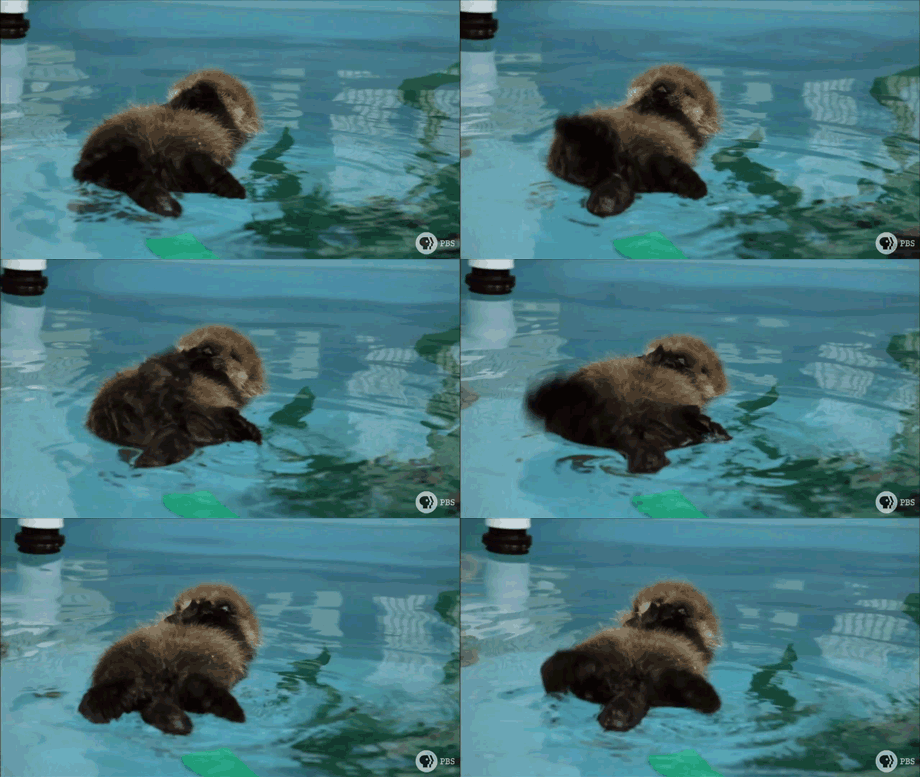
Recently a three-day old abandoned female otter pup arrives for an exam at the Aquarium. They call her Otter 501. After stabilizing her, the team begins to get her to accept an 'otter milk formula' from a bottle. While feeding her, the handlers are dressed in dark ponchos and welder's hoods. This disguise tries to cover up the human form so the newborn doesn't become attached to them.

here she will raised by Toola, the Aquarium's original surrogate mother otter. In secret roof tanks atop the Aquarium, Toola teaches her young student a series of basic otter lessons: how to dive, how to find food, how to break open and eat whole clams and other shellfish, and how to handle crabs


The little otter must also learn how to groom her fur as it will only keep her warm and dry when it's clean. Once she can eat solid food; swim, rather than just float; and haul herself out of the water, she will be accepted into their surrogate program.

In the program she will raised by Toola, the Aquarium's original surrogate mother otter. Toola teaches the youngster how to dive, how to find food, how to break open and eat whole clams and other shellfish, and how to handle crabs. After five months of training, the young otter is returned to the wild in the hope that she has been provided with enough training to survive and have pups of her own.

All of this is just another day in the lives of Karl and his team who continue their hard work, hoping to make a difference in a world where survival is a long shot at best.


Past the mighty Inca empire, various cultures developed their science , art and customs to astonishing degrees before being relegated to oblivion, swallowed by the passage of centuries and the splendor of the peoples who succeeded them. In the hands of most recent archaeological research will travel through time and history to show the mysteries of these brilliant civilizations.

So, will visit the ceremonial centers of Tiahuanaco culture developed in the sixth century AD in the region of the plateau, whose enigmatic sculptures and constructive forms baffle archaeologists and specialists. Today observatories shamans use their mystical rites who worship the sun by burning charms.

In the Peruvian coast, dominated by arid dunes and stifling atmosphere, find hundreds of canals built by the Chimu culture to sustain its irrigation. The Chimu civilization formed a complex witness whose heyday was the city of Chan-Chan. This settlement, built with clay soils in the eleventh century , was the most populated city in the world at the time, it reached 100,000. By observing archaeological finds, pieces of pottery and jewelery, discover the ties that still bind this cutura with the Peru Current , as is the use of " reed horses ", small boats, like those surfboards, the residents of the coastal area still use for fishing.

The Temples or archaeological sites in the thousands, but, unfortunately, are plundered by looters, who accompany, covered at night, in one of his clandestine excavations. The fruits of their plunder is sold pre-Columbian art dealers and shamans, who use fetishes in religious ceremonies in which usual intake mescaline in a preparation which they call "San Pedro ".


When we flew over the Pampa del Ingenio are revealed and lines drawings that remain carved in the floor. They are a little overwhelming and mark sundown constituting the world's largest astronomical book.

Finally, we can not miss the most important site of America in recent times: the tomb of the Lord of Sipan, which Walter Alba, archaeologist who directed the excavation, will talk extensively.
Source

This will put a smile on your face! The seal that's rolling with laughter

Life on the rocks is a barrel of laughs for this harbour seal who was spotted chortling as he took a relaxing break from swimming.

The mammal was spotted having a blast at Fisherman's Wharf in Monterey, California, an area of the US popular with the species.

It was spotted by keen photographer Veronica Craft, who said she takes pictures of seals because of their happy nature

The jovial beast, which Veronica nicknamed 'LOL' was more than happy to play up for the camera.

Harbour Seals come in a variety of colours, and all have dog-like heads without external ears.


This breed of seal particularly enjoy basking in the sun at low tides.

Veronica, from Marina in California, said: 'When I saw what he was doing my first thought to the seal was 'Please don't stop, I have to get a shot of this'.


'I like to think he was mugging for the camera or maybe he was laughing at me. He probably thinks humans are silly.

'Initially I couldn't believe I had captured the moment but as I clicked through my shots I realised that I had actually captured several moments.


'I love seals. It is extremely fun to see them play. They always bring a smile to my face and I can't stop photographing them.

'They are just cute and silly. I am truly blessed to live in an area with such diverse sea creatures.'
Source


Stats

Archives

Pages